Written by Tanya — Yoga Alliance RYS 200 (ID 252157), trained at Devvrat Yoga School, Varkala, India (December 2025). Tanya teaches Hatha and Yin yoga at Your Ritual Yoga in Golders Green, NW11.
Yoga for knee pain is one of the most common questions I receive from new students — and from experienced practitioners who have developed sensitivity in the joint over time. The knee is the most frequently injured joint in yoga, not because yoga is inherently dangerous to knees, but because the poses that involve the knee are often misunderstood or taught without sufficient attention to individual anatomy.
The good news is this: nearly every pose that is difficult for sensitive knees has an alternative, a modification, or a prop solution that keeps the practice intact. You do not have to choose between yoga and your knees. You may simply need to practise differently.
This post covers the most common sources of knee discomfort in yoga, universal modification principles, specific pose alternatives, and guidance on props. It ends with the most important guideline of all: when to stop practising and see a physiotherapist.
Knee pain in yoga: common causes
Before we discuss modifications, it is useful to understand what is actually happening in the knee when it is uncomfortable in yoga poses.
Over-rotation. The knee is a hinge joint designed to flex and extend in one plane. It has very limited tolerance for rotation. Many yoga poses that create problems — Hero pose, Pigeon, Lotus — ask for external rotation that the hip should produce but that, when the hip is too tight, travels instead to the knee. This is almost always the cause when a student feels pain on the outer side of the knee in seated hip openers.
Hyperextension. In standing poses and Warriors, students with hyperextended knees (joints that bend slightly backward when straight) can inadvertently lock the joint in extension, compressing the posterior joint structures. The cue “micro-bend the knee” in straight-leg poses exists for this reason.
Weight-bearing on a flexed joint. Full squatting positions, deep lunges, and Malasana (Garland pose) place significant load on the knee joint capsule and meniscus when the knee is deeply bent. For any student with cartilage issues, meniscal tears, or post-surgical knees, this load needs to be carefully managed.
Kneeling on a hard surface. Even with a mat, sustained kneeling in Tabletop, Cat-Cow, or low lunges creates pressure on the kneecap and bursae of the knee. This is easily addressed with appropriate padding.
Universal modifications
These principles apply across most yoga poses and are worth establishing as defaults before exploring pose-specific alternatives.
Never lock the knee in straight-leg poses. A very slight bend — just enough to soften the crease behind the knee — redistributes load from the joint capsule to the surrounding musculature. In Warrior I, II, and III, and in standing balance poses, practise with this micro-bend as a consistent habit.
Flex the feet in seated and supine hip openers. A flexed foot engages the ankle stabilisers and reduces the rotational force transmitted to the knee. This is particularly important in Supine Figure-4 (the reclined pigeon alternative), Reclined Bound Angle, and any pose where the shin is angled across the body.
Support the knees in supine poses. In Savasana and Reclined Bound Angle, a rolled blanket or bolster under the knees reduces tension in the posterior knee and lower back simultaneously. This is relevant even for students without acute knee pain — it is simply a more supported position.
Inform your teacher before class. A good teacher can watch for the specific mechanics that cause you difficulty and offer timely cues or alternatives. You do not need to announce your injury to the whole room — a quiet word before class is sufficient.
Specific pose alternatives
Hero pose alternatives, lunge modifications, Malasana with a block
Hero Pose (Virasana) — alternatives
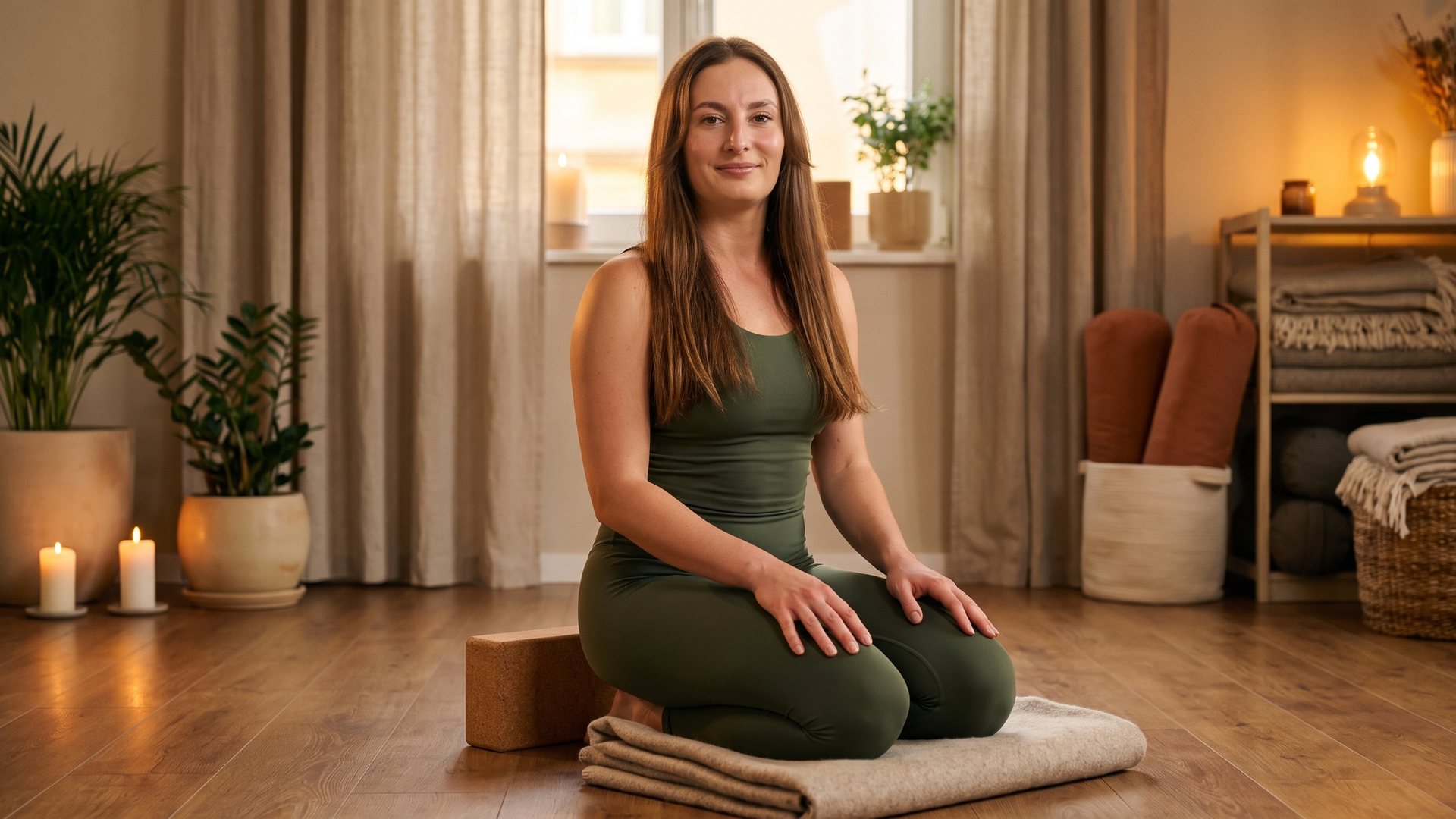
Hero pose — seated between or on the heels — is deeply uncomfortable for many knees, particularly those with cartilage sensitivity or post-surgical changes. The deep flexion of the knee in this shape compresses the joint in ways that are not manageable for everyone.
Alternatives:
– Dandasana (Staff Pose): Sit with legs extended straight in front of you. This is a perfectly valid meditation and breathing seat without any knee compression.
– Cross-legged / Sukhasana: The knees are bent but not compressed, and the rotation comes from the hips. Support the knees with folded blankets if they do not comfortably reach the floor.
– Hero with a block or bolster: Place a yoga block (low, medium, or high) between the feet and sit on it rather than on the mat. This reduces the range of knee flexion significantly and makes the pose accessible for many knees that cannot tolerate the full version.
Low Lunge (Anjaneyasana) — modifications
The back knee in a low lunge can be uncomfortable if it is pressing directly on a hard mat, or if the student is hyperextending the front knee.
Modifications:
– Fold a blanket double and place it under the back knee for significant cushioning.
– Maintain a micro-bend in the front knee: even in the lowest position of the lunge, the front knee should not travel beyond the ankle.
– Elevate the front foot on a block if the front knee is under strain — this reduces the depth of the lunge and the demand on the joint.
Malasana (Garland Pose / Squat) — with a block
A full squat is not accessible for many knees, especially those with meniscal issues or limited ankle mobility (which forces the knee inward).
Modifications:
– Place a rolled blanket or yoga block under the heels if the heels do not comfortably reach the floor — this removes the ankle-mobility demand and allows the squat to be deeper without knee strain.
– Sit on a block at its tallest height: this provides the hip-opening benefit of the shape without the full joint compression of the deep squat.
– Hold a door frame or chair back: external support allows you to find the position with more control and less load on the joint.
Props that change everything
Blanket under the knee in tabletop
Any pose that involves kneeling — Tabletop, Cat-Cow, Child’s Pose, all-fours variations — can become significantly more comfortable with a folded blanket under the knees.
Fold a blanket in half, then in half again, to create a firm, cushioned pad approximately two centimetres thick. Place it under both knees in Tabletop. The difference is immediate and significant.
Beyond blankets, the props that most reliably support knees in yoga are:
Blocks — primarily for reducing the depth of squats, supporting the sitting position in bound angle poses, and elevating the hands in forward folds (so the hamstrings, rather than the knee ligaments, bear the stretch demand).
Bolsters — under the knees in supine poses, between the thighs in Pigeon, and as seating support in any seated pose.
Straps — occasionally helpful in supine quad stretches (Reclined Hero or Supta Virasana) for limiting the depth of the extension to a manageable range.
When to see a physio
Modifications and props can address the mechanical demands of yoga poses on sensitive knees. They cannot address underlying pathology.
See a physiotherapist before continuing your yoga practice if:
- You have swelling, redness, or warmth in the knee joint
- You experienced a specific injury — a twist, a fall, a collision — and have not had it assessed
- You have a history of ligament tears (ACL, PCL, MCL) and the joint feels unstable
- You feel clicking or locking in the joint accompanied by pain
- Pain persists after class and does not resolve within twenty-four hours
- You have been diagnosed with osteoarthritis or significant cartilage wear and have not discussed yoga with your treatment team
A one-to-one session at the studio — where the class can be tailored entirely to your needs — is often the best option for students with active knee conditions. This allows alignment to be observed closely and modifications to be applied in real time.
Frequently Asked Questions
Is yoga good or bad for arthritic knees?
For mild to moderate osteoarthritis, gentle yoga may be supportive — it maintains range of motion, strengthens the muscles around the joint, and reduces the inflammation associated with a sedentary lifestyle. It is not appropriate for severe or acute arthritic flares without medical guidance. Always discuss with your GP or rheumatologist.
My knees click during yoga. Should I be worried?
Clicking (crepitus) without accompanying pain or swelling is generally benign and does not indicate damage. It is common, particularly in squatting movements, and is often related to gas bubbles in the joint fluid or tendon movement. If the clicking is painful, seek assessment.
Can yoga help with Runner’s Knee (PFPS)?
Patellofemoral pain syndrome responds well to approaches that strengthen the hip abductors and external rotators (which control how the knee tracks), reduce impact loading, and improve quadriceps flexibility. A modified yoga practice can address several of these factors. Discuss with a physiotherapist before beginning.
What is the safest yoga style for knee pain?
Yin yoga and restorative yoga are generally the gentlest on the knees, as they involve little weight-bearing through the joint. However, even Yin poses require modification for sensitive knees — particularly those involving deep hip flexion. A knowledgeable teacher is essential.
Should I tell the teacher about my knees?
Always. A brief mention before class — “I have knee sensitivity in deep squats and kneeling” — gives the teacher everything they need to watch for you and offer relevant cues or alternatives.
If you have a specific knee injury or condition, a one-to-one session gives us the space to work through your practice safely and precisely. Book a personal training session →. Or begin with one of our small group Hatha yoga classes, where individual attention is part of every session.
About the author
Tanya is a Yoga Alliance RYS 200 certified yoga teacher (ID 252157), trained at Devvrat Yoga School in Varkala, India (December 2025). She teaches Hatha and Yin yoga at Your Ritual Yoga in Golders Green, NW11 — a small, intentional studio where every class includes sound healing with Himalayan singing bowls and a post-class herbal tea ritual. www.ritual-yoga.co.uk