Written by Tanya — Yoga Alliance RYS 200 (ID 252157), trained at Devvrat Yoga School, Varkala, India (December 2025). Tanya teaches Hatha and Yin yoga at Your Ritual Yoga in Golders Green, NW11.
Yoga for wrist pain is one of those topics that separates thoughtful instruction from generic class cues. If you have spent years at a desk — mouse in one hand, keyboard angled slightly wrong — your wrists are likely carrying a degree of chronic load that most yoga sequences do not account for.
The good news is that yoga does not require pain-free wrists to be practised safely. It requires a teacher who understands modification, and a student willing to speak up before the class rather than push through and pay for it tomorrow.
1. Why Yoga Can Worsen Wrist Pain
The wrist is not designed to bear significant compressive load. The hands and wrists evolved primarily for grasping, pulling, and fine motor tasks — not for weight-bearing in dorsiflexion (the bent-back position your wrist is in during plank or downward dog).
When you place your palms flat on the mat and transfer body weight onto them, the load passes through the carpal bones, the tendons of the forearm, and — if alignment is off — directly into the median nerve and surrounding tissue. For someone with existing inflammation, RSI, carpal tunnel, or hypermobility, this is a recipe for irritation.
The problem is compounded in flowing styles where transitions happen quickly. Vinyasa sequences cycle through plank, chaturanga, and upward dog repeatedly, and a student with wrist pain who does not know an alternative will either push through (causing harm) or drop out of the flow entirely (missing the class).
In a thoughtful Hatha class, transitions are slower, holds are longer, and there is space to make adjustments. But modifications still need to be known in advance.
2. Universal Alternatives: Forearms, Fists, and Props
Before we get to specific poses, these three adjustments apply almost universally across any weight-bearing position:
Forearms — dropping to the forearms removes dorsiflexion entirely. The wrist stays neutral, the load transfers to the forearm bones, and the weight-bearing demand on the carpal tunnel is eliminated. You lose some range in the pose, but you can practise safely.
Fists — making a loose fist and placing the knuckles on the mat keeps the wrist in a neutral position rather than extended. This is surprisingly effective in plank and cat-cow, and requires only a firm rather than soft surface to work well.
Wedge or rolled blanket — placing a yoga wedge (or a tightly rolled blanket) under the heel of the hand slightly reduces the angle of extension. This does not eliminate load, but it reduces the degree of dorsiflexion by five to fifteen degrees, which is often enough to make a pose pain-free for mild cases.
3. Specific Pose Modifications
Forearm plank, dolphin instead of downward dog
Downward dog is the most commonly performed wrist-loading pose in yoga, and also the one most people do incorrectly. The most common mistake is dumping weight into the heel of the hand — precisely where the wrist is most vulnerable.
Correct alignment involves spreading the fingers wide, pressing firmly through the fingertips and the base of each finger, and drawing weight slightly forward and out of the heel of the hand. This alone can reduce wrist pain significantly in mild cases.
For moderate or severe cases, dolphin pose is the direct substitution: come onto forearms, elbows shoulder-width apart, press the forearms into the mat, and lift the hips exactly as you would in downward dog. You get the same posterior-chain lengthening, the same hip elevation, the same spinal decompression — without any wrist involvement.
Plank to forearm plank is equally simple. In forearm plank, the elbows are under the shoulders, the forearms are parallel, and the body forms the same straight line from crown to heels. Core engagement is identical to full plank. Wrist load is zero.
Chaturanga is best avoided entirely if you have wrist pain. The load in chaturanga is greater than in plank because the body is lowering under gravity and the wrist must resist both compression and shear force simultaneously. For students with wrist issues, a simple lowering from plank to the mat (knees-down or full-body) is perfectly adequate and far safer.
Cat-cow with fists — the wrist extension in cat-cow is gentler than in plank, but still present. If even this is uncomfortable, practise with fists on the mat or on two yoga blocks. The spinal articulation is identical.
4. Daily Desk-Day Wrist Resets
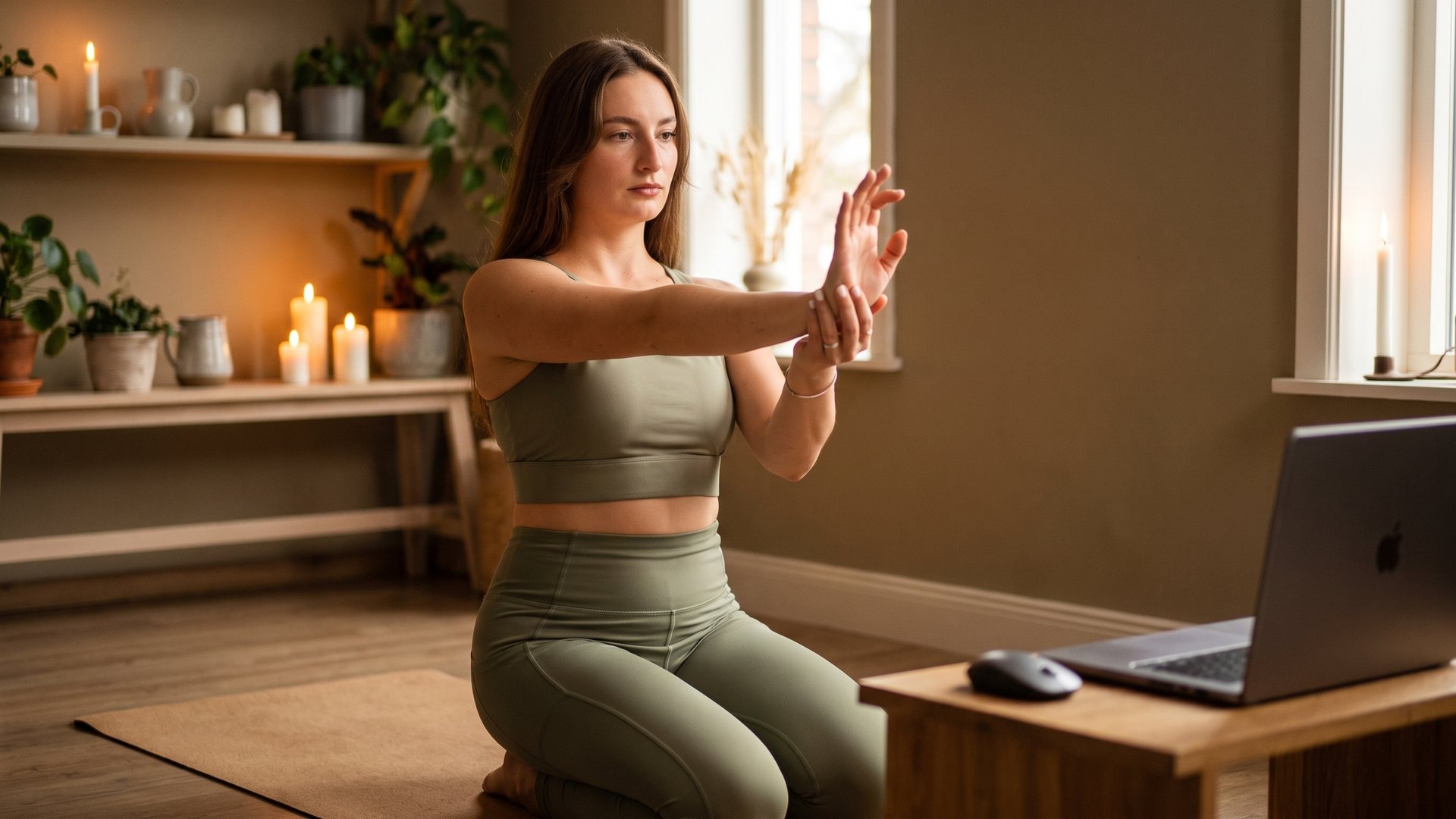
5-minute desk wrist routine
This sequence can be done at your desk, without a mat, during any natural break in the workday.
Prayer position, inverted (1 minute) — place the backs of the hands together at chest height, fingers pointing downward. Gently press them towards the body and hold. You will feel a stretch through the forearm flexors, which are often chronically shortened from keyboard use. Hold thirty seconds, release, repeat.
Wrist circles (thirty seconds each direction) — extend both arms in front of you and rotate the hands slowly through their full range. Ten circles clockwise, ten anticlockwise. This lubricates the joint rather than loading it.
Finger extension and spread (thirty seconds) — make a fist, then open the hand as wide as possible, spreading the fingers and extending them. Repeat ten times. This resets the intrinsic muscles of the hand that keyboard use holds in a contracted position.
Forearm flexor stretch (thirty seconds each side) — extend one arm in front with the palm facing up. With the other hand, gently draw the fingers downward towards the floor. Hold for twenty to thirty seconds.
Wrist flexor stretch (thirty seconds each side) — extend one arm with the palm facing down. With the other hand, gently draw the fingers upward and back. This stretches the extensors and is particularly useful after heavy mouse use.
Do this sequence once in the morning and once after lunch. It takes under five minutes and meaningfully reduces the cumulative load your wrists carry into an evening yoga class.
5. When to Seek Physio Input
Yoga modifications are appropriate for chronic, low-level wrist discomfort associated with desk work — mild RSI, general stiffness, diffuse aching after long typing sessions.
There are circumstances where a physiotherapist or GP should be consulted before continuing any weight-bearing yoga practice:
- Sharp, acute pain during wrist extension
- Numbness or tingling in the fingers (particularly thumb, index, or middle finger — possible carpal tunnel involvement)
- Pain that persists after rest
- A recent injury, fall, or fracture
- Swelling, redness, or heat in the joint
A good yoga teacher will always ask about existing injuries in the intake process. At Your Ritual Yoga, we discuss any physical concerns before your first class so that modifications can be built into your practice from the start, not retrofitted after something hurts.
If you have had physio input and been given specific exercises, share them with your teacher. Often, physiotherapy and yoga modifications are complementary — the physio addresses the injury, and the yoga supports the surrounding tissue and nervous-system response.
Frequently Asked Questions
Do I have to avoid all wrist-bearing poses if I have wrist pain?
Not necessarily. Mild cases often do fine with corrected alignment and the wedge or fingertip-pressure adjustments. Moderate to severe cases are better served by forearm alternatives until pain is resolved.
Will yoga help wrist pain, or make it worse?
Done with modifications, yoga can support wrist recovery — specifically through strengthening the forearm muscles and improving circulation to the area. Done without modification, it can aggravate an existing issue.
Can I practise Yin yoga with wrist pain?
Most Yin yoga poses do not involve wrist weight-bearing, making Yin an excellent choice for students with wrist issues. Notable exceptions include some sphinx and seal variations — ask your teacher for forearm alternatives if these cause discomfort.
How long does wrist pain from keyboard use take to resolve?
With consistent desk-break stretching, ergonomic adjustments, and avoidance of aggravating activities, mild RSI typically improves over four to eight weeks. Yoga with appropriate modifications is generally compatible with this recovery.
Should I tell the teacher about my wrists before class?
Yes, always. A good teacher will adapt cues in real time and offer modifications during transitions so you are not left scrambling mid-flow to remember what to do.
Practise safely with expert guidance. Learn modifications in a Hatha class at Your Ritual Yoga — or explore one-to-one sessions tailored entirely to your needs and any physical considerations.
About the author
Tanya is a Yoga Alliance RYS 200 certified yoga teacher (ID 252157), trained at Devvrat Yoga School in Varkala, India (December 2025). She teaches Hatha and Yin yoga at Your Ritual Yoga in Golders Green, NW11 — a small, intentional studio where every class includes sound healing with Himalayan singing bowls and a post-class herbal tea ritual. www.ritual-yoga.co.uk