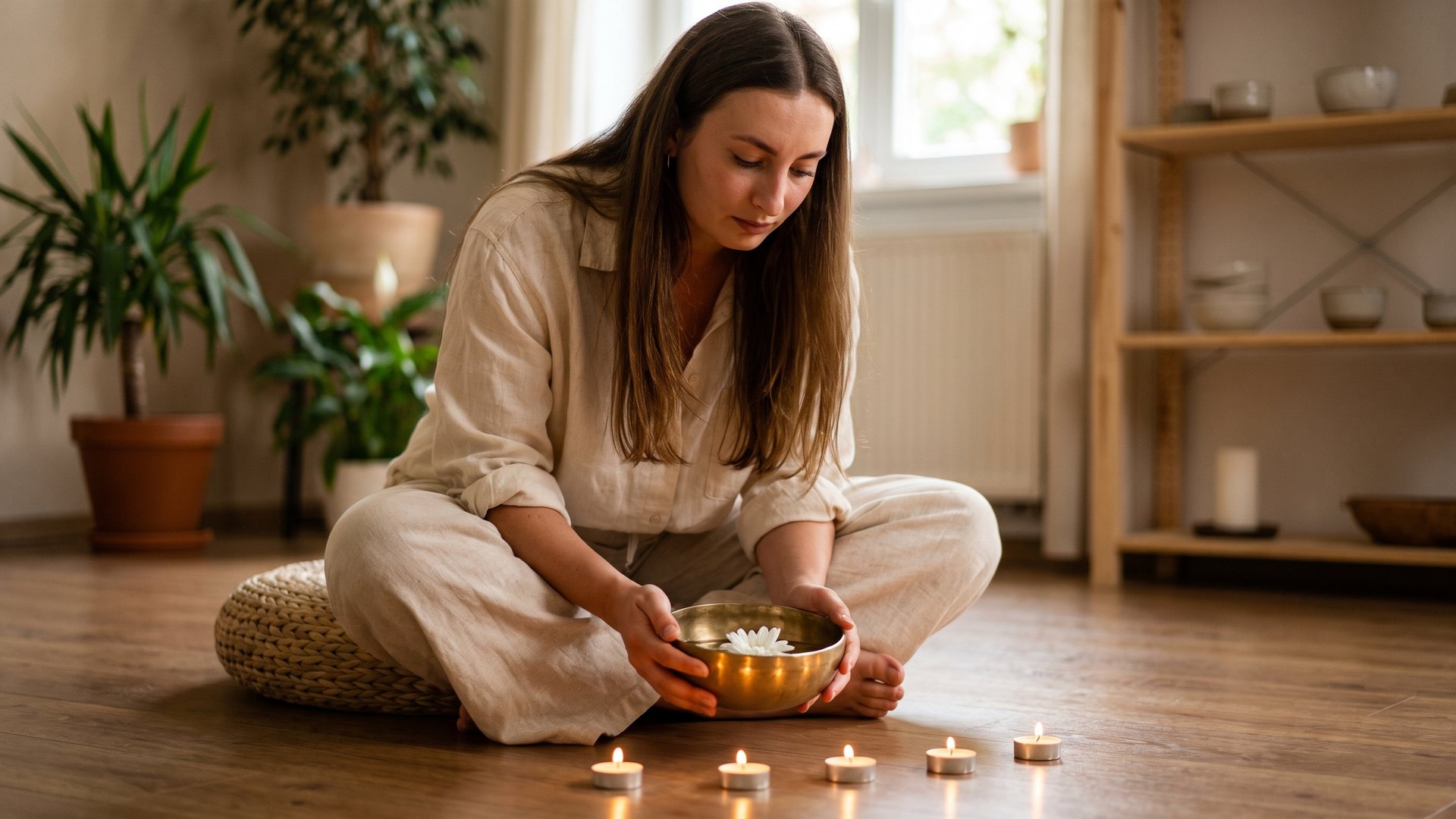
Written by Tanya — Yoga Alliance RYS 200 (ID 252157), trained at Devvrat Yoga School, Varkala, India (December 2025). Tanya teaches Hatha and Yin yoga at Your Ritual Yoga in Golders Green, NW11.
The yamas in yoga are the first of the eight limbs described by Patanjali in the Yoga Sutras — and the ones most likely to be skipped in a modern asana-focused class. They are often presented as a list of ancient prohibitions, interesting as historical context but not particularly useful on a Tuesday morning.
That framing does them a disservice.
The yamas are not commandments. They are observations about how to live with less friction — less internal contradiction, less harm generated towards yourself and others, less unnecessary suffering. Read through that lens, they are arguably more relevant today than they were two thousand years ago.
1. What the Yamas Are
The word yama translates roughly as restraint, discipline, or ethical observance. There are five of them, and together they describe a way of relating to the world — to other people, to resources, to time, to yourself.
Patanjali places the yamas first in the eight-limb path, before the niyamas (personal practices), before asana, before pranayama. This sequencing matters. It suggests that the physical and meditative practices of yoga rest on an ethical foundation — that without some attempt at right relationship with the world, the deeper practices have nowhere stable to land.
This does not mean you need to have mastered the yamas before stepping onto a mat. It means the mat is one of the places where you begin to explore them.
The five yamas are:
- Ahimsa — non-harming
- Satya — truthfulness
- Asteya — non-stealing
- Brahmacharya — energy management
- Aparigraha — non-grasping
2. Ahimsa: Non-Harming
Ahimsa is the most discussed of the yamas — and the most expansive. It is often translated as non-violence, but its scope reaches further than the absence of physical harm.
In practice, ahimsa asks: in what ways am I causing harm, and to whom? The most obvious applications — not hurting others, not engaging in cruelty — are relatively straightforward. The subtler ones require more attention.
Ahimsa as boundaries
Self-harming patterns are also within the scope of ahimsa. The person who pushes through an injury in a yoga class to keep up with the group is practising the opposite of ahimsa. So is the person who berates themselves silently for not being flexible enough, or who stays in an emotionally damaging situation because leaving feels selfish.
Ahimsa asks you to include yourself in the category of beings worthy of non-harm. This is not always comfortable, particularly for people conditioned to put others first.
In a yoga class, ahimsa is the principle that allows you to come out of a pose early, choose the modification, or rest in child’s pose when the group continues. It is permission, in the most philosophically grounded sense.
Beyond the mat, ahimsa can be practised in speech — noticing where your words towards yourself and others carry unnecessary sharpness. In food choices. In how you manage your attention and time. It extends, in some interpretations, to environmental impact and political engagement.
The point is not perfection. The point is the quality of attention brought to the question.
3. Satya: Truthfulness
Satya is truthfulness — in speech, in thought, and in how you present yourself to the world.
It sits in relationship with ahimsa. The yogic tradition acknowledges that these two principles sometimes create tension: a true thing can also be a harmful thing. When they conflict, ahimsa generally takes precedence. The question is not simply “is this true?” but “is this true and does it serve?”
In everyday life, satya often shows up not as dramatic revelations but as small, chronic compromises: agreeing to things you do not actually agree to, saying you are fine when you are not, representing yourself in ways that suit others’ expectations rather than your own experience.
The practice of satya begins with internal honesty. Before you can speak truthfully to others, you need to know what you actually think and feel — which requires the kind of quiet that yoga practice can help cultivate.
On the mat, satya might look like acknowledging that a pose is not as available today as it was last week, rather than forcing what yesterday’s body could do. Or admitting to a teacher that you are struggling, rather than performing ease.
It is a practice of showing up as you actually are. This is, it turns out, considerably harder than performing a more polished version.
4. Asteya: Non-Stealing
Asteya translates as non-stealing, and its most obvious application is clear: do not take what does not belong to you.
The more interesting inquiry is what counts as stealing beyond the straightforward. In yogic thought, asteya extends to:
Time — arriving late, taking more than your share of a conversation, expecting others to give their attention without reciprocating.
Credit — taking recognition for work that was shared, or presenting ideas as original when they came from others.
Energy — draining others’ resources through chronic need without ever contributing or restoring.
Space — in a physical sense (spreading out in a class without awareness of others) and a metaphorical one (dominating shared environments with your needs and preferences).
There is also an internal dimension to asteya. The Yoga Sutras suggest that the impulse to steal arises from a belief in scarcity — a sense that there is not enough, and that others having more means you have less. Practising asteya involves examining that belief. Is it true? What would shift if you assumed sufficiency rather than shortage?
On the mat, asteya is present in the small moments: not rushing to grab the best spot, not competing with the person beside you, not stealing from yourself by half-attending while your mind is elsewhere.
5. Brahmacharya: Energy Management
Brahmacharya beyond the celibacy reading
Brahmacharya is the most frequently misapplied of the yamas in modern contexts. It is often translated as celibacy or sexual abstinence, reflecting its use in traditional monastic settings where brahmacharya referred specifically to the management of sexual energy as a spiritual practice.
In a contemporary lay context, this reading is rarely applicable and, taken literally, creates an unnecessary barrier to the rest of the practice.
A more useful translation is energy management or right use of vital force. The underlying principle is about directing your energy — physical, mental, emotional, creative, sexual — towards what is genuinely nourishing rather than dispersing it through excess, compulsion, or unconscious habit.
This is immediately practical. Where are you spending your energy in ways that leave you depleted? Social media consumption that goes beyond enjoyment into numbing. Commitments made from obligation rather than genuine desire. Relationships that consistently take without giving. Work that is past the point of productive engagement and into the territory of diminishing returns.
Brahmacharya asks: what would it mean to husband your vital resources more carefully? Not through restriction or puritanism, but through conscious choice about where your aliveness goes.
On the mat, this might look like practising at seventy per cent effort rather than constantly at a hundred — leaving something in reserve, noticing how it feels to not go to the edge of every pose.
6. Aparigraha: Non-Grasping
Aparigraha is usually translated as non-attachment, non-possessiveness, or non-grasping. It is the yama that speaks most directly to the nature of suffering as described in yogic and Buddhist philosophy: that much of our pain arises not from what we do not have but from our resistance to impermanence, and our attempts to hold on to what cannot, by its nature, be held.
The most obvious application is to material things: the accumulation of objects beyond what is needed, the identification of self with possessions, the anxiety that arises when what we own is threatened.
But aparigraha extends further. Grasping applies equally to:
Experiences — trying to recreate a particularly good class, a particular feeling, a moment that has passed.
Identities — holding on to a self-concept (I am someone who can do this pose, I am a certain kind of person) beyond its useful life.
Outcomes — practising yoga in order to achieve a specific result, and measuring every session against that goal.
Other people — expecting relationships to remain static, or holding on to people or connections that have naturally run their course.
Aparigraha does not ask you to want nothing or care about nothing. It asks you to hold what you value lightly enough that when it changes — as all things change — you are not destroyed by the movement.
In a yoga class, this is the practice of releasing the comparison to last week’s practice, the expectation of what a forward fold should look like, the story about what kind of yogi you are or are not. Each class is its own complete thing, arrived in fresh.
Frequently Asked Questions
Do I need to follow the yamas to practise yoga?
No. The yamas are one layer of a multi-layered practice. Most people begin with the physical practice and encounter the philosophical dimensions gradually. The mat is a good place to begin exploring these principles, not a place that requires prior philosophical compliance.
Which yama is most important?
Patanjali lists ahimsa first and it is often considered foundational, with the others flowing from it. In practice, different yamas will be more relevant at different life stages. There is no hierarchy that applies universally.
Are the yamas religious?
They are rooted in Indian philosophical and spiritual traditions, but they are not specifically tied to Hinduism as a religious practice. They function equally well as secular ethical principles.
How do I begin practising the yamas?
Choose one. Observe where it arises in your day without trying to change anything immediately. The awareness itself is the first step. Satya is often the most accessible starting point — simply noticing where you speak or think in ways that are not fully true.
Can the yamas conflict with each other?
Yes. The tension between ahimsa and satya (a true thing that causes harm) is acknowledged in the tradition. These tensions are not problems to be solved but invitations to enquire more carefully about your situation.
Bring yoga philosophy into a weekly practice. Visit our About page to learn more about Tanya’s teaching philosophy, and explore the eight limbs of yoga in depth.
About the author
Tanya is a Yoga Alliance RYS 200 certified yoga teacher (ID 252157), trained at Devvrat Yoga School in Varkala, India (December 2025). She teaches Hatha and Yin yoga at Your Ritual Yoga in Golders Green, NW11 — a small, intentional studio where every class includes sound healing with Himalayan singing bowls and a post-class herbal tea ritual. www.ritual-yoga.co.uk