Written by Tanya — Yoga Alliance RYS 200 (ID 252157), trained at Devvrat Yoga School, Varkala, India (December 2025). Tanya teaches Hatha and Yin yoga at Your Ritual Yoga in Golders Green, NW11.
Yoga for menopause is not about doing gentle stretches and waiting for the transition to pass. It is about understanding what the body needs during a profoundly significant hormonal shift — and building a practice that meets those needs with intelligence, rather than defaulting to whatever yoga class happens to fit the schedule.
The menopause transition affects every system in the body. Sleep, mood, body temperature, bone density, cardiovascular health, cognitive function, and joint comfort all change in response to declining oestrogen and progesterone. Yoga, practised thoughtfully and consistently, may support several of these dimensions. It will not reverse the biology, but it can meaningfully improve how the transition is experienced.
1. Menopause and the Nervous System
Understanding menopause as a nervous-system event, not just a hormonal one, is the first step towards choosing the right practice.
Oestrogen has a regulatory role in the autonomic nervous system. As levels decline, the hypothalamus — which regulates body temperature, sleep, and stress response — becomes more reactive. This is why hot flushes occur (the brain misreads normal body temperature as too hot), why sleep becomes fragmented (the sleep-wake cycle becomes less stable), and why anxiety and mood instability can increase (the nervous system’s threshold for stress response is lower).
What this means for yoga is that practices which further stimulate or overheat the nervous system are generally counterproductive during this stage. Vigorous, hot, or intensely competitive classes add to the body’s overall stress load at a time when the stress-regulatory system is already under additional demand.
The practices that tend to support the menopausal nervous system are those that activate the parasympathetic response: long, slow holds; extended exhale breathing; cooling pranayama; and restorative positions that allow the body to fully release effort.
Yin yoga and restorative Hatha are particularly well suited to this. That does not mean vigorous practice is prohibited — it means it should be balanced, and the proportion of rest and restoration in a weekly practice should increase during perimenopause and menopause.
2. Which Yoga Styles Help Most
The research on yoga and menopause is still developing, but existing studies suggest that regular yoga practice may support:
- Reduction in self-reported severity of hot flushes
- Improved sleep quality and duration
- Reduced anxiety and depressive symptoms
- Better joint comfort and mobility
- Improved balance and proprioception (relevant for falls prevention as bone density declines)
These benefits appear most consistently in studies using slow, restorative, or Yin-based practices, and in studies where pranayama is explicitly included.
Yin yoga — the long, passive holds of Yin directly target the fascia and connective tissue, which can become stiffer during menopause as collagen production declines with oestrogen. Yin also powerfully activates the parasympathetic nervous system, supporting both sleep and mood regulation. For many menopausal women, Yin is the most immediately useful style.
Hatha yoga — traditional Hatha offers a balance of strength and flexibility, with breath awareness at its centre. It is weight-bearing enough to support the skeletal system without being so vigorous as to overstimulate. Held standing poses build lower-body strength and bone-loading capacity. The pace allows for proper alignment instruction, which matters when joint sensitivity increases.
Restorative yoga — a fully supported, prop-intensive practice that takes parasympathetic activation furthest. Excellent for women in acute stages of insomnia, high anxiety, or extreme fatigue. Can be integrated into a Hatha or Yin practice through the closing sequence.
Why intense Bikram-style heat is the wrong direction
Hot yoga — Bikram and its derivatives — is a particular mismatch for menopausal women. The externally elevated room temperature adds thermal load to a body already struggling to regulate temperature accurately. Hot flushes, dehydration, and cardiovascular stress are all more likely in a hot studio during this phase. The evidence does not support heat-based yoga as beneficial for menopause, and the common-sense physiology suggests it may worsen the most uncomfortable symptoms.
If you love hot yoga and are entering perimenopause, this is worth discussing with your GP or a knowledgeable women’s health physiotherapist.
3. Poses for Hot Flushes, Sleep, and Mood
Cooling pranayama for hot flushes
Sitali pranayama (cooling breath) — roll the tongue lengthwise into a tube (if able) and inhale through this tube, drawing the breath over the wet surface of the tongue. Exhale through the nose. This cools the breath as it enters and may help manage the acute heat of a flush. If you cannot roll your tongue, sitali’s close relative, sitkari, uses the teeth and lips to achieve a similar effect.
This pranayama can be practised during a flush itself — sitting quietly, eyes closed, ten rounds of cooling breath. Many women find it meaningfully reduces both the intensity and the recovery time.
Extended exhale breathing — practised anywhere: inhale for four counts, exhale for six or eight. This ratio directly stimulates the vagus nerve and activates the parasympathetic response. Particularly useful in the hour before sleep and during moments of anxiety or mood instability.
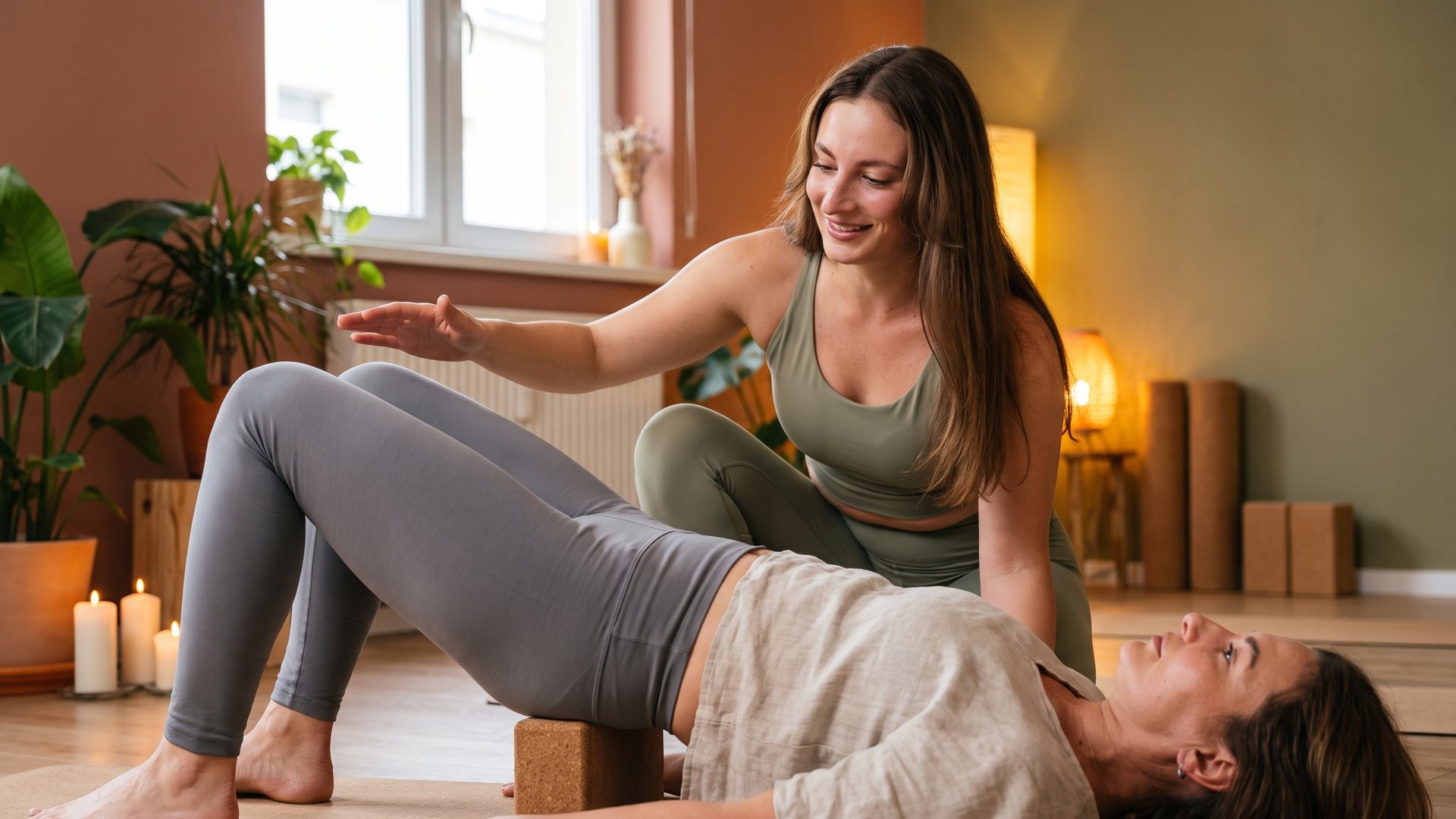
For sleep — the sequence of supported bridge (a bolster under the sacrum, legs extended or knees bent), followed by supine bound angle (supta baddha konasana with a bolster along the spine), followed by legs up the wall (viparita karani) is deeply calming for the nervous system and may support the transition to sleep when practised in the evening. Hold each position for three to five minutes.
For mood — gentle backbends (supported fish, sphinx, low cobra) open the chest and counteract the forward-folding that low mood tends to create in the body. They are activating without being stimulating, and tend to generate a mild sense of uplift and spaciousness. Pair with a slow, extended exhale breath.
4. Bone-Density Considerations
Weight-bearing poses for bone density
Oestrogen plays a key role in maintaining bone density, and its decline during menopause accelerates bone loss, increasing the risk of osteopenia and osteoporosis over the following decade. This is one of the most significant long-term health considerations of menopause, and one where yoga has a meaningful, if partial, role.
Weight-bearing exercise stimulates osteoblast activity (bone-building cells). In yoga, the relevant poses are those that load the skeleton in ways it does not experience during everyday life:
Standing poses — Warrior I, Warrior II, Trikonasana (triangle), Vrksasana (tree pose). These load the hips, femur, and spine in standing, which is the relevant zone for osteoporotic fracture risk.
Balance poses — tree, eagle, single-leg balance variations. Balance training reduces falls risk, which is the proximate cause of most osteoporotic fractures in older women.
Gentle arm-bearing — plank (on forearms for wrist sensitivity), table top, modified side plank. These load the wrist and forearm — another zone of osteoporotic fracture risk.
What yoga cannot do is replace the bone-loading effect of higher-impact exercise (walking with a weighted backpack, jogging, resistance training). For women with confirmed osteopenia or osteoporosis, yoga should complement a broader bone-health strategy rather than serve as the sole intervention. A conversation with your GP and, ideally, a physiotherapist with women’s health specialisation is worth having.
Deep spinal twists and extreme forward folds with a rounded back may not be appropriate for women with significant bone loss — this is another reason to practise in a small class where a teacher can adapt the sequence to your specific situation.
5. A Weekly Practice Template
This template is a starting point. It assumes you are in the menopausal transition and want to support both energy and recovery without overstimulating your nervous system.
Two or three times per week:
30–60 minutes of Hatha yoga — include at minimum: two to three standing poses (Warrior I, Warrior II, Trikonasana), one balance pose (tree or eagle), one gentle backbend (sphinx or low cobra), and a closing sequence ending in supported Savasana with props. Breath throughout: extended exhale (4 in, 6 out).
Once per week:
60–75 minutes of Yin yoga — long holds targeting the hips, lower back, and inner thighs. These are the zones where oestrogen decline tends to concentrate stiffness. Include: dragon (a deep hip-flexor hold), sleeping swan (piriformis and outer hip), supported butterfly, and a long Savasana. This session is your deepest parasympathetic reset of the week.
Daily (5–10 minutes):
Pranayama before sleep — sitali or extended exhale breathing, followed by a body scan relaxation. This single habit, done consistently, may support sleep more than any other single intervention in this list.
On difficult days:
Restorative positions with props — bolster under sacrum in bridge, legs up the wall, supported fish — require no energy, restore rather than deplete, and are appropriate even on days when fatigue or a difficult night make a full practice impossible.
Frequently Asked Questions
Can I start yoga for the first time during menopause?
Yes, and in many ways menopause is an excellent prompt to begin. There is no physical prerequisite beyond a willingness to start gently. A beginner-friendly Hatha or Yin class taught by a knowledgeable teacher is a safe and appropriate starting point.
Will yoga help with hot flushes specifically?
Some research suggests regular yoga practice may reduce self-reported flush frequency and severity over time, with cooling pranayama offering more immediate relief during an acute flush. Individual responses vary and yoga should not be positioned as a replacement for medical assessment or treatment.
How long before I notice a difference?
Most women notice improved sleep quality within two to four weeks of regular practice. Mood and anxiety tend to improve over a similar timeframe. Physical changes — strength, flexibility, joint comfort — develop over months.
Is Yin yoga appropriate if I have joint hypermobility?
Hypermobility is more common in women and can increase during the hormonal changes of menopause. If you have hypermobile joints, longer Yin holds should be approached with caution, and you should inform your teacher. Muscular engagement (rather than passive release into end range) is safer for hypermobile joints.
Can I practise yoga alongside HRT?
Yes. Yoga and hormone replacement therapy are complementary, not competing. Women on HRT benefit from yoga’s mood, sleep, and structural support just as those not on HRT do. Always keep your GP informed of your overall wellbeing regime.
A slow, intentional practice designed for this season of life — explore our Yin yoga classes, Hatha classes, or one-to-one personal training at Your Ritual Yoga in Golders Green, NW11.
About the author
Tanya is a Yoga Alliance RYS 200 certified yoga teacher (ID 252157), trained at Devvrat Yoga School in Varkala, India (December 2025). She teaches Hatha and Yin yoga at Your Ritual Yoga in Golders Green, NW11 — a small, intentional studio where every class includes sound healing with Himalayan singing bowls and a post-class herbal tea ritual. www.ritual-yoga.co.uk