Written by Tanya — Yoga Alliance RYS 200 (ID 252157), trained at Devvrat Yoga School, Varkala, India (December 2025). Tanya teaches Hatha and Yin yoga at Your Ritual Yoga in Golders Green, NW11.
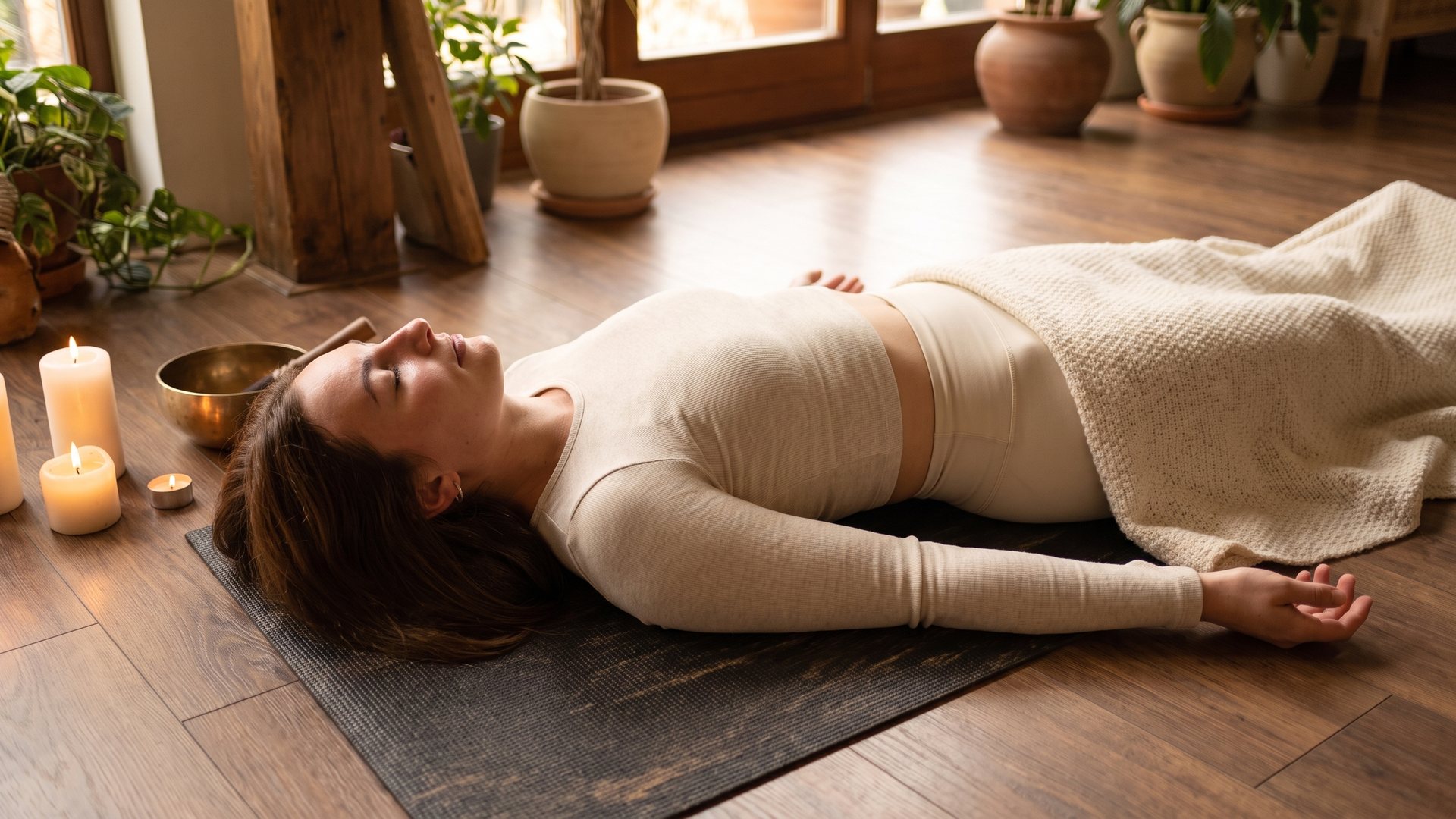
Savasana looks like lying down. It looks like doing nothing. From the outside, it is the most unremarkable position in the entire yoga sequence — a person flat on their back, apparently asleep.
This is, of course, the point. And it is also precisely why so many people find it the most difficult pose in the practice.
Savasana — corpse pose, final relaxation — is the culmination of everything that happened in the preceding hour. It is the moment when the nervous system is asked to genuinely receive the work it has done. Without it, the class is technically complete but experientially unfinished: the fruit of the practice is there, but left on the branch.
1. What Savasana Is Doing Physiologically
When you lie in Savasana — still, warm, eyes closed — the body is not idle. Several significant processes are underway.
Parasympathetic activation deepens. The movement phase of a yoga class already begins shifting the nervous system towards rest-and-digest, but the stillness of Savasana allows this shift to complete. Heart rate slows. Blood pressure drops slightly. Breathing becomes involuntary and rhythmic. The body releases the last layer of voluntary control and begins to do what it knows how to do on its own.
The nervous system consolidates. This is the phase that yoga teachers sometimes describe as integration — and it has a physiological basis. The proprioceptive information gathered during the asana practice (where the body is in space, how much effort each position required, which areas held and which released) needs time to be processed and filed. Savasana provides that time. Skipping it is analogous to closing a document without saving — the work was done, but the record is incomplete.
Cortisol clears. The physical exertion of asana practice temporarily raises cortisol (the stress hormone). Savasana is where cortisol levels return to baseline. Without sufficient rest at the end, you carry some of the stress response of the practice out of the door with you — which is the opposite of what you came for.
Brainwave activity shifts. As the body stills, the dominant brainwave frequency often moves from beta (alert, analytical) through alpha (relaxed, creative) and, in a deep Savasana, into theta (the borderline between waking and sleep, associated with deep rest and insight). This is the state in which the felt effects of yoga practice — reduced tension, clarity, groundedness — are most fully experienced.
2. Why People Skip or Rush It
The reasons people leave before Savasana, or lie there checking the time every two minutes, are not mysterious. They are the same reasons those people came to yoga in the first place.
The mind does not stop. For someone whose nervous system is chronically activated — a busy professional, a new parent, a person carrying anxiety — the instruction to simply lie still and let go is precisely the hardest thing imaginable. The body cooperates. The mind immediately begins generating content: the commute home, tomorrow’s meeting, a conversation that happened last week, the growing certainty that lying on the floor is a peculiar way to spend a Tuesday evening.
Stillness feels unproductive. Many people who practise yoga are high-functioning, high-achieving, and deeply conditioned to equate movement with value. Lying still registers as doing nothing. The nervous system, in full productive-mode, treats it as waste.
Time pressure is real. Ten minutes of Savasana at the end of a sixty-minute class requires a commitment that a packed evening schedule may not accommodate. This is a genuine constraint, not a character flaw.
Physical discomfort. Lower-back sensitivity when lying flat, neck discomfort without adequate support, cold, or restless-leg symptoms can make the position actively unpleasant.
All of these are workable. None of them are reasons to abandon the pose altogether.
3. How to Set Up for a Real Savasana
The quality of your Savasana depends significantly on how well the body is supported. An uncomfortable position cannot produce a restful state.
Bolsters, eye pillows, blanket
The lower back — place a rolled blanket or bolster under the knees to bring the lumbar spine gently to the floor. This is the single most important adjustment for anyone who experiences discomfort lying flat. The lower back releases when the psoas (the deep hip flexor connecting lumbar spine to femur) is not in a lengthened position, which is exactly what slightly bent knees provide.
The neck and head — a thin folded blanket under the head keeps the cervical spine neutral. Too high and the chin juts; too low and the back of the skull presses uncomfortably. The head should feel like it is being held, not placed.
Eye pillow — a small, lightly weighted eye pillow (often lavender-scented) presses very gently on the orbits and stimulates the oculocardiac reflex, which slows the heart rate. It also blocks light and, crucially, makes it harder to open the eyes and glance at your phone. Consider it non-optional for anyone who struggles with Savasana restlessness.
Blanket over the body — the body temperature drops when you stop moving. A light blanket prevents the cold from interrupting the rest. This is a practical detail with a meaningful effect: warmth supports parasympathetic activation.
4. Common Discomforts and Fixes
Restless mind: a permission script
If your mind will not settle, try this: give it explicit permission to be active, but narrow its focus. Something like: For the next ten minutes, the only job I have is to notice my breathing. Nothing else needs my attention right now. Everything else can wait.
This is not a suppression instruction. You are not telling the mind to be quiet. You are telling it that it can do what it likes, but that right now, the breath is the task. Most minds find this more workable than a blank instruction to relax.
Some students find a body scan more accessible than pure breath awareness: slowly moving attention from the feet upward, noticing sensation in each region without trying to change anything. This gives the mind a structured route to travel, which is easier than open-ended stillness.
Counting breaths — count exhales from one to ten, then restart. If you lose count, return to one without judgement. This is formal mindfulness practice in its simplest form, and it works in Savasana as well as anywhere.
5. Sound Healing in Savasana — the Deepening
Why our classes always include 10+ minutes
At Your Ritual Yoga, Savasana always includes sound healing with Himalayan singing bowls. This is not an add-on or a novelty. It is a considered decision about what Savasana is for and what it needs.
The singing bowls — bronze, hand-hammered, from Nepal — produce frequencies in the range of 40 to 600 Hz. These frequencies create vibration that is felt as much as heard: a physical resonance that moves through the body’s tissues and adds a tangible, somatic dimension to the rest state.
The brainwave-entrainment effect of sustained, regular sound waves is well documented. The auditory cortex responds to rhythmic sound by gravitating towards synchronisation — and the frequencies produced by singing bowls fall within the alpha and theta ranges associated with deep rest, reduced anxiety, and the kind of integration described above.
For students who struggle to settle in Savasana, the bowls offer something the instruction to relax cannot: a sensory anchor. The mind, occupied with the sound and the vibration, stops generating the usual stream of content and finds something closer to genuine stillness.
The minimum duration for effective Savasana is generally considered ten minutes. Less than this does not allow sufficient time for the physiological processes described above to complete. Our classes hold Savasana for at least ten minutes, often longer — because it is not the end of the class. It is the point of the class.
Frequently Asked Questions
Is it normal to fall asleep in Savasana?
Yes, particularly if you are sleep-deprived. Falling asleep in Savasana is not failure — it is a significant indicator that your body needed rest. Over time, as sleep improves through regular practice, you may find yourself awake and deeply rested rather than unconscious.
What if lying flat is genuinely uncomfortable?
Knee support (rolled blanket under the knees) resolves most lower-back discomfort. For students with particular spinal conditions, a semi-reclined position against a bolster is an equally valid alternative. Mention any physical constraints to your teacher before class.
Why is it called corpse pose?
The Sanskrit sava means corpse. The pose is a symbolic rehearsal of complete letting go — of effort, control, identity, activity. Some traditions view it as a preparation for understanding impermanence. In practice, most students simply find it very restful.
Can I leave before Savasana if I really need to?
Occasionally, yes. Consistently, no. The body adapts to what it is regularly asked to do. A practice that consistently skips Savasana trains the nervous system that rest is not available at the end of effort. Over time, this makes it harder, not easier, to wind down after exertion in everyday life.
Does Savasana count as the hardest pose?
It is certainly the pose most people find the most confronting. The physical difficulty of Savasana is zero. The psychological difficulty of genuinely doing nothing — of releasing control and simply receiving — is, for many people, considerable.
Experience Savasana with sound healing at Your Ritual Yoga — Himalayan singing bowls, a warm space, and as much time as the body needs to arrive at rest. View our Yin yoga classes for the deepest Savasana experience.
About the author
Tanya is a Yoga Alliance RYS 200 certified yoga teacher (ID 252157), trained at Devvrat Yoga School in Varkala, India (December 2025). She teaches Hatha and Yin yoga at Your Ritual Yoga in Golders Green, NW11 — a small, intentional studio where every class includes sound healing with Himalayan singing bowls and a post-class herbal tea ritual. www.ritual-yoga.co.uk