Written by Tanya — Yoga Alliance RYS 200 (ID 252157), trained at Devvrat Yoga School, Varkala, India (December 2025). Tanya teaches Hatha and Yin yoga at Your Ritual Yoga in Golders Green, NW11.
Pranayama for beginners does not have to be complicated. Most people arrive at breathwork expecting something advanced — a complex counting system, a particular posture they cannot yet hold, a room full of experienced practitioners who seem to breathe with enviable ease. But the truth is this: you have been breathing your whole life. Pranayama simply asks you to bring your attention to what is already happening, and then — gradually, gently — to begin to shape it.
The word pranayama comes from Sanskrit. Prana means life force or breath. Ayama means to extend or regulate. Together they describe the practice of working consciously with breath to influence the body and the mind.
What follows is a clear, unfussy introduction to the three techniques I teach first to every new student at Your Ritual Yoga in Golders Green. They are sequenced deliberately: each one builds the foundation the next requires.
1. Why Start With These Three
There are dozens of pranayama techniques described in classical texts. Some are energising. Some are cooling. Some are quite advanced — involving breath retention, specific bandhas (energetic locks), or internal rhythms that require a steady base of practice before they can be safely explored.
These three are different. They are calming, accessible, and grounding. They work with the parasympathetic nervous system — the branch responsible for rest and recovery — and they are the ones most likely to produce a noticeable shift in how you feel, quickly enough to stay motivated.
The order matters. Belly breath comes first because most adults have forgotten how to breathe into the belly at all. Extended exhale comes second because it uses what belly breath teaches. Nadi shodhana comes third because it requires the stability and attention that the first two develop.
None of these techniques require any flexibility. You do not need to sit in lotus. You do not need to have practised yoga before.
2. Technique 1: Belly Breath (Diaphragmatic Breathing)
This is the most fundamental breath practice — and also the most commonly lost. Under chronic stress, most people breathe primarily into the chest. The diaphragm, a dome-shaped muscle that should descend on each inhale to expand the lungs downward, barely moves. The breath becomes shallow and fast, and the nervous system reads this as a signal of ongoing threat.
Belly breath reverses this pattern.
How to practise:
Lie on your back with your knees bent, feet on the floor, one hand resting lightly on your belly. On your next inhale, see if you can send the breath downward — as if filling a bowl in the lower abdomen. Your hand should rise. Your chest remains relatively still.
On the exhale, let the belly fall back towards the spine, gently and without force.
Begin with five minutes. There is no counting required at this stage. Simply rest your attention on the rise and fall of the belly.
Sitting up vs lying down
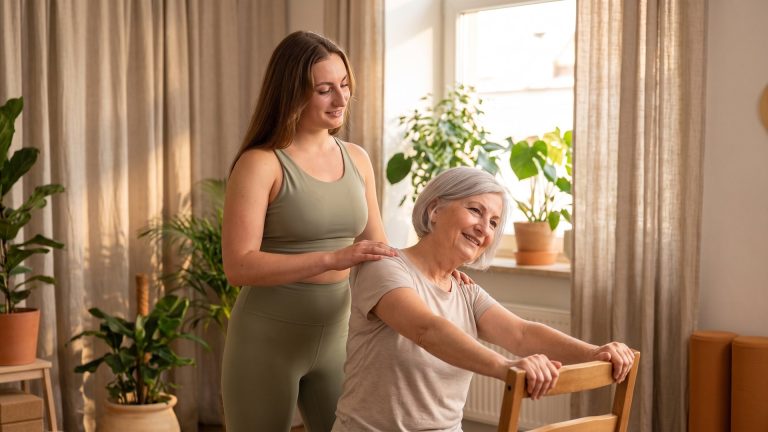
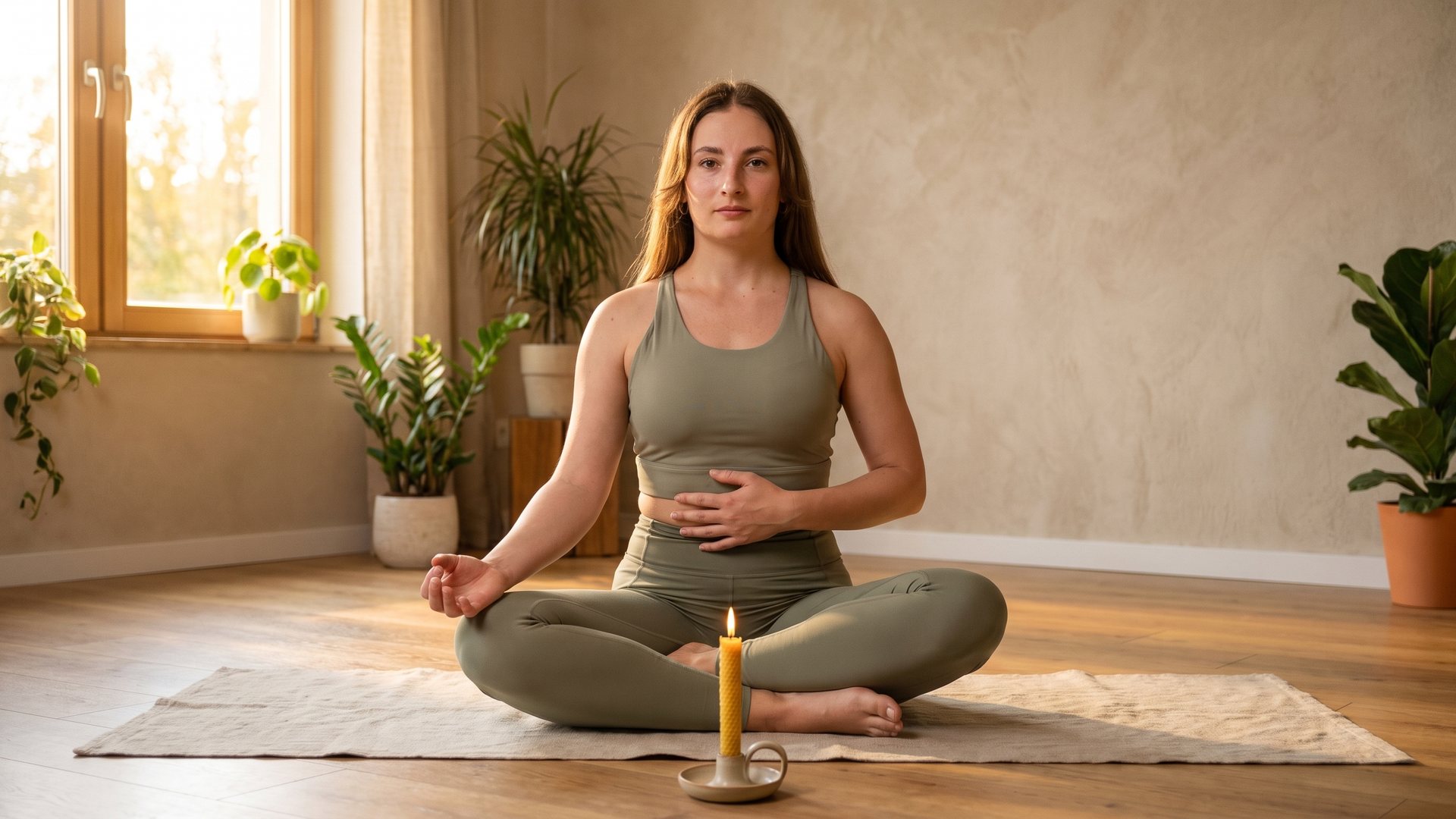
Lying down makes belly breath easier to find, because the floor provides feedback and the abdominal muscles are fully released. Once you can locate the movement consistently lying down, try sitting upright — cross-legged on a cushion or in a chair with your feet flat on the floor and your spine long.
Sitting is eventually more useful because it is portable. You can practise on the train, at your desk, or in the minutes before a meeting.
10 breaths a day, twice a day
Start small. Ten conscious belly breaths in the morning and ten before sleep is genuinely enough for the first week. Consistency matters far more than duration at this stage. The practice is not about achieving anything — it is about learning to recognise and return to the breath.
3. Technique 2: Extended Exhale
Once you have a reliable sense of belly breath, you can begin to work with the ratio of inhale to exhale. Specifically, you can begin to make the exhale longer than the inhale.
This matters because inhale is associated with sympathetic nervous system activation — a mild arousal, a readying. Exhale is associated with parasympathetic activation — a settling, a letting go. By gradually extending the exhale, you can consciously shift the body towards a calmer state.
How to practise:
Begin with a natural belly breath. Then, without forcing, count silently as you inhale. Perhaps it is four counts. On the exhale, aim for five or six counts — slightly longer than the inhale, still comfortable, still smooth.
Avoid any sense of strain or breathlessness. If the extended exhale feels uncomfortable, shorten it. A 4:5 ratio (four counts in, five counts out) is a perfectly reasonable starting point. You might eventually move towards 4:6 or 4:8, but only when the current ratio feels at ease.
When to use it:
Extended exhale is particularly useful in the moment. Before a difficult conversation, before sleep, in the middle of a stressful afternoon — a few rounds of extended exhale can be practised anywhere, with nobody noticing. It is one of the most practical tools pranayama offers.
4. Technique 3: Nadi Shodhana (Alternate Nostril Breathing)
Nadi shodhana translates roughly as “channel cleansing” — nadi meaning channel or pathway, shodhana meaning purification. In yogic understanding, this breath works to balance the two energetic channels that run alongside the spine: ida (lunar, cooling, associated with the right brain) and pingala (solar, warming, associated with the left brain).
From a more physiological perspective, there is evidence that alternate nostril breathing may support a calmer baseline state and reduced heart rate. What practitioners tend to notice is a quality of balance and clarity — not sedated, not activated, but centred.
How to practise:
Sit comfortably with your spine upright. Rest your left hand on your left knee. Bring your right hand to your face: index and middle fingers resting gently on the space between your eyebrows (or folded into the palm), thumb resting alongside the right nostril, ring finger alongside the left.
- Close the right nostril with your thumb. Inhale slowly through the left nostril.
- Close both nostrils briefly — the lightest pause — then release the right nostril and exhale slowly through the right.
- Inhale through the right nostril.
- Close both briefly. Release the left nostril and exhale through the left.
That is one full round. Begin with five rounds. The pace should be slow and unhurried — no counting required at first, just a calm, even rhythm.
This technique is woven into the ritual experience at Your Ritual Yoga, where we practise pranayama as part of every Hatha class. Experiencing it in a guided setting, with someone to help you find the right pace and hand position, can make a significant difference in how quickly it settles.
5. A 4-Week Beginner Plan
The following plan is intended as a quiet structure — not a rigid programme. If life interrupts, begin again without judgement.
Week 1 — Belly Breath only
Morning: 10 breaths lying down.
Evening: 10 breaths sitting up.
Notice: Is the belly moving? Is the chest softening?
Week 2 — Add Extended Exhale
Morning: 10 belly breaths, then 5 rounds of 4:6 breathing.
Evening: same.
Notice: Does the extended exhale feel natural or forced?
Week 3 — Introduce Nadi Shodhana
Morning: 5 rounds nadi shodhana.
Evening: 5 rounds extended exhale.
Notice: Any difference in mental clarity after nadi shodhana?
Week 4 — Build a short practice
Morning: 5 minutes — 2 minutes belly breath, then nadi shodhana.
Evening: 5 minutes — extended exhale and a few minutes of stillness.
Notice: How does the body feel different from week one?
By the end of four weeks, most students find that the breath is no longer something they have to consciously search for — it has become a texture of daily life, something they return to rather than begin.
Frequently Asked Questions
Do I need to sit in a specific position to practise pranayama?
No. Belly breath can be practised lying down. Extended exhale can be practised in a chair or on the bus. For nadi shodhana, a comfortable upright seat is helpful — a chair with your feet flat on the floor works perfectly well.
How long before I notice a difference?
Many people notice a shift in their state of mind after a single session of extended exhale or nadi shodhana. The deeper changes — in baseline anxiety, sleep quality, stress response — tend to emerge over weeks of consistent practice, not days.
Is pranayama safe for everyone?
For the techniques described here, yes, for most people. If you have a respiratory condition, cardiovascular concerns, or are pregnant, please speak to your GP before beginning any breath-retention practices. The three techniques above involve no full retention — they are among the gentlest in the pranayama repertoire.
Can I practise pranayama on its own, without yoga postures?
Absolutely. Pranayama is a complete practice in its own right. In classical yoga, breath is considered more fundamental than physical posture.
What if I feel light-headed?
Return to normal breathing and rest. Light-headedness can happen if you are breathing too fast or too deeply. Slow down, breathe naturally for a few minutes, and try again more gently. If it persists, please consult a healthcare professional.
Ready to experience pranayama in a guided setting? Join a Hatha class at Your Ritual Yoga — breathwork is woven into every session, and Tanya will guide you through each technique with care.
About the author
Tanya is a Yoga Alliance RYS 200 certified yoga teacher (ID 252157), trained at Devvrat Yoga School in Varkala, India (December 2025). She teaches Hatha and Yin yoga at Your Ritual Yoga in Golders Green, NW11 — a small, intentional studio where every class includes sound healing with Himalayan singing bowls and a post-class herbal tea ritual. www.ritual-yoga.co.uk