Written by Tanya — Yoga Alliance RYS 200 (ID 252157), trained at Devvrat Yoga School, Varkala, India (December 2025). Tanya teaches Hatha and Yin yoga at Your Ritual Yoga in Golders Green, NW11.
Yoga for over 50s in London is not a niche concern — it is, in many ways, where yoga is most at home. The practices that form the roots of yoga: slow movement, deliberate breath, extended stillness, a quality of turning inward — these are things a body over fifty tends to understand more readily than a body that has not yet learned to slow down.
And yet many people in this age group arrive at a studio for the first time carrying a particular hesitation. They wonder whether they are too stiff. Too late. Whether yoga is really for younger, more flexible people. Whether they will keep up.
The answer to all of these concerns is a quiet, certain no.
What follows is an honest guide to beginning yoga after fifty in North London — what your body may need, what to look for in a class, what to approach with care, and what you might find on the other side of a few months of patient practice.
1. The 50+ Body Has Different Needs
After fifty, the body is not the same as it was at thirty. This is not a limitation — it is simply a fact, and one that yoga is well-placed to work with.
Several things tend to shift with age that are directly relevant to a yoga practice:
Connective tissue becomes less elastic. Tendons, ligaments, and the fascia that wraps the muscles all lose some suppleness over time. This means that deep, fast stretching can be counterproductive and occasionally injurious. Slow, sustained holds — particularly the long passive holds of Yin yoga — tend to work more effectively and more safely with connective tissue than dynamic or forceful stretching.
Muscle mass decreases gradually. Sarcopenia, the age-related loss of muscle tissue, begins in the forties and continues unless actively managed. Yoga, particularly Hatha, builds and maintains functional strength — not bulk, but the kind of engaged, distributed strength that supports posture, balance, and joint stability.
Balance becomes more important. Falls are a leading cause of injury in people over sixty, and balance relies on a combination of strength, proprioception (the body’s awareness of itself in space), and calm nervous system function. Yoga addresses all three.
The nervous system may be carrying years of accumulated stress. Chronic tension, poor sleep, a lifetime of over-busyness — these are common in people over fifty, and they create a particular kind of tightness that is not purely physical. The parasympathetic practices within yoga — slow breath, extended exhale, held postures, sound — address this layer directly.
Joint health, bone density, balance
Weight-bearing postures in yoga — standing poses, gentle arm balances approached carefully — can support bone density. The emphasis on alignment rather than extremity means joints are loaded thoughtfully rather than stressed. And the consistent focus on proprioception and balance in every standing sequence quietly builds the neural pathways that keep people upright and steady.
2. Why Slow Hatha and Yin Suit Best
Not all yoga is the same. For a body over fifty, the styles matter.
Hatha yoga at a traditional pace — not the fast-flow hybrid classes that borrow the name — is built around holding postures for several breaths, exploring alignment, working with breath, and moving deliberately between shapes. There is space to feel what is happening, to adjust, to ask a question. A good Hatha class in this tradition is unhurried, methodical, and deeply attentive to the body’s response.
Yin yoga takes the principle of slow holding even further: postures are held for three to five minutes in a passive, surrendered way, targeting the connective tissue rather than the muscles. This is the style most useful for the kind of deep, chronic stiffness that accumulates in the hips, lower back, and inner thighs over decades of sitting and stress. It is also profoundly calming — the long holds activate the parasympathetic nervous system in a way that few other practices match.
Both styles are offered at Your Ritual Yoga in Golders Green, and both are explicitly all-levels: no prior experience required, no particular level of flexibility assumed.
What to be cautious of: hot yoga, fast-flow Vinyasa, and power yoga classes are generally not the best starting point for anyone over fifty who is new to practice. They can be explored later, once a foundation has been built — but as a starting point, they tend to push before the body is ready.
Why studio temperature matters at 55
Many people find that they feel the cold more acutely after fifty — the circulatory system becomes slightly less efficient, and warming up takes longer. A studio that maintains a warm (but not hot) ambient temperature makes a genuine difference to how the body opens during practice. At Your Ritual Yoga, we keep the room warm enough that you are never fighting the cold, but not so hot that the heat is doing the work for you.
3. What to Avoid in a Class Environment
A thoughtful class environment matters as much as the style of yoga itself. For people over fifty, there are a few specific things worth looking out for — and away from.
Avoid: large, impersonal classes where individual adjustments are not possible. When a teacher cannot see you, they cannot notice if a posture is not working for your particular body.
Avoid: studios that use competitive or comparison-based language. You are not here to achieve a shape. You are here to practise.
Avoid: teachers who push students into deeper versions of poses before the student has signalled readiness. A good teacher offers options; they do not impose progression.
Avoid: classes where the pace is set by the most experienced person in the room. In a well-taught class, each student works within their own range.
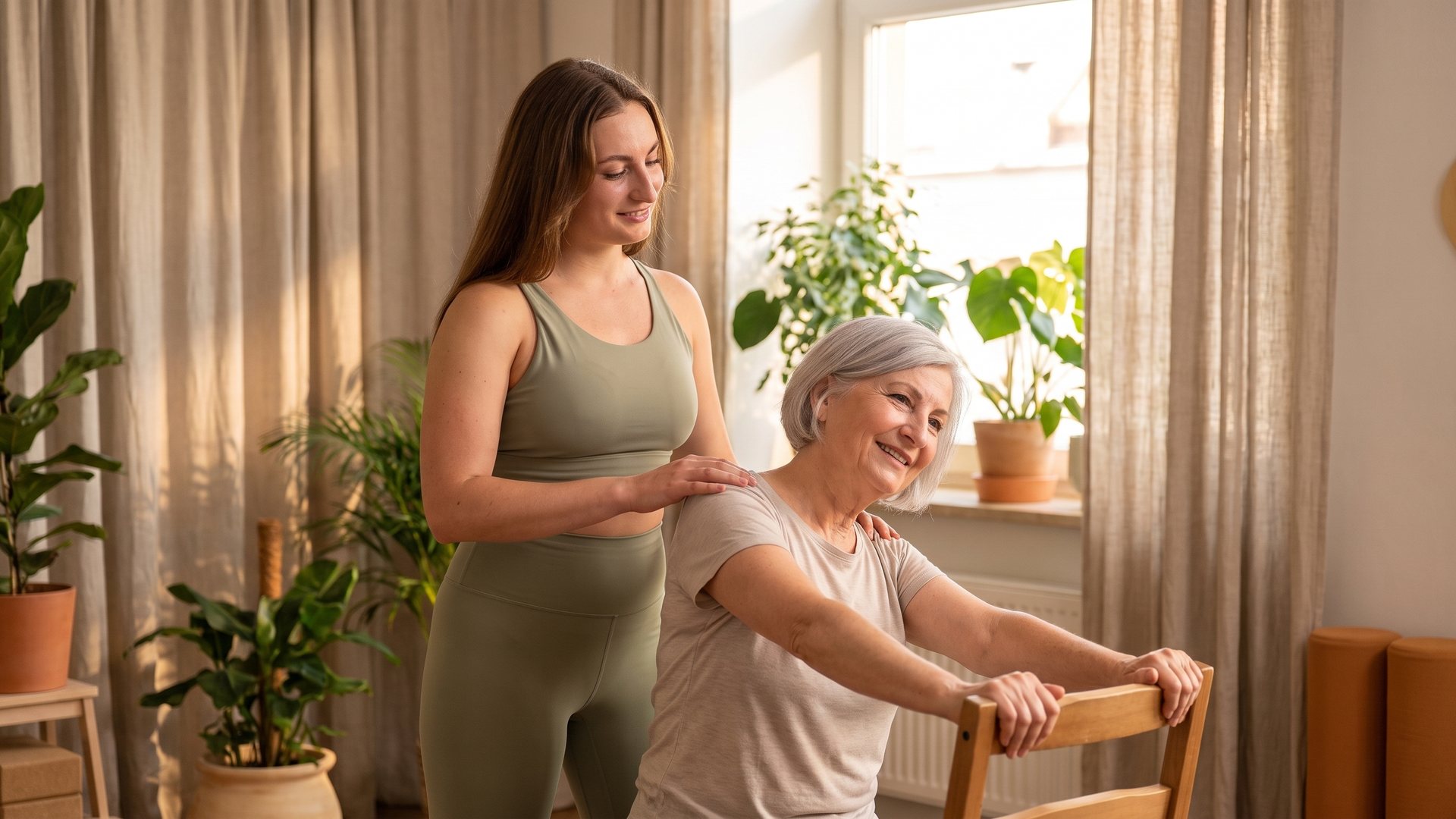
Look for: small classes. A teacher who knows your name. A studio where modifications are offered as a matter of course, not as a concession. A space where rest is presented as part of the practice, not an absence of effort.
4. How to Start Without Injury
The most common yoga injuries are not caused by yoga itself — they are caused by impatience. Pushing through discomfort, trying to match someone else’s range of movement, or progressing before the body has adapted are the usual culprits.
A few principles that serve beginners over fifty particularly well:
Work at 70–80% of your range. A well-chosen yoga posture should produce a sensation of stretching — present, noticeable, and workable. It should never produce sharp pain, pinching in a joint, or the feeling that something is about to give. If you feel those, ease back.
Tell your teacher what you are carrying. Old injuries, chronic pain, recent surgery, joint replacements — these are all relevant, and a good teacher will adapt. At Your Ritual Yoga, a brief intake conversation before your first class is simply part of how we teach.
Use props freely. Blocks, straps, bolsters, and blankets are not admissions of limitation — they are precision tools that allow the body to find the correct position without overstretching. A block under the hand in triangle pose, for example, often makes the pose more therapeutically effective, not less.
Allow yourself to rest. Child’s pose is always available. Savasana is always available. Choosing rest when the body asks for it is an act of wisdom, not weakness.
Consider beginning with Yin yoga if your primary experience is of deep, long-held tension — the kind that feels structural, almost embedded. Hatha is wonderful for beginners who want to build strength and range alongside each other. Many students find that alternating between the two styles creates the most well-rounded foundation.
5. What Three Months of Practice Tends to Change
Three months is enough time to notice real change — provided the practice is consistent, even if that consistency means once a week.
What students in this age group most often report after three months:
The hips feel different. There is more ease when sitting, rising, and walking. The particular morning stiffness that makes the first ten minutes of a day feel laboured starts to ease.
Sleep begins to shift. The nervous system, gradually becoming more familiar with states of deep rest, starts to access them more readily at night.
The breath becomes a resource rather than a background noise. Students who have been practising pranayama — conscious breathing — for a few months find that they reach for the breath in stressful moments automatically.
Posture improves, quietly and without effort. The lengthening of the spine, the opening of the chest, the softening of the jaw and shoulders — these accumulate over months of practice and are sometimes noticed first by people who know the student, not the student themselves.
Honest expectations: the 4-week-mark shift
Around four weeks in, most new students notice a point at which the practice begins to feel familiar rather than foreign. The sequence of a class stops requiring active effort to follow. The mind quiets a little more readily. This is not a finish line — it is the point at which practice actually begins.
Frequently Asked Questions
I have never done yoga before. Is it too late to start in my fifties or sixties?
No. Many of the students who find yoga most transformative come to it later in life, precisely because a life lived fully tends to create the kind of body that needs exactly what yoga offers. There is no age requirement and no prior experience needed.
I have a knee replacement (or hip replacement). Can I still practise?
In many cases, yes — with appropriate modifications. Please share this information with your teacher before your first class so that specific postures can be adapted. Avoid any studio where this conversation is brushed aside.
Will yoga help my lower back pain?
Many people find that a gentle, consistent yoga practice supports lower back health — particularly when the root cause is a combination of sedentary habits and chronic muscular tension. However, if you have a diagnosed spinal condition, please consult your GP or physiotherapist before beginning, and choose a teacher who has experience working with back issues.
How many times a week should I practise as a beginner?
Once a week in a class setting, supplemented by a few minutes of simple breathing or gentle movement at home, is a meaningful starting point. Two classes a week, once you have found your footing, tends to accelerate the sense of change noticeably.
I am not flexible. Is that a problem?
Inflexibility is one of the best reasons to begin yoga, not a reason to wait. Flexibility is a result of practice — not a prerequisite for it.
If you are in North London and considering your first class, a gentle Hatha session at Your Ritual Yoga is a quiet, unhurried place to begin. Small classes, individual attention, and no pressure to be anywhere other than where you are. You are welcome to read about Tanya’s teaching approach before booking.
About the author
Tanya is a Yoga Alliance RYS 200 certified yoga teacher (ID 252157), trained at Devvrat Yoga School in Varkala, India (December 2025). She teaches Hatha and Yin yoga at Your Ritual Yoga in Golders Green, NW11 — a small, intentional studio where every class includes sound healing with Himalayan singing bowls and a post-class herbal tea ritual. www.ritual-yoga.co.uk