Written by Tanya — Yoga Alliance RYS 200 (ID 252157), trained at Devvrat Yoga School, Varkala, India (December 2025). Tanya teaches Hatha and Yin yoga at Your Ritual Yoga in Golders Green, NW11.
4-7-8 breathing is one of the few techniques that people encounter, try once, and feel something shift. It is not subtle in the way some breathwork practices are. Done correctly, it produces a noticeable change in the nervous system within minutes — a slowing, a heaviness in the limbs, a quieting of the mental stream that makes sleep feel genuinely possible.
If you have ever lain awake with a busy mind and a body that will not release, this practice is worth learning properly.
What 4-7-8 is
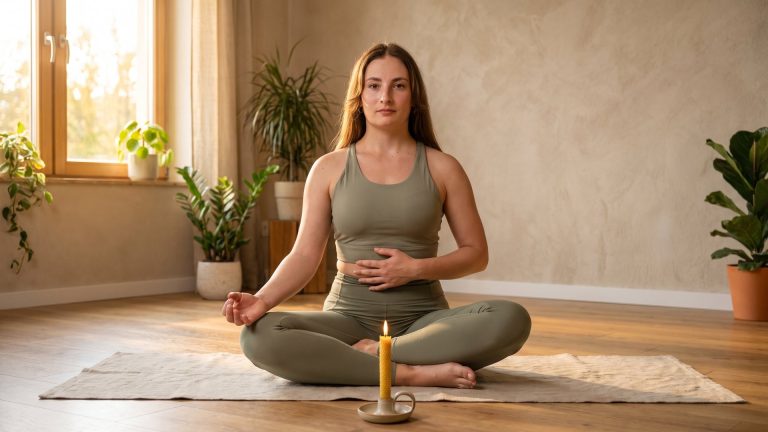
The 4-7-8 technique is a pranayama-derived breathing pattern made more widely accessible by Dr Andrew Weil, though its roots lie in ancient yoga breathing practices — specifically kumbhaka, the art of breath retention. The ratio is simple:
- Inhale through the nose for 4 counts
- Hold the breath for 7 counts
- Exhale slowly through the mouth for 8 counts
This is one cycle. The recommended starting practice is four cycles, twice a day — once in the morning and once at bedtime. Over the first few weeks, you can build to eight cycles per session.
The counts do not correspond to seconds unless you choose to count at one-per-second. What matters is the ratio — the exhale is always exactly twice the hold, and the hold is always nearly twice the inhale. If you count slowly, the technique deepens. If you count quickly, it is still effective but the nervous-system effect is milder.
Why long exhales work
The parasympathetic exhale story
The breath is unique among the body’s autonomic functions: it operates involuntarily (you breathe while you sleep without thinking about it) but can also be consciously controlled. This dual nature means the breath is a direct, accessible bridge between the voluntary nervous system — the part you can influence with intention — and the autonomic nervous system, which governs heart rate, digestion, stress response, and, critically, sleep.
The key mechanism in 4-7-8 breathing is the extended exhale.
When you exhale slowly and fully, you activate the vagus nerve — the primary pathway of the parasympathetic nervous system. The heart rate slows. Blood pressure eases. The hypothalamus receives signals that it is safe to reduce the production of cortisol. The amygdala — the brain’s threat-detection centre, which generates much of the cognitive noise that keeps people awake — quiets.
The breath-hold in 4-7-8 plays a different role. Retaining the breath briefly raises carbon dioxide levels in the blood, which triggers the body to take a deeper, more efficient inhale. This, combined with the extended exhale, produces a carbon dioxide and oxygen balance that is deeply conducive to relaxation.
In Pranayama philosophy, the retention — kumbhaka — is understood as the moment in which prana (life force) is gathered and distributed. The pause is not empty. It is full.
A 30-day habit plan
The science of habit formation is clear on one point: specificity matters more than willpower. A habit that is attached to an existing cue in your environment — a time, a location, a preceding action — is far more likely to become automatic.
Here is a 30-day structure that uses the bedtime routine itself as the cue.
Days 1–7: Establish the anchor
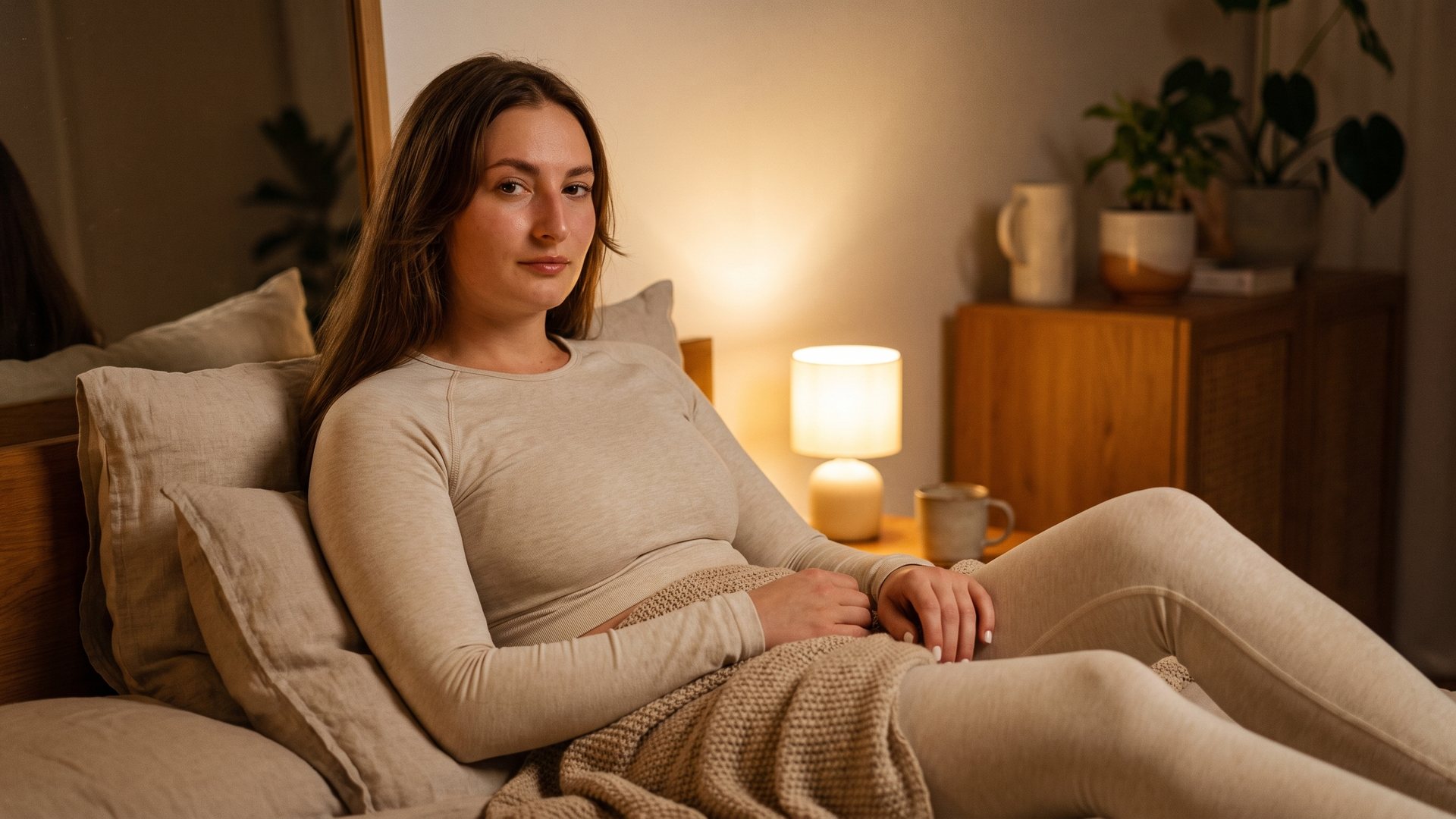
Each night, immediately after getting into bed and before picking up your phone or turning out the light, practise four cycles of 4-7-8 breathing. This is your only task. Do not worry about perfection with the counts. The goal this week is simply: breath practice happens after getting into bed, before anything else.
Days 8–14: Extend to 6 cycles
By now the sequence is beginning to feel familiar. Add two more cycles — six total. Notice whether the drop into the exhale feels slightly automatic by cycle three or four.
Days 15–21: Add a second practice point
Continue your bedtime practice. Add a second shorter session — four cycles — in the morning before getting out of bed, or at a moment of daytime stress (a difficult meeting, a difficult moment in traffic). Observe whether the technique feels different when used proactively rather than reactively.
Days 22–30: Full integration
Eight cycles at bedtime, four cycles as needed during the day. By this point, many practitioners find the breath-hold has become comfortable and the exhale naturally lengthens beyond the eight-count minimum as the nervous system relaxes into the pattern.
After thirty days, reflect: has the quality of sleep changed? Has the time to fall asleep shortened? Has the practice influenced daytime anxiety in any way?
Pairing with legs up the wall
Combine with herbal tea + dim lights
4-7-8 breathing is effective alone. Combined with other parasympathetic-activating inputs, it becomes part of a genuine bedtime ritual — not a single technique but a composed environment that signals, consistently, to the nervous system: it is safe to rest now.
The most effective combination for sleep preparation:
Legs up the wall (Viparita Karani) — 10 minutes. This mild inversion reverses blood-pooling from the day’s activity, activates baroreceptors in the neck, and produces a pronounced calming effect. Practise immediately before your 4-7-8 breath cycles. See our Yin yoga page for more on why passive inversions support sleep so effectively.
Herbal tea — 20 minutes before bed. A warm, non-caffeinated herbal blend drunk slowly and without a screen — chamomile, lemon balm, passionflower, valerian — warms the body from within and initiates the temperature drop that triggers sleep onset. This is a version of the post-class tea ritual we offer at the studio, brought into the home.
Dim lights — 30 minutes before bed. Melatonin production requires darkness, and even moderate artificial light — particularly the blue-spectrum light of screens — suppresses melatonin significantly. Dim the lights, put the phone away or into greyscale mode, and allow the visual system to wind down alongside the breath.
The ritual is this: dim the lights, make the tea, lie with your legs up the wall for ten minutes, come to lying in bed, practise your 4-7-8 cycles. Then close your eyes and receive the quiet you have prepared for.
What to do if it doesn’t work
A small number of people find 4-7-8 breathing activating rather than calming — particularly in the early weeks, when breath-holding can trigger a mild anxious response. If this is your experience:
Reduce the hold. Instead of 4-7-8, try 4-4-8 or even 4-2-8. The most important element is the extended exhale, not the hold.
Focus only on the exhale. If breath retention of any length feels distressing, abandon the hold entirely and simply practise a long, slow exhale — in for four, out for eight. This produces the core parasympathetic effect.
Practise during the day first. If bedtime practice feels too pressurised (you become aware of being “supposed” to fall asleep), establish the habit at a neutral time of day — mid-afternoon, say — before bringing it to the bedtime environment.
Be patient with the first week. The nervous system takes time to learn that a new pattern is safe. Four or five days of mild activation is not unusual before the calming effect begins to predominate. Most people notice a shift by day seven.
Frequently Asked Questions
Is 4-7-8 breathing safe for everyone?
It is generally safe for healthy adults. It is not recommended for people with certain respiratory conditions (asthma, COPD) without medical guidance, as breath-holding can be uncomfortable or counterproductive. Pregnant women should practise only with medical approval. If you feel dizzy, lightheaded, or experience any distress, stop and return to normal breathing.
How long until 4-7-8 breathing helps with sleep?
Many people notice a difference within the first week. Meaningful change in sleep quality — time to fall asleep, number of night-wakings, depth of sleep — typically emerges after two to three weeks of consistent practice.
Can I do more than eight cycles at once?
In the early weeks, limit yourself to four to eight cycles per session. Extended sessions beyond this can sometimes produce dizziness. As the technique becomes familiar and comfortable, experienced practitioners extend naturally, but gradual progression is safer.
Does it matter whether I count in my head or aloud?
Counting in the head is fine. Some people find it helpful to count silently on the fingers, which adds a tactile anchor that reduces mind-wandering. Counting aloud would disrupt the breath pattern, so keep the count internal.
Can children use 4-7-8 breathing?
With modification, yes. The breath-hold is generally not appropriate for young children. A simplified 4-0-6 pattern (in for 4, out for 6) can be appropriate for children from around age 8 upward, with parental supervision. Always consult a paediatrician for any specific concerns.
Evening Yin yoga pairs beautifully with a 4-7-8 breathing practice — the class calms the nervous system, the breath sustains that calm into sleep. See the schedule and add evening Yin to your week →
About the author
Tanya is a Yoga Alliance RYS 200 certified yoga teacher (ID 252157), trained at Devvrat Yoga School in Varkala, India (December 2025). She teaches Hatha and Yin yoga at Your Ritual Yoga in Golders Green, NW11 — a small, intentional studio where every class includes sound healing with Himalayan singing bowls and a post-class herbal tea ritual. www.ritual-yoga.co.uk