Written by Tanya — Yoga Alliance RYS 200 (ID 252157), trained at Devvrat Yoga School, Varkala, India (December 2025). Tanya teaches Hatha and Yin yoga at Your Ritual Yoga in Golders Green, NW11.
Cat cow pose — or more precisely, the flowing movement between Cat (Marjaryasana) and Cow (Bitilasana) — is one of the first things taught in almost every yoga training, and for good reason. It is accessible to nearly everyone, it requires no warm-up to begin, and five minutes of it in the morning produces a disproportionately large improvement in how the spine feels for the rest of the day.
If you have time for nothing else in the morning, do this. Ideally on a mat, but if not, on a blanket, a rug, a piece of carpet — anywhere your knees and hands are comfortable.
What cat-cow does for the spine
The spine is designed to move in six directions: flexion (rounding forward), extension (arching backward), lateral flexion (side-bending), and rotation (twisting). Modern sedentary life collapses most of these movements. Sitting holds the spine in a single, often poorly supported position for hours at a time. The intervertebral discs — which depend on movement to receive fluid and nutrients — become compressed and dehydrated. The surrounding muscles shorten and stiffen.
Cat-cow addresses the first two of these six movements in a continuous, breath-led oscillation. Alternating between full spinal flexion (Cat) and full spinal extension (Cow) creates a gentle hydraulic pumping action in the discs, encouraging the reabsorption of synovial fluid. It mobilises the facet joints throughout the entire length of the spine — cervical (neck), thoracic (mid-back), and lumbar (lower back). It releases the paraspinal muscles that have been isometrically contracted all night, and it wakes the breath connection to the body before more demanding movement begins.
After five minutes of unhurried cat-cow, most people notice:
– Reduced stiffness in the lower back and neck
– A sense of the torso lengthening
– Easier, fuller breathing
– A slightly quieter mind — because the continuous breath-movement coordination requires just enough attention to interrupt the early-morning mental chatter
How to do it well
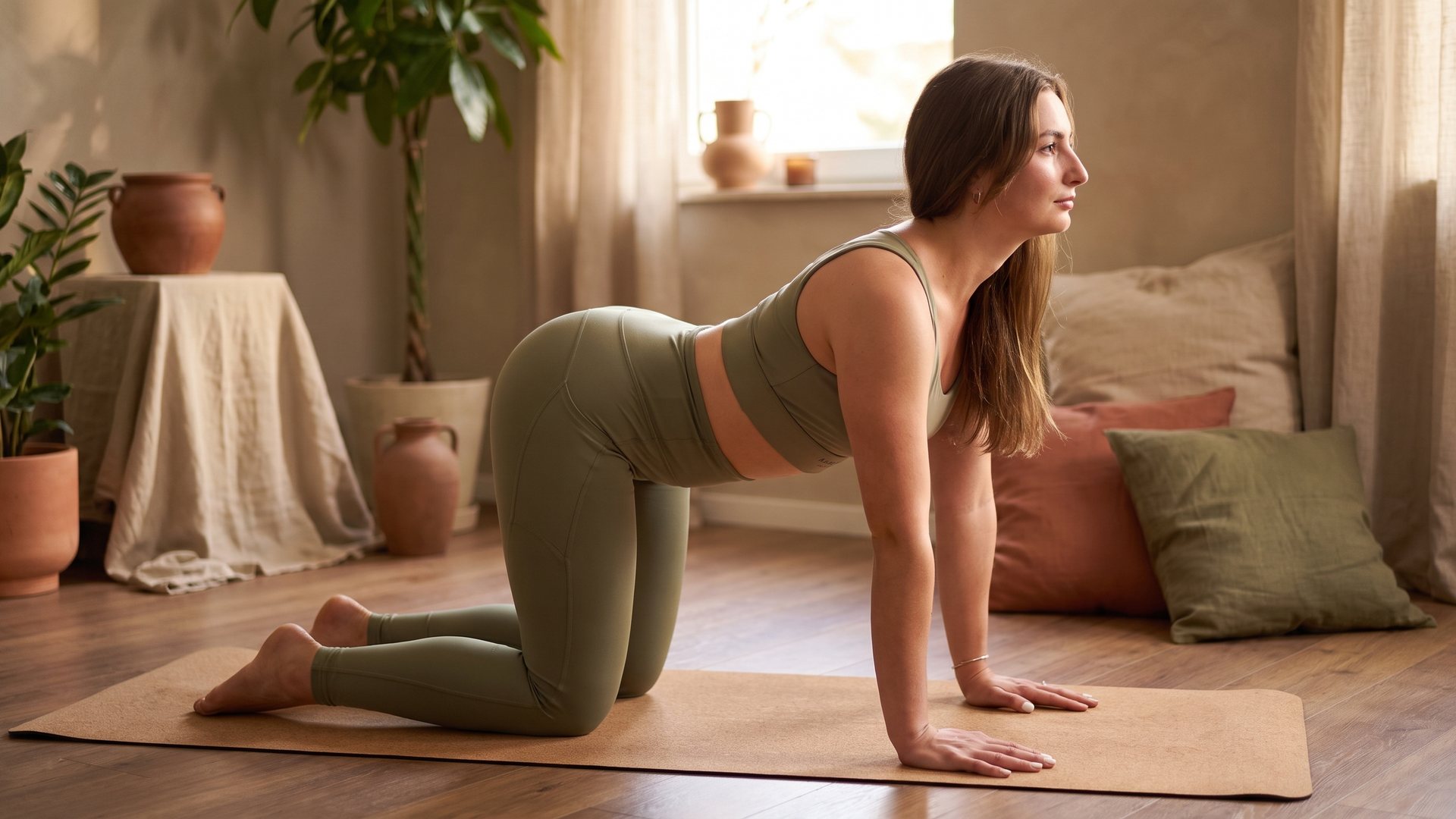
Come to hands and knees. Stack the wrists beneath the shoulders and the knees beneath the hips. The spine is neutral — a long, horizontal line without exaggeration in either direction.
Cow (Bitilasana): On an inhale, begin the movement at the tailbone — tip it upward. Allow the ripple of extension to travel up the spine: the belly drops towards the floor, the chest opens, the shoulder blades draw together and downward, the gaze softens upward. The neck is the last to move — it follows the spine rather than leading it.
Cat (Marjaryasana): On an exhale, reverse from the tailbone — tuck it under. The spine rounds evenly from base to crown: the navel draws gently upward towards the ceiling, the shoulder blades splay wide, the chest hollows, the chin falls towards the chest. Press the floor away with both hands to deepen the rounding of the upper back.
Move slowly — one full breath for each direction. The movement should feel like water, not a hinge. There is no locked position at either end; the pose exists in the transition itself.
Common mistakes
Leading with the neck. Many students, particularly in Cow pose, immediately look up — tilting the head back before any movement has occurred in the thoracic or lumbar spine. The neck should follow the movement of the spine, not initiate it. Keep the gaze soft and the neck in line with the rest of the spine for the first third of each movement.
Hinging only in the lower back. Students with a stiff thoracic spine often produce most of the Cow’s arch from the lumbar region — which is already hypermobile in many people — without any movement through the mid-back. Actively focus attention on the area between the shoulder blades. On the inhale, imagine the thoracic spine softening downward. A slight narrowing of the hands towards each other (without moving them) can help engage the mid-back extensors.
Rushing. Cat-cow done quickly becomes mechanical — a movement without much benefit. Slow it down until one full breath cycle (inhale + exhale) takes six to eight seconds. In that tempo, the body actually has time to find its range and the mind has time to follow the movement.
Locking the elbows. Straight but not hyperextended elbows. A very slight softness in the elbow crease protects the joint and allows better shoulder engagement.
Variations to deepen the warmup
Threading the needle as a variation
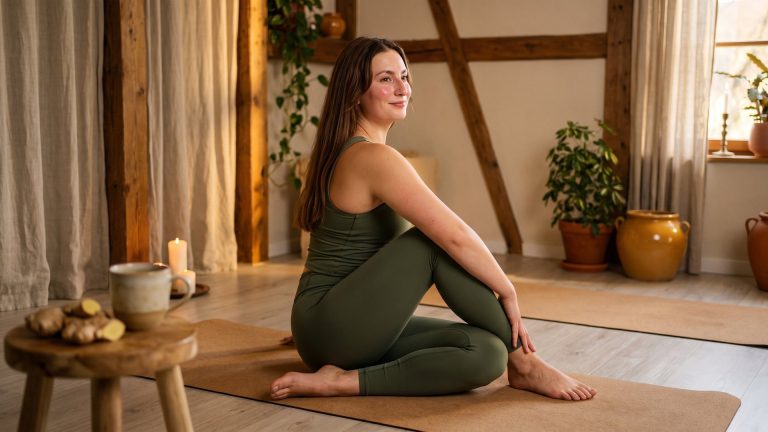
After several rounds of standard cat-cow, add a variation that brings rotation into the spinal warmup.
From a neutral Tabletop position, on an exhale, slide the right arm under the body towards the left side — threading it through like a needle. The right shoulder rests on the mat, the right cheek (or forehead) touches the floor, and the left arm remains extended for balance or the left hand rests on the left hip. Hold for three to five breaths. Inhale back to Tabletop and repeat on the left side.
Threading the needle adds thoracic rotation — one of the movements most consistently lost with desk work — and provides a gentle opening for the shoulder and chest that cat-cow does not address.
Hip circles in Tabletop are another useful addition: maintaining a neutral spine, trace slow circles with the hips — forward, out to the right, back, out to the left — five circles in each direction. This moves the lumbar spine and sacroiliac joint in all planes simultaneously and often resolves morning stiffness that cat-cow alone does not reach.
Breath-led vs movement-led
There are two ways to practise cat-cow, and both have value.
In breath-led cat-cow, the breath initiates the movement. You begin the inhale, and the body follows — the belly drops because the breath fills it and creates the arch. This version is more meditative and connects the physical practice to the pranayama tradition. It produces a calmer, more receptive state.
In movement-led cat-cow, the body moves and the breath follows. This version is often faster, more exploratory, and feels more like physical mobilisation. It is useful when the body is particularly stiff and needs mechanical movement before the breath connection can be felt clearly.
Begin with movement-led on very stiff mornings, then transition to breath-led as the spine loosens.
Building a 5-minute morning ritual
Five minutes of cat-cow in the morning does not require waking earlier, changing clothes, or arranging a practice space. It requires a surface, a few minutes before standing up from bed or immediately after.
A simple structure:
- 1 minute: Neutral Tabletop. Feel the weight of the hands on the floor, the temperature of the room, the quality of the breath. Nothing to do yet — just arrive.
- 2 minutes: Breath-led cat-cow, moving slowly. Follow every vertebra.
- 1 minute: Threading the needle, three to five breaths per side.
- 1 minute: Hip circles in Tabletop, five each direction, then return to neutral.
Finish by pressing back into Child’s Pose for three breaths before standing. From Tabletop to standing in five minutes — and the spine that greets the day is markedly different from the one that woke up.
Frequently Asked Questions
Can I do cat-cow if I have a herniated disc?
Cat-cow is often recommended for back health, but whether it is appropriate for a herniated disc depends on the location of the herniation and the direction it is pressing. Some disc herniations are worsened by spinal flexion (Cat); others by extension (Cow). Please consult your physiotherapist or GP before practising any spinal movement with a known disc herniation.
How many repetitions should I do?
There is no exact prescription. In five minutes at a slow breath-led pace, you will complete roughly fifteen to twenty cycles — which is sufficient for a meaningful warm-up. More is not necessarily better; quality and attention matter more than volume.
Should I do cat-cow before or after exercise?
Cat-cow is an excellent warm-up before any physical activity. It can also be used as a stand-alone practice and — carefully, gently — as a cool-down movement after exercise to release spinal tension.
My wrists hurt in Tabletop. What can I do?
Fold a blanket and place it under the heels of the hands to reduce wrist extension. Alternatively, come onto the fists (knuckles to the mat) which keeps the wrist in a more neutral position. Making fists can feel unusual at first but is completely effective and joint-friendly.
Is cat-cow the same in every yoga style?
The basic movement is the same, but the pacing and emphasis differ. In vinyasa flow, cat-cow is often done quickly. In Hatha yoga, it is slower and more deliberate. The slow, breath-led version described in this post provides the deepest spinal benefit.
Cat-cow is a foundation of our Hatha yoga classes — come and practise it properly, with guidance, in a warm and quiet studio. Book tomorrow’s Hatha class →
About the author
Tanya is a Yoga Alliance RYS 200 certified yoga teacher (ID 252157), trained at Devvrat Yoga School in Varkala, India (December 2025). She teaches Hatha and Yin yoga at Your Ritual Yoga in Golders Green, NW11 — a small, intentional studio where every class includes sound healing with Himalayan singing bowls and a post-class herbal tea ritual. www.ritual-yoga.co.uk