You’ve decided to try yoga. Maybe you’re seeking stress relief, hoping to sleep better, wanting to increase flexibility, or simply curious about what yoga actually is. Whatever your reason, you’re probably a bit nervous about your first class.
This is completely normal. Most first-time yoga students feel some combination of excitement, curiosity, and apprehension. Will you be the only beginner? Will you have to wear special clothes? Will the poses be too hard? Will you look silly?
This comprehensive guide will ease your concerns, prepare you practically and psychologically, and set you up for an excellent first yoga experience.
Why Yoga Might Feel Intimidating (And Why It’s Not)
Let’s be honest about common first-class fears:
“Everyone will be advanced and I’ll be behind”
Reality: Most people in beginning classes are beginners. Teachers always offer modifications. Your practice is for you, not for comparison.
“I’ll be the only beginner”
Reality: There’s always someone new. And honestly? Everyone in the room remembers being a beginner. There’s no judgement.
“I’m too inflexible/overweight/old/unfit for yoga”
Reality: These are exactly the people yoga helps most. Yoga meets you where you are. Modifications exist for every pose.
“I’ll feel silly doing strange poses”
Reality: Within minutes, you’re too focused on your body and breath to worry about how you look. Everyone’s focused on themselves.
“I don’t understand yoga philosophy or terminology”
Reality: A good teacher explains everything. You don’t need prior knowledge. You’ll learn as you go.
“I have an injury/physical limitation”
Reality: Tell your teacher. Yoga has modifications for every condition. In fact, personalised yoga often helps injuries.
The truth? Yoga studios are among the most welcoming, non-judgemental spaces you’ll encounter. People are there for personal practice, not to judge others.
Choosing Your First Class
Type of Yoga
Your first choice is between Hatha and Yin yoga:
Hatha Yoga:
– More active, engaging movement
– Slower pace than some styles
– Good for building strength and flexibility
– Good first experience of yoga as physical practice
Yin Yoga:
– Deep relaxation and extended holds
– Deeply calming
– Good for stress relief and nervous system reset
– Good if you’re seeking relaxation versus active engagement
Recommendation for first-timers: Start with Hatha yoga. It’s more engaging and gives better sense of what yoga is. You can try Yin later.
Beginner or All-Levels Class?
Beginner classes: Slower pace, more instruction, more modifications. Best for first-timers.
All-levels classes: Mix of experience levels, assumes some familiarity. Better for second or third class.
Recommendation: Look for beginner classes if available. All-levels classes work too—just let the teacher know it’s your first time.
Studio Choice
Large studios: More classes, variety, potentially less personal attention.
Small studios: Smaller classes, more personalised attention, community feel.
Recommendation: Small studios (like Your Ritual Yoga in Golders Green) provide better first-class experience through personalised attention.
Practical Preparation
What to Wear
Wear comfortable clothing you can move in:
– Ideal: Yoga pants or leggings + tank top or t-shirt
– Fine too: Comfortable shorts + shirt
– Avoid: Jeans, overly tight clothing, anything restrictive
The idea is to move freely without clothing being a distraction.
First-class tip: Don’t overthink this. Wear comfortable, moveable clothes you already own. Don’t buy special yoga clothes for your first class.
What to Bring
Essential:
– A water bottle
– Yourself with open mind
Optional but helpful:
– Your own yoga mat (studios provide these)
– Small towel
– Any props you might need (back support, wrist support, etc.)
That’s it. You don’t need anything else.
How to Prepare
The night before:
– Get good sleep
– Avoid heavy meals
– Review mentally—you’re just going to try something new
The morning of (for morning class) or day of:
– Eat lightly or skip eating 1-2 hours before class
– Drink water throughout the day
– Wear clothing prepared the night before
– Arrive with 5-10 minutes to spare
Mentally:
– Release expectations about how yoga “should” be
– Come with curiosity, not judgement
– Remember: everyone started as a beginner
– Your only job is to show up and try
Arriving at the Studio
You’ll likely feel a bit nervous walking in. This is normal. Here’s what typically happens:
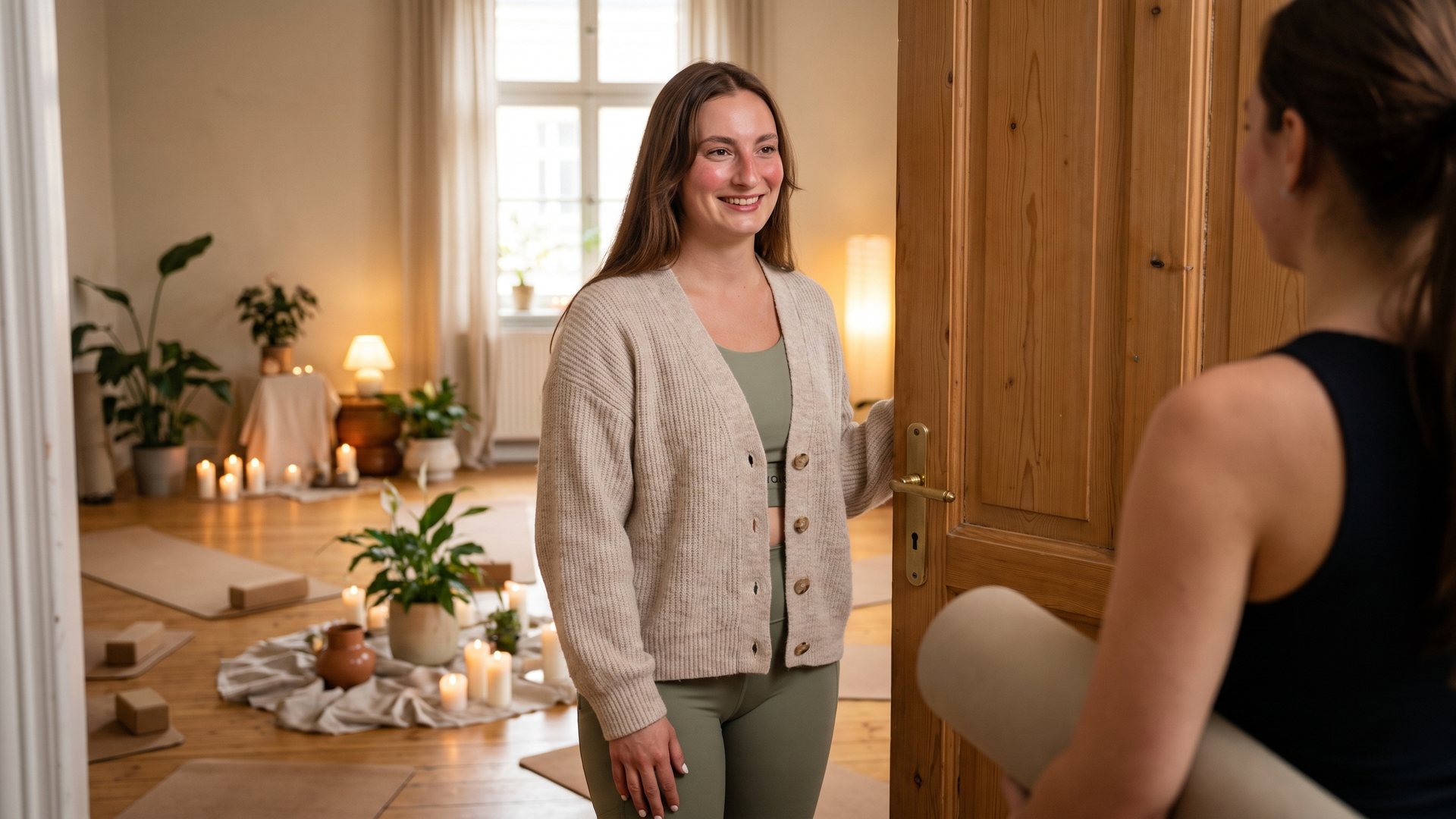
- Reception: You’ll be greeted warmly. Tell them it’s your first class.
- Paperwork: You might fill out a simple form (health history, emergency contact).
- Studio: You’ll enter the yoga space—likely calm, warm, peaceful. You might feel your nervous system settle immediately.
- Mat placement: You’ll set up your mat. Don’t worry about placement—anywhere is fine.
- Settling: Sit quietly, notice your breath, relax. Class typically starts in 5-10 minutes.
What Happens During Your First Class
Opening (5-10 minutes)
The teacher guides everyone into a comfortable seated position. You’ll likely:
– Close your eyes
– Focus on breathing
– Hear a brief introduction and intention-setting
This opening helps your mind shift from daily life into practice. It’s preparing you psychologically for what’s coming.
Warm-up (5-10 minutes)
You’ll begin with gentle movements—shoulder rolls, neck stretches, cat-cows. The teacher is:
– Warming up your muscles
– Getting you moving consciously
– Preparing your body for deeper practice
Main Practice (30-45 minutes)
This is the heart of class. You’ll move through:
– Standing poses (building strength and balance)
– Seated or floor poses (deepening stretches)
– Possibly some flows (moving with breath)
The teacher will:
– Demonstrate each pose
– Walk around observing students
– Offer modifications for different levels
– Provide alignment cues
– Adjust your pose if helpful
Your job: Follow along, use modifications when needed, listen to your body, ask questions anytime.
Important: Every pose has variations. If a pose doesn’t feel right, skip it or use a modification. Your teacher will show options.
Breathing Work & Meditation (5-10 minutes)
Before final relaxation, you might practice:
– Conscious breathing techniques
– Guided meditation
– Body awareness
This transitions you from active practice towards relaxation.
Shavasana (10-15 minutes)
The final pose—complete relaxation. You lie on your back, fully supported, arms at your sides, legs extended. Your job is simply to relax and observe.
At Your Ritual Yoga, this is when singing bowl sound healing happens. You’ll hear resonant tones deepening your relaxation.
Many first-time students report that Shavasana is their favourite part—a profound peace they might not have experienced in years.
Closing & Tea Ritual (5-10 minutes)
Slowly, you’re invited back to consciousness. The teacher might offer closing words or gratitude. You slowly sit up.
Then you move to the tea space (if available). You have herbal tea, chat with other students, gradually transition back into your day.
This gradual transition is important—you don’t want to jump from deep relaxation directly into chaos.
What You’ll Actually Experience
Physical Sensations
During practice:
– Warmth in muscles as you move
– Stretching sensation in muscles being stretched
– Energy or aliveness in your body
– Breath becoming deeper and more natural
During Shavasana:
– Progressive relaxation as muscles release
– Heaviness in your body
– Tingling, warmth, or other sensations
– Deepening calm
Mental Experience
During practice:
– Mind might be busy initially, then settle
– Focus on what’s happening in your body
– Less thinking, more present awareness
– Possibly some emotions surfacing
During Shavasana:
– Mind becomes very still
– Peaceful, meditative quality
– Possible mental silence (very peace-filled)
– Time might seem to disappear
Emotional Experience
During & after:
– Calm and peaceful
– Possibly lighter or less burdened
– Possibly emotional (this is normal—yoga releases emotions)
– Sense of care and support from the teacher and space
Physical Effects (After Class)
Most first-time students notice:
– Relaxed muscles
– Calm nervous system
– Increased flexibility immediately
– Better posture
– Lighter mood
– Often, excellent sleep that night
Frequently Asked First-Time Questions
Q: Is it okay to modify poses?
A: Yes, absolutely. Modifications make every pose accessible. Using modifications is intelligent practice.
Q: What if I need to leave early?
A: Let your teacher know at the beginning. You can leave, though we encourage staying for Shavasana and tea.
Q: What if I feel emotional?
A: Completely normal. Yoga releases emotions. We create safe, non-judgemental space for whatever arises. Your emotions are welcome.
Q: What if I’m hungry/thirsty?
A: Light snack 30 minutes before is fine. Avoid large meals 2 hours before. Water is fine. Avoid other drinks.
Q: What if I’m too sore to come back?
A: Mild soreness is normal after first class (like beginning any new activity). It typically subsides within days. This soreness means your muscles are working—a good sign.
Q: What if I fall asleep in Shavasana?
A: That’s fine. Your body might need sleep. You’ll still receive benefits.
Q: Will I be able to do this?
A: Yes. Yoga is designed for every body. The teacher will offer modifications ensuring the practice is accessible to you.
Tips for Maximum First-Class Benefit
Mental Approach
Release perfectionism: You’re not trying to achieve anything. Yoga isn’t about perfect poses.
Approach with curiosity: Notice what happens. Observe without judgement.
Let go of comparison: Your practice is uniquely yours. Don’t compare to others.
Trust the process: Even if it feels “soft” or “easy,” benefits are real.
Physical Approach
Listen to your body: Your body is your best teacher. Honour its signals.
Use modifications: They’re not “easier”—they’re smarter practice.
Breathe consciously: Focus on breathing. This is more important than achieving perfect poses.
Move slowly: Slow, mindful movement is more powerful than quick movement.
Practical Approach
Arrive early: Gives you time to settle and reduce nervousness.
Tell the teacher: “Hi, it’s my first class” or note it on any form. They’ll give extra attention.
Stay for the whole class: Especially Shavasana, which is often most transformative.
Participate in tea ritual: This community element is special and supports integration.
Go back: Benefits increase with consistency. Try 3-4 classes before deciding if it’s for you.
After Your First Class
Immediate Aftereffects
Most students feel:
– Deep relaxation
– Calm mind
– Lighter body
– Better mood
– Sense of peace
Enjoy this feeling. It will extend into your day.
Recovery
You might experience:
– Mild soreness next day (good sign—muscles worked)
– Better sleep that night
– Less stress next day
– Improved focus and clarity
All are normal, positive effects.
What to Do Next
If you felt good:
– Book another class
– Aim for 2-3 classes weekly
– Notice cumulative benefits
If you had questions:
– Ask your teacher next class
– Don’t be shy—teachers love questions
– Read the FAQ section on our website
If something felt off:
– Tell the teacher
– Maybe try a different style (Hatha vs. Yin)
– Give it at least 3 classes before deciding
– Consider personal training if group classes don’t feel right
Setting Realistic Expectations
Don’t expect:
– To be flexible after one class
– To be an expert immediately
– To understand everything right away
– To feel perfect always
Do expect:
– Noticeable calm after your first class
– Gradual physical improvements over weeks
– Growing appreciation for practice
– Real transformation within 4-8 weeks
– Increasing ease and peace over months
The First Class Is Just the Beginning
Your first yoga class is not the goal—it’s the beginning of something that might profoundly transform your life. Most people who stick with yoga report that it’s among the most valuable practices they’ve undertaken.
The nervous system regulation, the physical benefits, the mental clarity, the emotional processing, the spiritual opening—these unfold over consistent practice, not in a single class.
So embrace your first class not as a test to pass, but as an invitation to a journey that could genuinely transform how you experience your body, your mind, your emotions, and your life.
You’ve got this.
About Tanya
Tanya is a Yoga Alliance RYS 200-certified Hatha and Yin yoga teacher (Reg. ID 252157), trained at Devvrat Yoga School in Varkala, India (200-hour intensive, December 2025) under Rakesh Kumar. She teaches small-class, ritual-led Hatha and Yin yoga in Golders Green, NW11 London — integrating singing-bowl sound healing in Shavasana and a post-class herbal tea ritual.
Read more about Tanya · See the weekly schedule · Enquire about private sessions