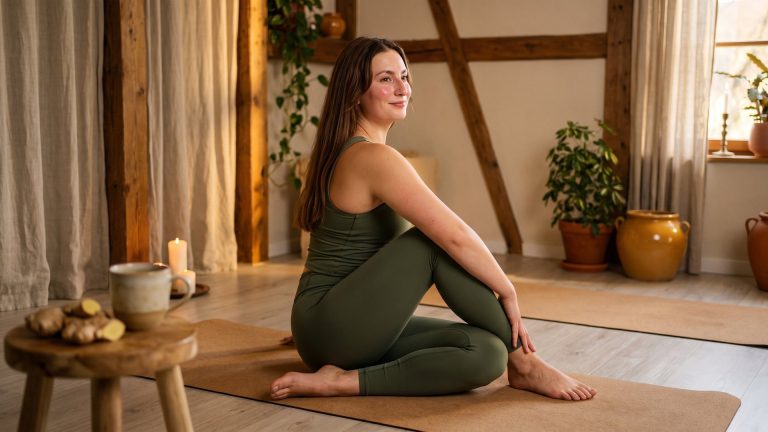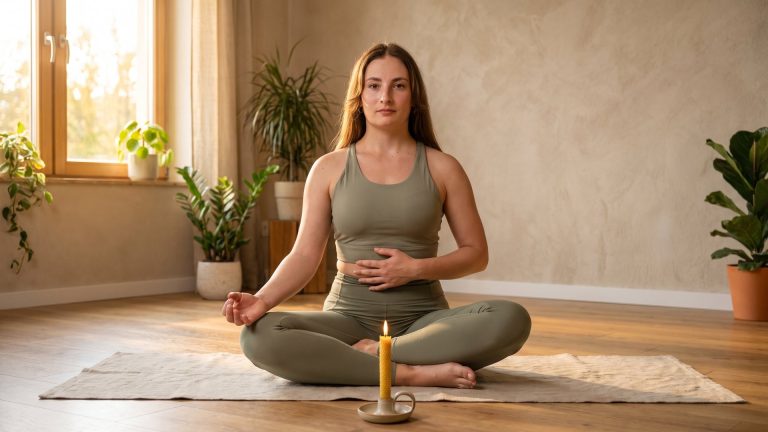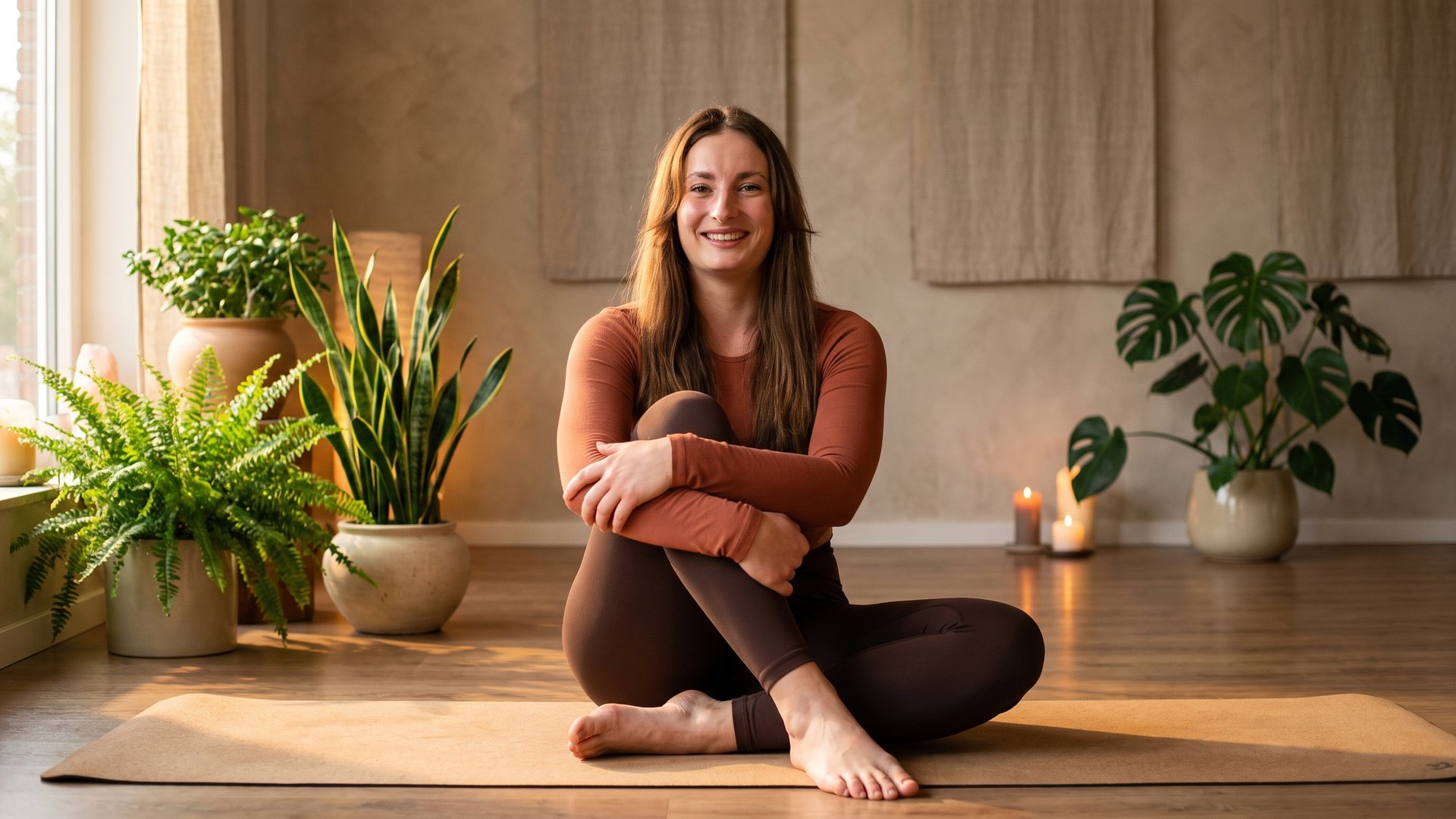
Written by Tanya — Yoga Alliance RYS 200 (ID 252157), trained at Devvrat Yoga School, Varkala, India (December 2025). Tanya teaches Hatha and Yin yoga at Your Ritual Yoga in Golders Green, NW11.
The conversation about yoga body image usually begins somewhere familiar: a person who has been curious about yoga for months, or years, who has watched the videos and read the posts and thought “I would love to try that” — and then has not gone.
Not because of logistics. Not because of cost. But because of a quiet, persistent voice that says: not yet. When you are lighter. When you are more flexible. When you look more like the people in those photos.
This post is for that person.
The ‘I’ll start when I’m…’ trap
The “I’ll start when I’m ready” delay has a particular quality. Unlike ordinary procrastination — which tends to be about the task feeling difficult or boring — this version is about the self feeling insufficient. The task (going to a yoga class) is actually appealing. What feels insufficient is the body that would walk through the door.
It is worth naming what has created this: the visual language of mainstream yoga marketing. A decade of carefully lit images — slim bodies in advanced poses, a narrow range of shapes and sizes presented as the “yoga body” — has attached itself to the idea of yoga practice and convinced many people that they need to earn their place on the mat through prior self-improvement.
This is both historically false and practically harmful.
Yoga, in its traditional conception, has no prerequisites of appearance. The ancient texts do not describe a body that yoga is for. Patanjali’s Yoga Sutras — the foundational text of classical yoga — are concerned entirely with the mind. The word “asana,” in its original use, meant simply “a steady, comfortable seat.” The physical practice as we know it developed over centuries as a support for the internal work, not as its own aesthetic endpoint.
The modern idea that you need to look a certain way to practise is a cultural overlay. It is not yoga.
What a body-affirming studio looks like
Knowing this intellectually does not make walking through a strange studio door any easier. The environment matters. The teacher matters. The composition of the room matters.
A studio that genuinely welcomes all bodies tends to share certain characteristics:
The language of the website and marketing. Does the studio use a narrow range of body types in its imagery? Does the copy speak about “transforming your body” and “getting toned”? Or does it speak about breath, rest, and nervous-system regulation — language that is not contingent on a particular body shape? This tells you something significant about the studio’s values before you arrive.
The physical environment. Mirrored walls are common in many fitness studios and in some yoga spaces. Mirrors direct attention outward — to the appearance of the pose rather than the inner experience of it. A studio without mirrors, or that encourages you to close your eyes during many poses, is prioritising inward attention. For anyone working with body-image discomfort, this is a meaningful difference.
Class size. In a very large class, the teacher cannot see everyone clearly and students often spend significant time watching and comparing themselves to others. In a small, intimate class, the teacher can offer individual attention and the dynamics of comparison have less room to operate. Smaller is generally more supportive for new students.
What the teacher says about modifications. A teacher who presents the “full expression” of a pose as the goal and modifications as “if you can’t do the pose” is, however unintentionally, creating a hierarchy of ability. A teacher who presents modifications as different tools for different bodies — all equally valid — understands yoga differently.
Telltale signs a studio isn’t for you
It is reasonable to change your mind after a first visit. Signs that a studio may not be the right environment for you include: a teacher who cues with “sucking in your stomach” or “tone your core” as aesthetic instructions rather than anatomical ones; a room where you feel watched or compared unfavourably; a culture of before-and-after framing, weight loss, or body “fixing.” Trust the felt sense of how you feel when you leave. If you feel worse about yourself than when you arrived, that studio is not for you.
Modifications, props, and the seat closest to the door
Modifications are not consolation prizes. They are intelligent adaptations — the application of yoga’s core principle of ahimsa (non-harming) to your own body.
A block under the hand in a standing forward fold is not evidence that you “can’t do” the pose. It is the pose, made appropriate for your structure today. A bolster under the knees in Savasana is not a crutch — it is precision. The person who uses a chair in a balance pose is practising the same essential skill — finding steadiness — as the person who does not. The form is different. The practice is the same.
Props exist to bring the pose to the body, not to coerce the body into a pose. This distinction is not semantic. It changes what you are practising: receiving versus forcing, softening versus controlling.
And the seat closest to the door? Take it if you want it. Many experienced students choose the back corner because they prefer to follow their own rhythm without feeling observed. There is no prestige gradient in where you place your mat.
Permission slips for the first month
The first month of yoga practice has its own particular texture. Nothing feels natural yet. The body is unfamiliar with the shapes, the breath instructions feel slightly theoretical, the names are foreign, and the culture of the room is still being learnt. This is normal. This is what being new to anything feels like.
Here are some permissions that might be useful to hold onto:
You do not need to look like you know what you are doing. Every experienced practitioner in any yoga class was once entirely lost. The ones who look confident now simply had more Tuesdays on a mat.
You are allowed to rest. Coming out of a pose early, choosing Child’s Pose, or lying in Savasana when the class is still moving is always available to you. A good teacher will not make you feel that you have failed by resting. Rest is yoga.
You are allowed to hate some poses. Not every pose will feel good or make sense in your body. This is data, not failure. Note it and return.
You are allowed to come back without being consistent. “I missed three weeks” is not a reason not to return. Yoga is not a reward for perfect attendance. The mat holds its welcome without conditions.
Your body is not a project. It is not a before-and-after. It is the means through which you experience your life, and it is worthy of care right now, as it is, without improvement.
Body-neutrality over body-positivity
A word about body-positivity: it is a generous idea, but for many people, “love your body” is a feeling that does not arrive on demand. The pressure to feel positive about a body you have been struggling with can add another layer of failure.
Body-neutrality is a different approach. It asks not that you love or even feel good about your body, but simply that you allow it to be. You practise yoga not to feel beautiful but to feel something. To breathe. To move. To rest. To arrive.
This is a quieter ask. It is also, for many people, a more reachable one.
Frequently Asked Questions
What if I am the largest person in the room?
You may be. And you may find that after twenty minutes of practising, you have entirely forgotten about it — because yoga, when it is working, directs attention inward. If a studio environment makes you consistently conscious of your size in ways that feel unkind, find a different studio.
Will the teacher make me do things I cannot do?
A good yoga teacher will never force or push a student further than their body allows. You always have the option to modify, rest, or skip a pose. Make sure your teacher knows of any injuries or areas of sensitivity before class.
Do I need to be flexible to start yoga?
This question comes up constantly, and the answer is the same every time: no. Flexibility is not a prerequisite for yoga — it is sometimes a result of it. People begin yoga with every degree of flexibility. The practice meets you where you are.
What should I wear?
Comfortable, stretchy clothing that allows movement. Nothing beyond that matters. Bare feet are the norm. There is no required aesthetic.
I am not sure I am the yoga “type.” Is this studio for me?
At Your Ritual Yoga, there is no type. We are a small, quiet studio for anyone who needs permission to slow down — whatever their background, body, or experience level. Come as you are. Visit our studio and see if it feels right.
Our studio in Golders Green is small, quiet, and genuinely non-competitive. If you have been waiting until you were “ready,” you already are. Visit our small, no-pressure studio →
About the author
Tanya is a Yoga Alliance RYS 200 certified yoga teacher (ID 252157), trained at Devvrat Yoga School in Varkala, India (December 2025). She teaches Hatha and Yin yoga at Your Ritual Yoga in Golders Green, NW11 — a small, intentional studio where every class includes sound healing with Himalayan singing bowls and a post-class herbal tea ritual. www.ritual-yoga.co.uk