Written by Tanya — Yoga Alliance RYS 200 (ID 252157), trained at Devvrat Yoga School, Varkala, India (December 2025). Tanya teaches Hatha and Yin yoga at Your Ritual Yoga in Golders Green, NW11.
Yoga for lower back pain is one of the most searched wellness topics in the UK — and for good reason. Lower back pain affects roughly 80% of adults at some point in their lives, and the majority of cases are muscular and mechanical in origin. That means movement, done thoughtfully, is often exactly what the body needs.
This guide walks through eight poses that support the lower back, explains three that frequently cause more harm than good, and helps you understand how to practise safely. If your pain is persistent, radiating, or accompanied by any neurological symptoms, please speak with your GP or physiotherapist before beginning a new movement practice.
1. Why Most Lower Back Pain Is Muscular and Mechanical
The lumbar spine — the five vertebrae that form your lower back — is designed to bear load, flex, extend, and rotate. When we sit for hours, stand unevenly, or carry tension without release, the muscles surrounding those vertebrae (the erector spinae, quadratus lumborum, glutes, and hip flexors) become either over-tight or under-active. The result is the familiar ache: dull, diffuse, sometimes sharp on one side, often worse first thing in the morning or after long periods of sitting.
This muscular-mechanical category of back pain responds well to gentle, targeted movement. The goal is not to “fix” the spine — the spine is almost certainly fine — but to release the soft tissue that surrounds it, restore mobility, and re-engage the deep stabilising muscles that protect it.
What yoga adds that simple stretching does not: breath. When you breathe consciously into a posture, you activate the diaphragm, which directly influences intra-abdominal pressure and releases the deep psoas muscle — one of the most underappreciated contributors to lower back pain.
A note before we begin: the poses below are suitable for common, non-specific lower back pain. They are not a replacement for medical assessment. If you have a diagnosed disc herniation, spinal stenosis, spondylolisthesis, or any condition affecting the nerves of the spine, please work with a physiotherapist or a yoga teacher trained in therapeutic application before attempting any of these independently.
2. The 8 Poses, Step-by-Step
Cat-Cow (Marjaryasana-Bitilasana)
Perhaps the most accessible movement for the lumbar spine, cat-cow gently mobilises every segment of the spine and warms the surrounding musculature before anything more demanding.
Begin on all fours with wrists under shoulders and knees under hips. On an inhale, let the belly drop, the tailbone lift, and the chest open — this is cow. On an exhale, press the floor away, round the spine towards the ceiling, and tuck the chin gently — this is cat. Move slowly, linking each phase of the breath to each phase of movement.
Do 8–10 rounds. There is no rush. The slower you go, the more you will feel each vertebra respond.
Why it helps: The rhythmic flexion and extension pumps synovial fluid into the facet joints, releases the erector spinae on the flexion phase, and gently stretches the thoracolumbar fascia.
Child’s Pose (Balasana)
Bring the big toes together, take the knees as wide as feels comfortable, and fold forward, extending the arms in front of you or resting them alongside the body. Allow the forehead to soften towards the floor.
Hold for 1–3 minutes, breathing into the lower back. With each exhale, notice the lower back gently widening.
Why it helps: Child’s pose creates a long, passive traction through the lumbar spine, releasing the compression that accumulates from upright sitting. The wide-knee variation also opens the inner groin and hip flexors, which often contribute to lower back tension when tight. See our full guide to Yin Yoga for more long-hold postures that work this way.
Sphinx Pose (Salamba Bhujangasana)
Lie on your front. Place your forearms on the floor with elbows under shoulders. Gently press the forearms down and lengthen through the crown of the head, allowing the chest to lift without forcing. The pubic bone and legs remain in contact with the floor.
Hold for 1–2 minutes, breathing naturally.
Why it helps: Sphinx is a gentle backbend — a movement most of us have almost completely removed from our daily lives. It strengthens the deep spinal extensors, opens the hip flexors (particularly the psoas), and, for people whose pain is exacerbated by sitting, may provide significant immediate relief by reversing the predominant spinal position of the day.
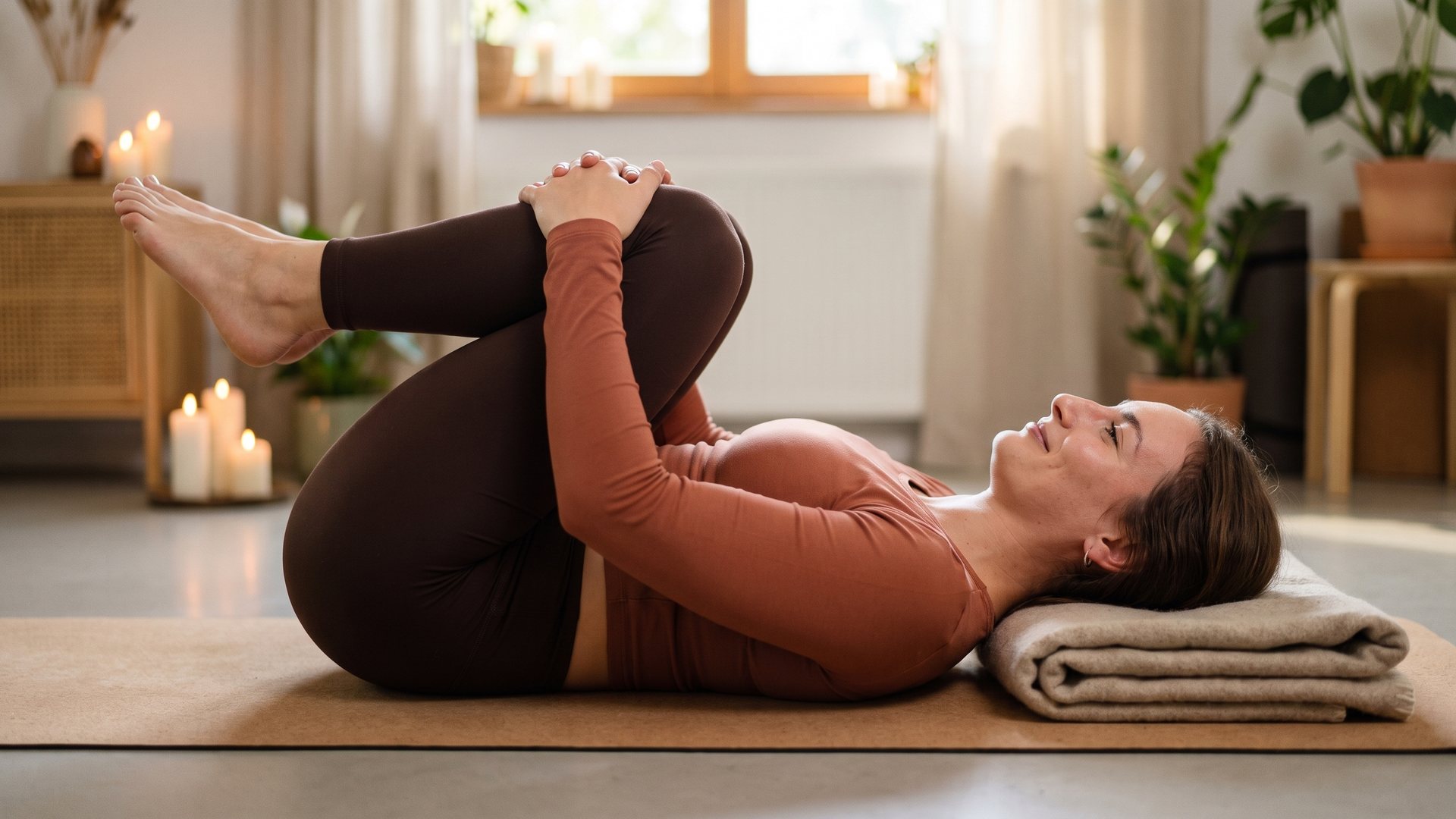
Supine Twist (Supta Matsyendrasana)
Lie on your back. Draw one knee into the chest, then guide it across the body while extending that arm along the floor. The gaze can soften to the opposite side. Keep both shoulders grounded — it matters more that the shoulders stay down than that the knee reaches the floor.
Hold 1–2 minutes per side.
Why it helps: Rotation is one of the most neglected movements in everyday life and one of the most nourishing for the lumbar spine. A supine twist releases the quadratus lumborum (often the primary site of one-sided back pain), the outer hip, and the thoracolumbar fascia. Because the body is supported by the floor, it can soften fully rather than bracing.
Bridge Pose (Setu Bandha Sarvangasana)
Lie on your back with knees bent and feet hip-width apart, flat on the floor. On an inhale, press the feet down and lift the hips, lengthening through the spine. Hold for 5 breaths, then lower slowly on an exhale. Repeat 3–5 times.
Why it helps: Bridge is one of the best poses for re-engaging the glutes — the large posterior muscles that are often under-active in people who sit for long periods. When the glutes don’t do their job, the lower back muscles compensate and become chronically overworked. Even a few rounds of bridge per day can meaningfully shift this pattern over time.
Supported Fish (Matsyasana Variation)
Place a rolled blanket or bolster horizontally across the mat. Sit just in front of it and gently recline so the support lands between the shoulder blades. The head can rest on a block or second folded blanket so the neck is comfortable. Arms rest by the sides or open wide. Legs can be extended or soles of feet together.
Hold for 3–5 minutes.
Why it helps: This is a passive backbend that opens the chest, reverses thoracic rounding, and — crucially — softens the psoas through surrender rather than effort. It is particularly useful for people whose lower back pain is linked to forward-collapsed posture and shallow breathing.
Legs Up the Wall (Viparita Karani)
Sit sideways to a wall, then swing the legs up as you lower the back to the floor. Adjust so the backs of the legs rest against the wall and the hips are a few inches from the baseboard. A folded blanket under the hips adds gentle lumbar support for many bodies.
Hold 5–15 minutes with easy, natural breath.
Why it helps: This inversion gently decompresses the lumbar spine by reversing the gravitational load it carries all day. It also activates the parasympathetic nervous system, which means muscle tension held in the lower back — the kind that’s stress-related rather than purely mechanical — has a chance to genuinely release.
Savasana (Corpse Pose)
Lie flat on the back with legs extended, feet falling open, arms resting away from the body with palms face-up. If the lower back aches in this position, place a rolled blanket under the knees. Allow the body to be completely still.
Hold for 5–10 minutes.
Why it helps: Savasana is often underestimated as a therapeutic tool. It allows the nervous system to integrate everything that has come before. Lower back muscles that have been gently stretched and mobilised can finally let go when the body feels fully safe and still. Do not skip it.
3. The 3 Poses to Avoid (or Modify Heavily)
Why Deep Forward Folds Backfire
Seated forward folds — particularly with straight legs — place the lumbar spine under significant load in flexion. For people with healthy, mobile hamstrings and a neutral lower back, this is manageable. For people who are already in pain, whose lower backs are already rounded and compressed, folding deeply forward can worsen symptoms, particularly if there is any disc involvement.
The modification: always bend the knees generously in a forward fold when the lower back is tender. The goal is to lengthen the spine, not to touch the toes. A long back with bent knees is far more therapeutic than a rounded back with straight legs.
Poses to treat with caution: Paschimottanasana (seated forward fold), Uttanasana (standing forward fold), and any intense hamstring stretch that demands a flat lower back.
Boat Pose and Strong Abdominal Loading
Navasana (boat pose) and any crunching, curling movement that repeatedly flexes the spine under load can aggravate lower back pain, particularly in its acute phase. The hip flexors — which are often already shortened and over-active in people with back pain — are the prime movers in these shapes, which can increase compressive load at the lumbar segments.
This is not to say core strengthening is irrelevant to back pain. It is very relevant. But the entry point should be gentler: bridge pose, bird-dog on all fours, and slow spinal extensions before any loaded flexion.
Red-Flag Symptoms — Radiating Pain, Numbness
The two poses above address mechanical concerns. But there is a more important category: symptoms that suggest the nervous system is involved rather than simply the muscles.
If you experience any of the following, please stop practising independently and see a medical professional:
- Pain that radiates from the lower back down one or both legs, particularly below the knee
- Numbness, tingling, or weakness in the legs or feet
- Lower back pain associated with loss of bladder or bowel control (this is a medical emergency — seek immediate care)
- Pain that is worse at night and not relieved by any position
- Back pain following a fall, collision, or trauma
These symptoms suggest possible nerve involvement, disc pathology, or — rarely — something more serious that requires proper assessment. A yoga class is not the right first response to these symptoms.
4. How Often, How Long
For common muscular lower back pain, a daily gentle practice of 15–20 minutes is more effective than an occasional longer session. Consistency matters more than intensity.
A simple daily structure:
– Cat-cow — 2 minutes
– Child’s pose — 2 minutes
– Sphinx — 2 minutes
– Bridge — 2 minutes (3–5 rounds)
– Supine twist — 2 minutes each side
– Legs up the wall — 5 minutes
That is roughly 17 minutes. Done daily, most people notice meaningful change within 2–3 weeks.
If you are joining a yoga class — which offers the advantage of proper alignment guidance — a twice-weekly Yin or Hatha class alongside a short daily home practice is a sound approach. Our Yin classes are particularly well suited to lower back care because of the long passive holds that allow connective tissue to genuinely soften.
5. When to See a Physio or Doctor
Yoga is a supportive tool for common lower back pain, not a first-line medical treatment. Consider seeing a physiotherapist or GP if:
- Pain has persisted for more than 6 weeks without improvement
- Pain is severe enough to significantly limit daily function
- You have any of the red-flag symptoms described above
- Pain began following an injury
- You are unsure what is causing your pain
A good physiotherapist and a thoughtful yoga teacher work well together. Many students at Your Ritual Yoga come with physio notes and find that the slow, breath-centred approach of Hatha and Yin complements their rehabilitation. Personal training sessions allow us to tailor every posture to your specific situation, working around any restrictions your physiotherapist has identified.
For desk workers whose lower back pain is linked to long hours of sitting, our post on yoga for desk workers walks through additional strategies.
Frequently Asked Questions
Q: Can yoga make lower back pain worse?
A: It can, if the wrong poses are chosen or if pain is severe and requires medical attention first. As a general rule, if a pose produces sharp, shooting, or radiating pain, come out of it. Dull discomfort that eases as you hold a stretch is normal; pain that worsens is not. When in doubt, work with a teacher rather than from a screen.
Q: Is Yin or Hatha yoga better for lower back pain?
A: Both can help, and they work in complementary ways. Hatha builds gentle strength and mobility through active postures. Yin targets the connective tissue — fascia, ligaments — through long passive holds. Many people with lower back pain benefit from both: Hatha to strengthen the supporting muscles, Yin to release the deep tension in the hip flexors, glutes, and lumbar fascia. Our Yin Yoga page has more detail.
Q: How long before I notice a difference?
A: With a consistent daily practice, most people with common muscular back pain notice some reduction in stiffness within 1–2 weeks. Meaningful, lasting change in the tissue typically takes 6–12 weeks. This is not a quick fix — it is a practice.
Q: Should I do yoga during a flare-up?
A: Gentle movement is generally better than complete rest for non-specific back pain, even during a flare. The key word is gentle: cat-cow, child’s pose, legs up the wall, and savasana are safe starting points. Avoid anything that loads the spine under compression. If the pain is severe or came on suddenly after a movement, rest for 48 hours and see your GP if it does not begin to ease.
Q: Can I join a yoga class if I have back pain?
A: Yes, with caveats. Tell your teacher before class begins so they can offer modifications. A small-group or one-to-one class is ideal for anyone with a specific concern, because a good teacher will adjust postures to your body rather than asking your body to fit the posture. If you would like personal attention for your back, our personal training sessions are designed precisely for this.
Back pain that responds to gentle movement deserves a practice built around it. If you would like one-to-one support — poses chosen for your specific symptoms, adjustments made in real time — enquire about personal training at Your Ritual Yoga.
About the author
Tanya is a Yoga Alliance RYS 200 certified yoga teacher (ID 252157), trained at Devvrat Yoga School in Varkala, India (December 2025). She teaches Hatha and Yin yoga at Your Ritual Yoga in Golders Green, NW11 — a small, intentional studio where every class includes sound healing with Himalayan singing bowls and a post-class herbal tea ritual. www.ritual-yoga.co.uk