Written by Tanya — Yoga Alliance RYS 200 (ID 252157), trained at Devvrat Yoga School, Varkala, India (December 2025). Tanya teaches Hatha and Yin yoga at Your Ritual Yoga in Golders Green, NW11.
The science of sound healing sits in an interesting place: between a long empirical tradition (sound has been used in healing contexts across cultures for thousands of years), a growing body of contemporary research, and a wellness industry that sometimes makes claims considerably beyond what the evidence supports.
This post tries to do something useful: explain what we actually know, be honest about the limits of current research, and help you evaluate what you encounter in studios, online, and on product packaging.
1. The Neuroscience of Sound and the Nervous System
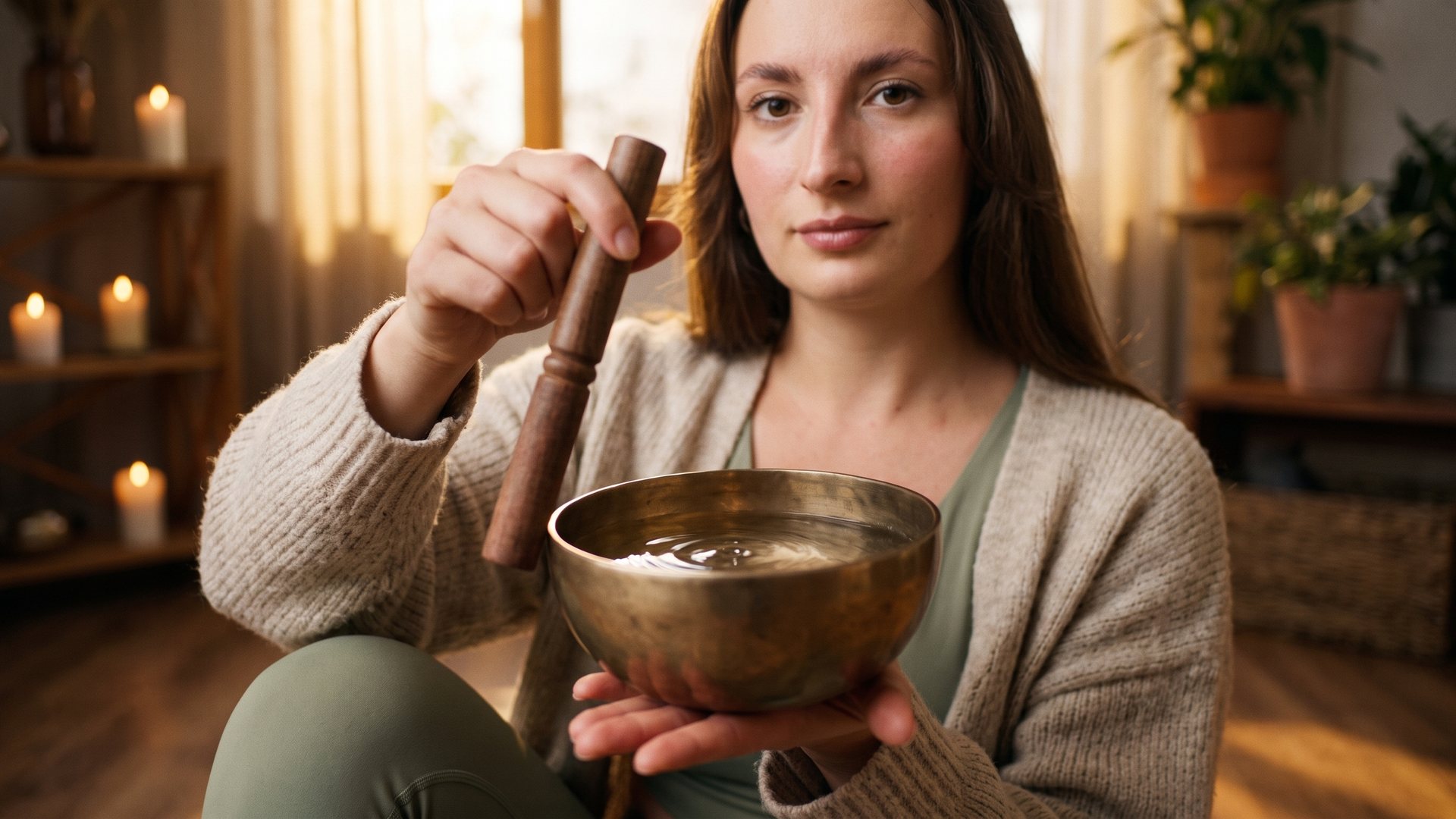
Sound is vibration. When vibration reaches the ears, the cochlea — the fluid-filled spiral structure of the inner ear — converts mechanical movement into electrical signals that travel via the auditory nerve to the brain. But sound does not only enter through the ears. Low-frequency vibrations, particularly those produced by large instruments like Himalayan singing bowls, can be felt as physical sensation through the skin and bones — a phenomenon called tactile sound.
This matters for understanding how sound affects the body, because the pathway is not purely auditory. The vibrational component of singing bowls (which produce frequencies ranging from roughly 40 Hz to 600 Hz depending on the bowl’s size and composition) reaches the body as both heard sound and felt sensation simultaneously.
The autonomic nervous system responds to sound. Sudden loud noises activate the sympathetic response; slow, low, rhythmic sounds tend to have the opposite effect. This is not culturally learned — it is present from infancy. The neurological basis involves the vagus nerve, which has connections to the auditory system via the stapedius muscle of the middle ear. Slow, low-frequency sound appears to activate the myelinated vagal pathway — the branch associated with social engagement, safety, and parasympathetic regulation.
This is one mechanism by which sound may directly influence nervous-system state — not through meaning or association, but through direct neurological pathway.
2. Brainwave Entrainment: What’s Solid
Alpha, Theta, Delta States
The brain produces electrical activity that oscillates at different frequencies depending on mental state. These are broadly categorised as:
- Beta (14–30 Hz): Alert, thinking, analytical — the default state of a working day
- Alpha (8–13 Hz): Relaxed but aware — the state associated with closed-eye rest, light meditation, creative flow
- Theta (4–7 Hz): Deep relaxation, dreaming, the border of sleep — associated with insight, memory consolidation, and deep meditative states
- Delta (0.5–3 Hz): Deep sleep, unconscious — associated with physical repair and immune function
Brainwave entrainment refers to the tendency of the brain to synchronise its electrical activity with external rhythmic stimuli. This phenomenon — also called the frequency following response — is reasonably well documented in the literature. Studies using EEG measurements have shown that exposure to binaural beats (slightly different frequencies played into each ear) and, to a lesser extent, live acoustic instruments, can shift brainwave activity towards the frequency of the external stimulus.
The claim that singing bowls played in Savasana can encourage a shift from beta towards alpha or theta is plausible and supported by some evidence — including a small number of EEG studies showing alpha-wave increases during sound-bath conditions. The research in this area is, however, limited: study sizes are small, controls are difficult to implement, and the specific mechanisms are not fully mapped.
The honest summary: there is evidence suggesting direction, but not definitive clinical proof. The tradition arrived at this effect empirically — thousands of years of people reporting feeling different after singing-bowl sessions — and the contemporary neuroscience is beginning to provide a framework for why.
3. Vagal Tone and the Parasympathetic
Heart-Rate Variability Research
Vagal tone refers to the baseline activity of the vagus nerve. High vagal tone is associated with a range of positive health markers: better cardiovascular regulation, more resilient stress response, better sleep, and more effective emotional regulation. Low vagal tone is associated with chronic stress, inflammation, and a range of health difficulties.
Heart-rate variability (HRV) — the variation in time between successive heartbeats — is a widely used indirect measure of vagal tone. Higher HRV generally indicates better physiological resilience.
Several studies have examined the effect of sound-based practices on HRV. Research on yoga and pranayama consistently shows HRV improvements with regular practice. Studies specifically on singing-bowl meditation have found statistically significant reductions in heart rate and systolic blood pressure compared to control conditions, as well as self-reported reductions in tension, anger, and fatigue.
A 2014 study published in the Journal of Evidence-Based Complementary & Alternative Medicine (Goldsby et al.) found that Himalayan singing-bowl meditation significantly reduced tension and anxiety compared to a silent-rest control, with participants who had no previous meditation experience showing similar effects to experienced practitioners. This is a meaningful finding, though the study was small.
The broader picture: the physiological mechanisms are plausible and partially evidenced. The effects reported by participants are consistently positive. The limitation is the research volume — sound healing has not received the funding that pharmaceutical interventions receive, and the study quality is variable.
4. Where Evidence Ends and Marketing Begins
This is the section that the wellness industry would rather not exist — but it is the most useful.
Claims that are reasonably evidenced:
– Sound-based practices may support relaxation and reduced physiological arousal
– Singing-bowl meditation may reduce self-reported anxiety, tension, and stress
– Sound may influence brainwave activity in the direction of more relaxed states
– Regular sound-based practice may support better sleep onset
Claims that exceed the evidence:
– That specific frequencies cure specific diseases or heal specific organs
– That singing bowls “remove toxins” or “cleanse the aura”
– That 432 Hz tuning is scientifically superior to 440 Hz in meaningful ways (there is no robust evidence for this widely circulated claim)
– That sound healing replaces conventional medical treatment for any diagnosed condition
The marketing around sound healing has outpaced the research. This does not mean the practice is ineffective — it means that some vendors make claims they cannot substantiate, and a discerning person deserves to know the difference.
At Your Ritual Yoga, singing bowls are played during Savasana as part of The Ritual Experience — not because they will cure anything, but because they consistently create a quality of stillness and depth in the final phase of class that nothing else matches. The students who return most consistently say that the Savasana with bowls is the thing they look forward to most. That reported experience is real, whatever the underlying mechanism.
5. How to Evaluate a Sound-Healing Claim
Why Studio Acoustics Matter
Not all sound-healing contexts are equal. A few things worth knowing when evaluating what you encounter:
Instrument quality matters. Himalayan singing bowls vary enormously in quality, composition, and the frequencies they produce. Handmade bronze bowls from Nepal produce a richer, more complex harmonic spectrum than machine-made versions — and the harmonic overtones (multiple frequencies sounding simultaneously) may be part of why live bowls feel different from recordings.
Acoustic environment matters. A room with good natural resonance — stone, wood, high ceilings — allows the sound to behave differently than a dry, carpeted room. This is not metaphysical; it is basic acoustics. The environment in which sound is experienced affects the experience.
Live vs recorded is not the same. Recordings of singing bowls on a phone speaker or even headphones do not replicate the tactile dimension of being in the same room as a bowl being played. The vibration you feel in your sternum when a large bowl is struck nearby is not available through a recording. Both have value; they are different things.
Group vs solo matters in ways that are hard to measure. Shared silence and shared sound create a different quality of experience than individual practice. This is consistent with what is known about social co-regulation — the nervous system’s tendency to synchronise with others in close proximity.
Whose claims? If a practitioner or product claims that sound healing treats cancer, reverses neurological disease, or produces guaranteed outcomes, be sceptical. If they say it may support relaxation, reduce perceived stress, and deepen meditation, that is consistent with the evidence.
Sound healing is at the heart of every class at Your Ritual Yoga — Himalayan singing bowls played live during Savasana, in an acoustically considered studio. Experience it in our weekly classes and form your own view of what it does.
About the author
Tanya is a Yoga Alliance RYS 200 certified yoga teacher (ID 252157), trained at Devvrat Yoga School in Varkala, India (December 2025). She teaches Hatha and Yin yoga at Your Ritual Yoga in Golders Green, NW11 — a small, intentional studio where every class includes sound healing with Himalayan singing bowls and a post-class herbal tea ritual. www.ritual-yoga.co.uk