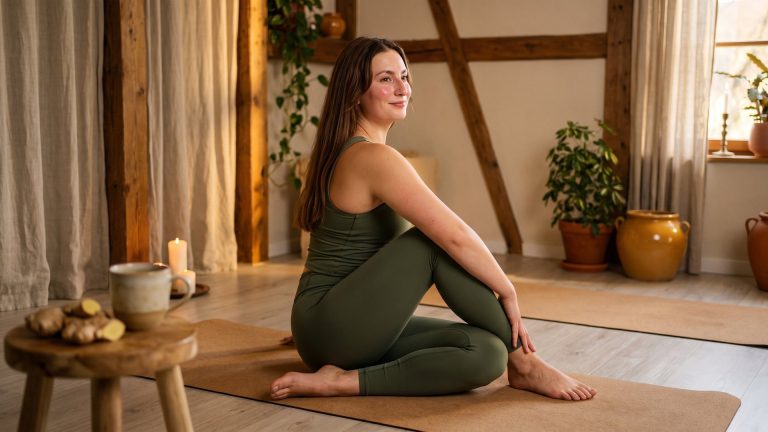
Written by Tanya — Yoga Alliance RYS 200 (ID 252157), trained at Devvrat Yoga School, Varkala, India (December 2025). Tanya teaches Hatha and Yin yoga at Your Ritual Yoga in Golders Green, NW11.
Yoga for burnout is not what many people imagine. It is not a vigorous morning practice that kickstarts a new chapter. It is not a challenging flow series that sweats the cortisol out. It is not a detox, a reset, or a reclaim — at least not in the beginning.
At the beginning, it is simply rest with a shape to it.
Burnout is one of the most common presentations in urban professional life, and yet it remains poorly understood — even by those who are experiencing it. The instinct, for many high-achieving people, is to treat burnout as another problem to be solved efficiently: read the book, find the practice, run the protocol, recover by next quarter.
But the nervous system does not respond to urgency. It responds to safety, repetition, and time.
This guide is for anyone at some stage of burnout — whether in the acute phase of collapse, the foggy middle weeks of partial recovery, or the slow return to something that resembles yourself again. The yoga it describes is gentle and specific. It is designed to support, not to demand.
1. Burnout Isn’t Just Tiredness
The medical and psychological understanding of burnout has deepened significantly in recent years. The World Health Organisation now classifies it as an occupational phenomenon characterised by three dimensions: emotional exhaustion, depersonalisation or cynicism, and reduced professional efficacy.
In practical terms, it tends to feel like this: you are too tired to rest. Sleep does not restore you. Things that once brought pleasure feel flat or inaccessible. You can still function — often you can still perform at a high level — but there is a quality of going through the motions that is hard to describe and harder to admit.
This is not the same as ordinary tiredness, which resolves with a good night’s sleep. Burnout involves a kind of systemic depletion that affects the adrenal system, the hormonal system, and the nervous system in ways that take weeks or months — not hours — to restore.
Understanding this is important before beginning any recovery yoga practice. If you approach burnout recovery with the same drive that contributed to the burnout, you will delay the very recovery you are seeking.
2. Why Power Yoga Makes Burnout Worse
The Exhaustion-Collapse Loop
Here is the pattern that many burnout-affected students fall into with vigorous yoga practice:
Week one — the intensity feels purposeful. The endorphins are real. The sweat feels like progress. There is a version of feeling better.
Week two — fatigue accumulates. The body, already depleted, cannot sustain the recovery demand of regular intense exercise. Sleep deteriorates slightly.
Week three — motivation collapses. The practice stops, often accompanied by guilt. The student concludes that yoga has not helped them.
This loop is not a character failing. It is a physiological inevitability. A body in burnout does not have the adrenal and cortisol reserves to sustain a demanding exercise regimen. Every vigorous class draws on a reserve that is already overdrawn.
Power yoga, hot yoga, and dynamic Vinyasa sequences are sympathetic-nervous-system practices — they activate the body’s stress response. That is precisely what they are designed to do. For a healthy body, this activation is stimulating and beneficial. For a body in burnout, it adds to the load.
The alternative is not inactivity. It is choosing practices that activate the parasympathetic nervous system: the rest-and-digest counterpart to fight-or-flight. Yin yoga, restorative yoga, and slow, breath-focused Hatha are parasympathetic practices. They tell the nervous system: you are safe. You can soften. You do not need to be ready for the next emergency.
Yin and Restorative as a Medicine
Yin yoga works through long, passive holds — typically three to five minutes — in floor-based poses that target the connective tissue and fascia rather than the muscles. The nervous system, held in quiet and stillness over this extended period, begins to downregulate.
The experience in the room is often one of unexpected emotion. Students in burnout frequently find that the stillness of a Yin class surfaces feelings they have not had the space to feel — grief, exhaustion, relief, sadness, sometimes a very quiet joy at simply being allowed to stop. This is part of the healing, not a sign that something is wrong.
The Ritual Experience at Your Ritual Yoga — sound healing with Himalayan singing bowls during Shavasana, followed by a warm herbal tea ritual — is particularly well suited to the burnout-recovery student. The bowls create an acoustic environment that many people describe as one of the deepest forms of rest they have experienced. The tea ritual is a small, grounding transition back into the world.
3. The Four-Week Return Plan
This plan is designed for someone in the middle or later stages of burnout — not in acute collapse, but not yet fully restored. Adapt it as needed. The goal is consistency and gentleness, not volume or intensity.
Week One: Arrive
One class only. A Yin class or a very gentle Hatha class. The goal is not a workout; it is permission to be in a yoga space. Notice how the room feels. Notice whether you can breathe. If you cry in Shavasana, that is all right. That is, in many ways, the point.
After this single class, rest. Do not assess whether the practice is “working” yet. Give the body a week.
Week Two: Return
Two classes this week, ideally separated by at least two days. Continue with Yin or gentle Hatha. Notice what begins to feel different — even slightly. Sleep, energy levels, emotional reactivity, your relationship to your own thoughts.
Between classes, spend five minutes each day in a simple resting pose: Legs Up the Wall (Viparita Karani) or Reclined Butterfly. No screens. Slow breath. That is enough.
Week Three: Deepen
Two to three classes this week. Begin to notice which elements of the practice bring the most relief — the breathwork, the long holds, the Shavasana, the tea afterwards. Begin to cultivate those specifically.
If energy allows, add a short daily pranayama practice at home: five rounds of Nadi Shodhana (alternate nostril breathing) in the morning. This is five minutes. Not more.
Week Four: Establish
Three classes this week if it feels genuinely available (not forced). Notice the cumulative effect: how does the body feel at the end of week four compared to week one? The changes at this stage are often subtle — a slightly lighter quality, a greater capacity to rest, a small return of curiosity or pleasure.
Do not use week four as a launchpad for more. Burnout recovery continues long after the first month of yoga. The four-week plan is a foundation, not a finish line.
4. What to Track Week by Week
The markers of burnout recovery are not dramatic. They are quiet, and easy to miss if you are not attending to them. These are the areas worth noting each week.
Sleep, Energy, Mood, and Focus Markers
Sleep — Are you falling asleep more easily? Are you waking less frequently? Is the sleep itself beginning to feel more restorative? These are the first signs of nervous-system recovery.
Energy — Not the frenetic energy of a cortisol spike, but a quieter, more sustained quality of aliveness. Many students describe it as “beginning to feel like myself again” before they can name anything more specific.
Mood — Burnout often produces a flattening of emotional range — neither very low nor able to feel genuine pleasure. As the practice takes hold, the emotional landscape tends to become more available. You may feel sadder before you feel better; this is the normal sequence of emotional thaw.
Focus — One of the early casualties of burnout is the capacity for sustained attention. As the nervous system recovers, the ability to concentrate — to read a page of a book, to finish a sentence without losing the thread — gradually returns. Notice it when it does.
5. When to Add 1-on-1 Support
Group yoga classes are a powerful support for burnout recovery. But there are circumstances where a group setting, even a small and quiet one, does not fully meet the need.
If you are managing significant anxiety or trauma alongside burnout — if the idea of a room with strangers feels overwhelming rather than supportive — a one-on-one session may be the gentler entry point. In a private session with Tanya, the practice can be built entirely around what your body and nervous system are ready for on that day. There is no class schedule to keep pace with, no performance pressure, no comparison.
Personal training at Your Ritual Yoga is available by appointment. Sessions are tailored to your individual presentation — whether that is physical exhaustion, emotional overwhelm, a specific set of symptoms, or simply not knowing where to begin.
Many students who come for burnout-related personal training move into the group classes over time, as confidence and capacity return. Others find that a monthly one-on-one session alongside regular group practice is the combination that works best for them.
The practice meets you where you are. Not where you think you should be.
Frequently Asked Questions
Q: I’m exhausted — won’t lying still in yoga just make me more tired?
A: It can feel counterintuitive, but Yin yoga and restorative practices tend to produce a different quality of rest than ordinary tiredness. Many students emerge from a Yin class feeling genuinely lighter rather than more fatigued. If you do feel more tired after class, this is often a sign that the body is beginning to release tension it has been holding — not a sign that yoga is wrong for you.
Q: How long does burnout recovery take?
A: This varies considerably depending on the depth and duration of the burnout, the support available, and the individual’s circumstances. Mild burnout may improve meaningfully within a few months; more significant burnout may take a year or longer. Yoga can be a meaningful support throughout that arc, but it is not a substitute for rest, professional support, and often, changes to working conditions.
Q: Should I tell my yoga teacher I’m in burnout recovery?
A: Yes, if you feel comfortable doing so. A teacher who knows your context can support you more effectively — choosing poses, pacing, and adjustments that serve your recovery rather than inadvertently pushing against it. You do not need to share details; simply saying “I’m in a period of recovery and need gentle practice” is enough.
Q: Can yoga replace therapy for burnout?
A: No — and it should not try to. Yoga is a somatic (body-based) support that may help regulate the nervous system and create space for reflection. It works well alongside therapy, not instead of it. For significant burnout, particularly where anxiety, depression, or trauma are present, please seek appropriate professional support.
Q: Is it normal to feel emotional during Yin yoga?
A: Very. The long holds and deep stillness of Yin create conditions in which emotion that has been suppressed or bypassed begins to surface. Tears in Shavasana, a feeling of sudden sadness, a wave of relief — all are normal responses, particularly for students under significant stress.
Talk to Tanya about what a recovery practice could look like for you. Explore personal training for a fully tailored approach, or come to a Yin yoga class as your first quiet step.
About the author
Tanya is a Yoga Alliance RYS 200 certified yoga teacher (ID 252157), trained at Devvrat Yoga School in Varkala, India (December 2025). She teaches Hatha and Yin yoga at Your Ritual Yoga in Golders Green, NW11 — a small, intentional studio where every class includes sound healing with Himalayan singing bowls and a post-class herbal tea ritual. www.ritual-yoga.co.uk