Written by Tanya — Yoga Alliance RYS 200 (ID 252157), trained at Devvrat Yoga School, Varkala, India (December 2025). Tanya teaches Hatha and Yin yoga at Your Ritual Yoga in Golders Green, NW11.
Interest in sound baths in North London has grown steadily over the past three years, following a broader wave of mainstream interest in sound healing that shows no sign of slowing. What was once a fringe practice — associated primarily with complementary health centres and yoga retreats — has moved into wellness studios, corporate wellbeing programmes, and the quiet corners of ordinary people’s lives.
This expansion is largely welcome. More people experiencing the genuine rest that well-facilitated sound healing produces is a good thing. But it has also created a market where the quality and depth of what is being offered varies considerably.
This guide is for anyone in North London looking for a sound bath experience that goes beyond pleasant background noise — an encounter with vibrational sound healing that actually does something.
1. What a Real Sound Bath Looks (and Sounds) Like
The term “sound bath” has become somewhat elastic. It is applied to everything from a focused Himalayan singing bowl session led by a trained practitioner to a playlist of binaural beats played through Bluetooth speakers while twenty people lie on yoga mats in a co-working space.
Both exist on a spectrum of sound wellness experiences. But they are not the same thing.
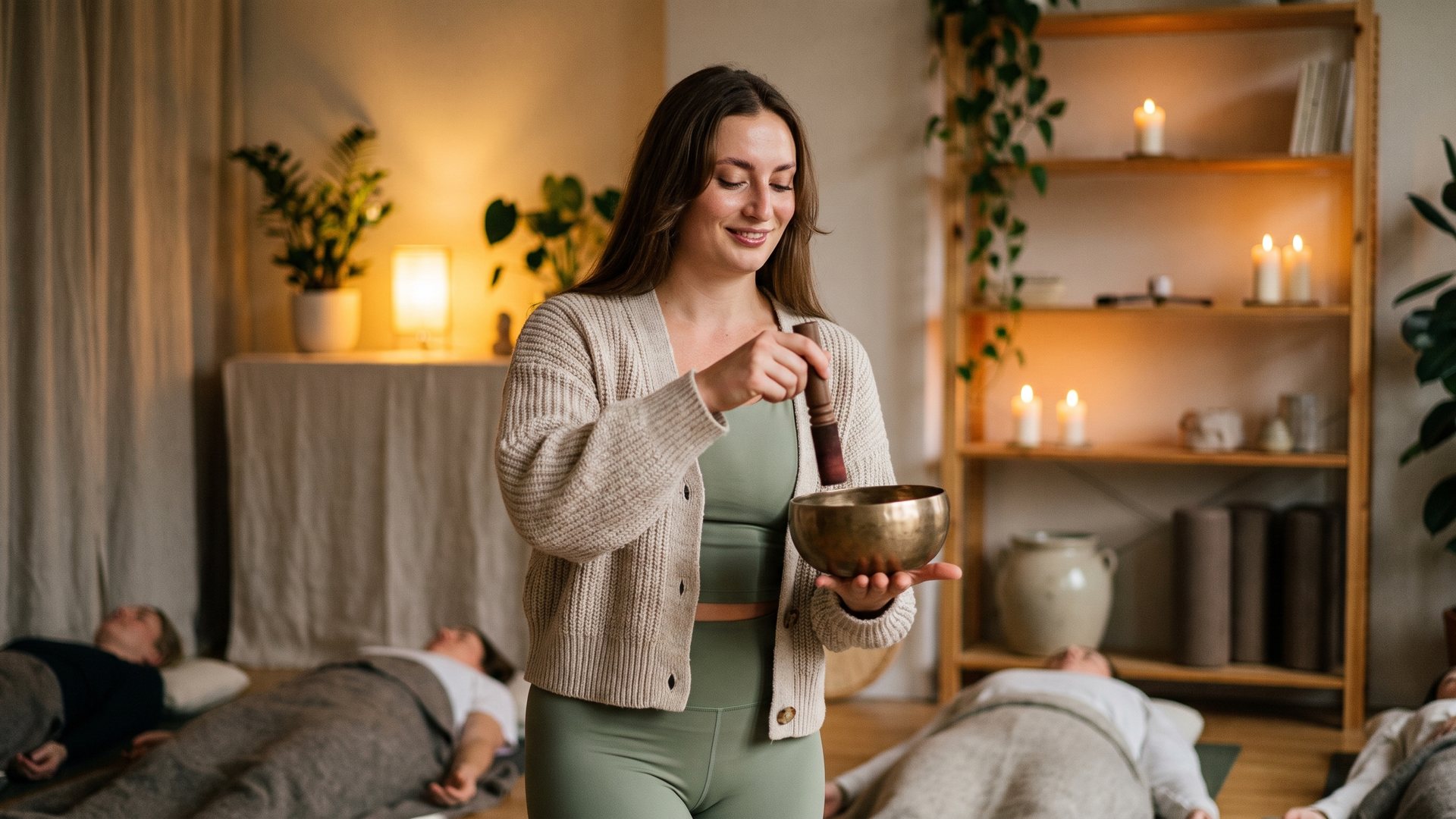
A genuine sound bath — in the sense that the term originates from — involves live instruments played by a skilled practitioner in the room. The vibrations produced by Himalayan singing bowls, crystal singing bowls, gongs, and other resonant instruments are physical as well as auditory: they move through the body, are felt as well as heard, and create an acoustic environment that recorded sound simply cannot replicate.
A skilled practitioner does not simply strike a bowl and wait. They move around the space, position instruments near different parts of the body, layer tones and overtones deliberately, and pace the session to guide participants through progressive stages of relaxation. This requires training, sensitivity, and presence — not just equipment.
When searching for sound healing in North London, the first question to ask is whether the session uses live instruments, played by a practitioner who is trained in their use. If the answer is yes, the session is worth investigating further.
2. Sound Bath vs Sound Healing During Yoga
There is a meaningful distinction between a standalone sound bath and sound healing integrated into a yoga class — and understanding it helps you identify which experience you are looking for.
A standalone sound bath is typically 45–75 minutes of lying still while sound is played around and over you. There is no physical yoga practice beforehand. Participants arrive, settle on their mats, and receive the sound from the first tone to the last.
This format is accessible and requires no prior yoga experience. It is also, for many people, somewhat harder to enter deeply — particularly for those who arrive carrying the tension of a busy day. The transition from ordinary wakefulness into the open, receptive state that sound healing works best in can take ten to twenty minutes, which in a 45-minute session leaves relatively little time in the deepest layers of relaxation.
Sound healing integrated into yoga — as happens at Your Ritual Yoga — uses the yoga practice as a preparation. A full Hatha or Yin class brings the body through physical movement, breathwork, and progressive settling before Shavasana begins and the singing bowls are played. By this point, the nervous system has already moved from activation towards rest. The physical tension of the shoulders, hips, and jaw has been progressively released through the preceding practice.
Why Sound Healing Layered into Yin is More Powerful Than a One-Off Bath
Yin yoga is particularly effective as a preparation for sound healing because of how deeply it works with the parasympathetic nervous system. The long, passive holds — three to five minutes per pose — require the body to surrender muscular effort and the mind to release its grip on doing. By the end of a 75-minute Yin class, many students are already in a state of profound quiet.
When the singing bowls begin in this context, they land in a body that is genuinely prepared. Students who have attended both standalone sound baths and Yin-plus-sound-healing sessions frequently describe the latter as significantly deeper — an experience of rest that a standalone bath, however beautifully facilitated, rarely reaches in the same session length.
This is not to say that standalone sound baths lack value. They do not. But for those seeking the deepest possible experience of sound healing, the layered approach offers something more.
3. What to Look for in a Practitioner
As sound healing has grown in popularity, the range of people offering sessions has expanded considerably. Some bring years of training, personal practice, and a deep understanding of how sound interacts with the body. Others have attended a weekend workshop and purchased a set of bowls.
A few questions that help distinguish the two:
What is their training? Sound healing does not have a single, unified certification pathway in the UK — but a practitioner should be able to describe where they trained, with whom, and for how long. A weekend course is a beginning; several hundred hours of training and personal practice is something more.
What instruments do they use? Himalayan singing bowls (also called Tibetan or Nepalese bowls) are the most commonly used instruments in sound healing. They are made from an alloy of metals, produce complex, layered tones, and have been used in Himalayan spiritual and healing traditions for centuries. Crystal bowls, gongs, and other instruments are also used by skilled practitioners. Ask whether instruments are played live in the room.
How large are their sessions? Smaller groups allow the practitioner to move around, position instruments near different participants, and pay attention to individual responses. Very large group sessions (40+ people) make this impossible. For a first experience, a smaller session is preferable.
Can they describe what they do? A practitioner who can speak clearly and specifically about the frequencies used, the instruments, and their training is more likely to be offering something grounded than one whose description consists primarily of vague wellness language.
4. Where to Find Sessions in North London
The landscape of sound healing in North London changes regularly as practitioners move, new studios open, and temporary events come and go. The best current sources for finding sessions are:
Yoga and wellness studios in Golders Green, Hampstead, Muswell Hill, and Highgate — these areas have a concentration of independent wellness practitioners, and many studios host visiting sound healing practitioners for workshops and special events. Checking studio websites and Instagram accounts is the most reliable way to find current listings.
Your Ritual Yoga (Golders Green, NW11) — every single class at Your Ritual Yoga includes Himalayan singing bowl sound healing during Shavasana. This is not an occasional event or an add-on — it is a permanent feature of every Hatha and Yin class. For North London students who want to experience sound healing as part of a regular yoga practice, this is the most consistent and accessible option in the area. View the Ritual Experience page for full detail on how the sound healing works within each class.
Eventbrite and Insight Timer — both platforms list standalone sound bath events across London, often filterable by location. The quality varies; reading practitioner bios carefully and checking reviews where available is advisable.
Word of mouth — within North London’s wellness community, personal recommendation remains the most reliable way to find consistently good practitioners. If you have a yoga teacher, therapist, or wellness practitioner you trust, their recommendation is worth more than a listing.
5. How to Prepare for Your First Sound Bath
Preparation for a sound bath is genuinely simple. The most important things are practical:
Arrive with time to settle — if you rush in at the last moment, your nervous system will spend the first ten minutes of the session simply arriving. Come five to ten minutes early, lie down, and begin to breathe slowly.
Eat lightly beforehand — a heavy meal before lying still for an hour is uncomfortable. A light snack one to two hours before is sufficient.
Dress warmly — the body temperature drops when lying still. Layer up. Thick socks, long sleeves, and a blanket are not excessive; they are practical.
Bring no agenda — this is the most important preparation. Do not arrive hoping for a specific outcome (sleep, peace, insight, emotional release). Arrive willing to receive whatever the session offers. Some people feel deeply moved; others feel simply rested; others feel little during the session and notice the effects only later, in the quality of their sleep or the quiet of the following morning. All of these are valid responses.
Remain for the full closing — the period of quiet at the end of a sound bath is part of the session. Leaving immediately as the last tone fades cuts short the integration that is happening. If possible, remain lying for a full five minutes after the sounds end before sitting up slowly.
Frequently Asked Questions
Q: Is sound healing the same as sound therapy?
A: The terms are often used interchangeably, but sound therapy sometimes refers to clinical applications of sound (used by audiologists and occupational therapists) while sound healing is more commonly used for the wellness and contemplative tradition that includes singing bowls, gongs, and sound baths. The context usually makes the distinction clear.
Q: Do I need to believe in the benefits for it to work?
A: No — the physical vibrations produced by singing bowls interact with the body regardless of belief. That said, arriving with openness (rather than active scepticism) tends to allow a more complete experience. Many people who describe themselves as sceptical before their first session leave genuinely surprised.
Q: How often should I attend sound healing sessions?
A: There is no fixed prescription. Some students attend weekly as part of a regular yoga practice (which is what happens when they attend classes at Your Ritual Yoga). Others attend monthly standalone sessions. Even a single session, experienced fully, produces noticeable effects.
Q: Is sound healing safe during pregnancy?
A: Many pregnant women find sound healing deeply relaxing and beneficial. Gong sessions are generally avoided in the first trimester, as the intensity of the vibration may be too strong. Himalayan singing bowl sessions are typically gentler. Always let the practitioner know if you are pregnant, and consult your midwife or GP if you are unsure.
Experience sound healing in every class at Your Ritual Yoga. Explore the Ritual Experience and join a Yin yoga class in Golders Green, NW11.
About the author
Tanya is a Yoga Alliance RYS 200 certified yoga teacher (ID 252157), trained at Devvrat Yoga School in Varkala, India (December 2025). She teaches Hatha and Yin yoga at Your Ritual Yoga in Golders Green, NW11 — a small, intentional studio where every class includes sound healing with Himalayan singing bowls and a post-class herbal tea ritual. www.ritual-yoga.co.uk