Written by Tanya — Yoga Alliance RYS 200 (ID 252157), trained at Devvrat Yoga School, Varkala, India (December 2025). Tanya teaches Hatha and Yin yoga at Your Ritual Yoga in Golders Green, NW11.
Yoga for men is not a niche concept. Historically, yoga was practised almost exclusively by men — the tradition of Hatha yoga was developed by male scholars and ascetics over centuries in India. The modern assumption that yoga is primarily for women is roughly fifty years old. It is recent, and it is incorrect.
What has changed is marketing. The studios that dominate Instagram, the imagery on booking apps, the language of most yoga-class descriptions — these have drifted towards a specific aesthetic that does not reflect the origins of the practice, nor does it reflect the full range of people who would benefit from it.
If you are a man who has been curious about yoga and quietly talked yourself out of it, this is an honest look at what you will find, what the research says, and how to begin.
The ‘Yoga Isn’t for Men’ Myth
The number most often cited is that around 72 percent of yoga practitioners in Western countries are women. If that is accurate, it means roughly 28 percent are men — not zero, not negligible. And participation rates among men have been rising steadily for a decade.
The barrier is rarely physical. It is social. Many men report feeling conspicuous in a room where they are the minority, worried about being the least flexible person present, or uncertain whether yoga will offer anything a gym session does not.
These are understandable concerns. They are also, for the most part, unfounded.
On the flexibility point: yoga is not a test of how flexible you already are. It is a practice that gradually changes the body. Beginning with stiff hips and a tight lower back is not a disadvantage — it simply means there is more room for noticeable progress early on. Most men who begin yoga report feeling tangible change within the first three to four weeks of regular practice.
On the gym comparison: yoga does things a gym session cannot. We will return to this shortly.
What Strength and Recovery Research Says
The research on yoga for men is more substantial than it might appear.
Studies examining yoga’s effect on flexibility in male athletes — runners, cyclists, footballers, swimmers — have consistently found improvements in hamstring length, hip rotation, and spinal mobility over eight to twelve weeks of regular practice. These are the exact areas where most men who train regularly carry chronic tightness.
Beyond flexibility, research has documented yoga’s effect on cortisol levels. Regular yoga practice — particularly slower, breath-led styles — has been associated with measurable reductions in circulating cortisol over time. For men in demanding professional roles, or those whose training volume is high, this matters. Chronically elevated cortisol suppresses recovery, disrupts sleep, and affects mood. Practices that actively down-regulate the nervous system offer something that additional weight training cannot.
There is also evidence relating to sleep quality. Yin yoga in particular — with its long, passive holds and parasympathetic emphasis — has been linked to improved sleep onset and duration. For men whose sleep is disrupted by stress, training load, or a busy mind, this is not a minor benefit.
None of these effects require you to be a lifelong practitioner. They appear in studies with participants who are beginners. You do not need a foundation of flexibility or prior yoga experience to start seeing results.
What to Expect as a Man in Class
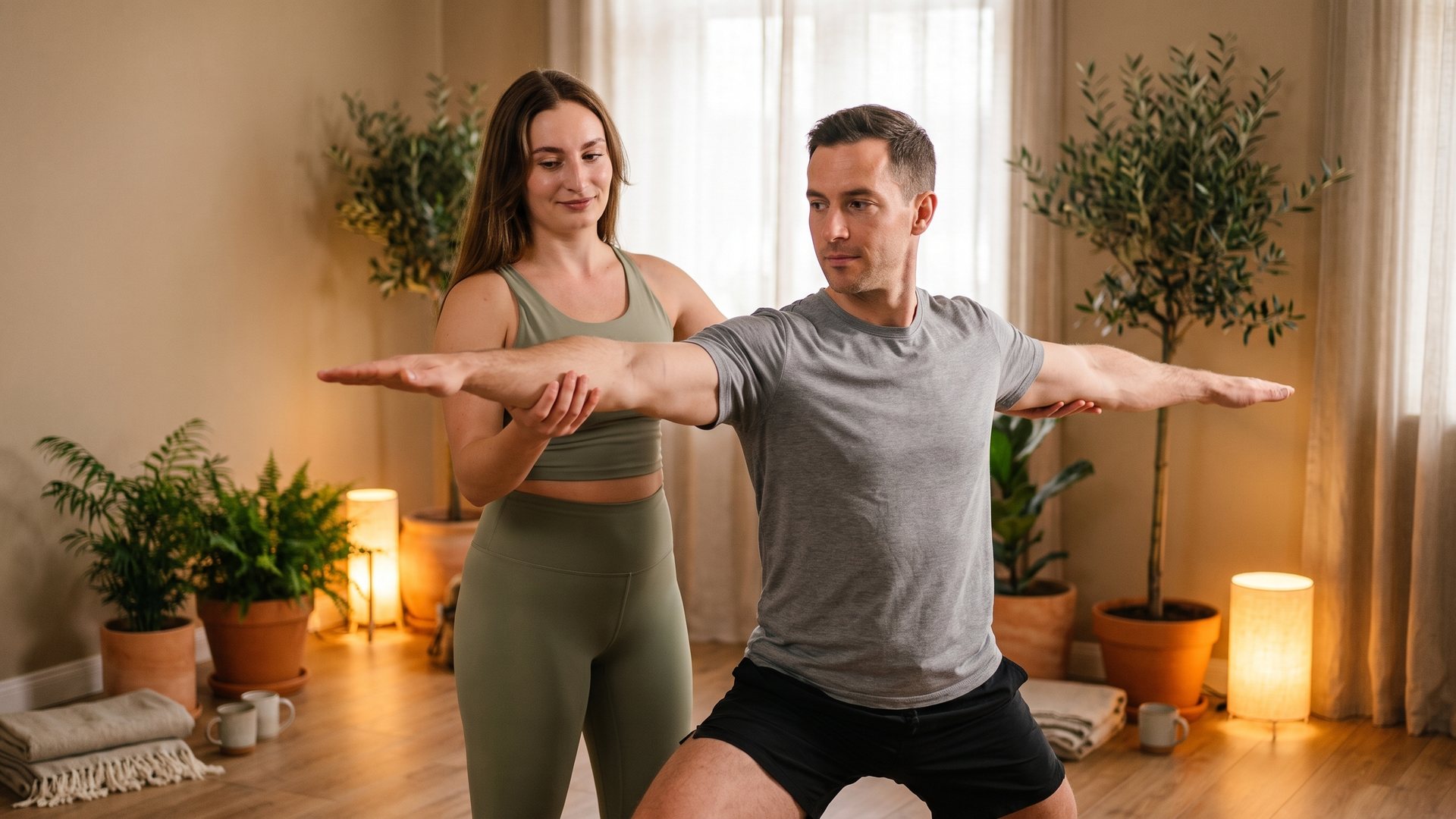
In an intimate studio setting — small group, unhurried pace — your experience as a man in class will depend largely on the teacher and the atmosphere. At a studio where small-class teaching is the norm, your alignment and comfort in a pose will receive genuine attention.
What you will not find, in a well-run class, is any expectation that you perform at a particular level. Yoga poses have modifications. A good teacher offers them without commentary, as a natural part of the class.
You will likely find the first few sessions physically challenging in unexpected ways. Not because the poses are extreme, but because they will ask your body to do things that are unfamiliar — slow, sustained holds that require patience rather than power. The tendency to push hard, a useful instinct in the gym, is something yoga asks you to set aside. Effort and force are different things. Learning that distinction is part of the practice.
You may also find that the breathing, the pauses, and the stillness feel unusual at first. This is normal. It often becomes, over time, the part that people value most.
Best Styles for Stiff, Strong Bodies
Not all yoga is the same, and the style you begin with matters.
Hatha for Strength, Yin for Stiff Hips
Hatha yoga is a traditional, accessible style that moves at a pace that allows you to feel each pose properly. Postures are held long enough to find alignment, breathe into the shape, and develop genuine stability. For men who are physically strong but inflexible — common in those who train regularly — Hatha offers a structured, progressive experience without the overwhelm of a faster-paced class.
Hatha yoga classes are 60 minutes and suitable for all levels.
Yin yoga operates at an entirely different pace. Poses are held for three to five minutes, targeting the connective tissue — fascia, ligaments, joint capsules — rather than the muscles. For men with chronically stiff hips, tight IT bands, or compressed lumbar spines, Yin yoga can reach places that no stretch held for twenty seconds has managed to touch.
The counterintuitive thing about Yin for strong men is that the challenge is not physical — it is the practice of staying still and breathing through discomfort without forcing your way out of it. Many men find this genuinely difficult and genuinely transformative.
Yin yoga classes are 75 minutes and also suitable for all levels.
Why Power Yoga Isn’t Always the Right Entry
There is a temptation to start with the most dynamic, physically demanding style available — hot yoga, power yoga, Ashtanga — on the basis that if it is hard, it is worth doing. This is not necessarily the best approach for beginners.
Fast-paced yoga without a foundation in alignment can reinforce poor movement patterns rather than correcting them. The speed leaves little room to understand what the pose is actually asking of the body. Starting with a slower style builds the understanding that makes every subsequent practice more useful.
A 4-Week Starter Plan
This plan assumes one or two classes per week. More is fine; less is fine. Consistency over a month matters more than frequency in any single week.
Week 1 — Arrive as you are. Book a Hatha class. Tell the teacher you are new. Do not modify your expectations downward: just show up and observe what the practice asks of your body.
Week 2 — Notice the sticking points. Which poses feel most difficult? Where does the body resist? These are useful observations, not problems. They tell you where there is the most room for change.
Week 3 — Try a Yin class. The contrast with Hatha is illuminating. The stillness will likely feel strange. Stay with it. The second half of a Yin class is where most people begin to understand what the practice is actually for.
Week 4 — Reflect on what has changed. Sleep? Tension in the shoulders? Range of motion in the hips? Recovery after training? After four weeks, most people notice something. The question worth asking is: what would staying consistent over three months look like?
Frequently Asked Questions
Do I need to be flexible before starting yoga?
No. This concern keeps more people out of yoga than any other. Yoga is how you develop flexibility — you do not need it as a prerequisite. Beginning with a stiff body is completely normal and often means you notice progress faster.
Will yoga replace the gym?
It depends what you want from both. Yoga will not build the same kind of muscular hypertrophy that heavy resistance training does. What it will do is improve mobility, support recovery, reduce stress hormones, and strengthen the stabilising muscles around joints in ways that can meaningfully complement gym training.
Is yoga suitable if I have a lower back injury?
Often, yes — with appropriate modification. Tight hamstrings and hip flexors are a common contributor to lower back pain, and yoga addresses both. A small class where the teacher can see you and offer adjustments is a much safer environment than a large group class. Speak to your teacher before class about any existing injuries.
What should I wear?
Comfortable clothes that allow movement — shorts or fitted tracksuit trousers tend to work well. Yoga is practised barefoot.
Will I feel out of place as a man?
In a well-run, welcoming studio, no. In a small class where the atmosphere is unhurried and the teacher is paying attention to the room, most people report feeling at ease within one or two sessions.
Curious but not quite sure where to begin? A beginner-friendly Hatha class is the natural starting point. Small group, no prior experience required, and enough space in the room for your questions. Book your first class at Your Ritual Yoga.
About the author
Tanya is a Yoga Alliance RYS 200 certified yoga teacher (ID 252157), trained at Devvrat Yoga School in Varkala, India (December 2025). She teaches Hatha and Yin yoga at Your Ritual Yoga in Golders Green, NW11 — a small, intentional studio where every class includes sound healing with Himalayan singing bowls and a post-class herbal tea ritual. www.ritual-yoga.co.uk