Written by Tanya — Yoga Alliance RYS 200 (ID 252157), trained at Devvrat Yoga School, Varkala, India (December 2025). Tanya teaches Hatha and Yin yoga at Your Ritual Yoga in Golders Green, NW11.
Yoga for period pain is one of those things that sounds either obvious or impossible, depending on how you feel about exercise during menstruation. If your experience of period pain involves days where getting off the sofa feels like a small triumph, the idea of a yoga class may seem laughably ambitious.
This guide is for that version of the experience — not the mild discomfort that two ibuprofen resolves, but the kind that changes what your week looks like. It is also an honest look at what yoga can and cannot offer, and at how tuning your practice to your cycle — rather than ignoring the cycle entirely — tends to produce something more sustainable than grinding through the same class every week regardless of where you are.
A note before we begin: this is general educational information. Severe or worsening period pain should be assessed by a GP or gynaecologist, as conditions such as endometriosis and fibroids require proper diagnosis and medical management.
The Menstrual Cycle and Yoga
The body is not the same across a menstrual cycle. Hormone levels fluctuate significantly — oestrogen and progesterone rise and fall in distinct patterns across roughly four phases — and those fluctuations affect energy, mood, pain sensitivity, joint laxity, and how recovery from physical effort feels.
Treating every week as interchangeable tends to create friction. There are weeks when a strong, active Hatha practice feels energising and relatively easy. There are others when the same class feels like wading through fog.
Yoga’s adaptability is one of its genuine strengths. Unlike most fitness modalities, a yoga practice can be calibrated — more active or more restorative, longer holds or gentler ones — in response to where you actually are, rather than where you think you should be.
The phase most relevant to this guide is menstruation itself: typically days one to five of the cycle. This is when prostaglandins (hormone-like compounds that cause uterine contractions to shed the lining) tend to produce cramping, and when many people feel most depleted.
Poses for Cramps and Lower-Back Pain
Cramps during menstruation are primarily felt in the lower abdomen but often radiate into the lower back and upper thighs. Poses that open the hips, soften the lower belly, and gently compress or release the sacrum can offer meaningful relief for some people.
Reclining Bound Angle, Supported Child’s Pose, Gentle Twists
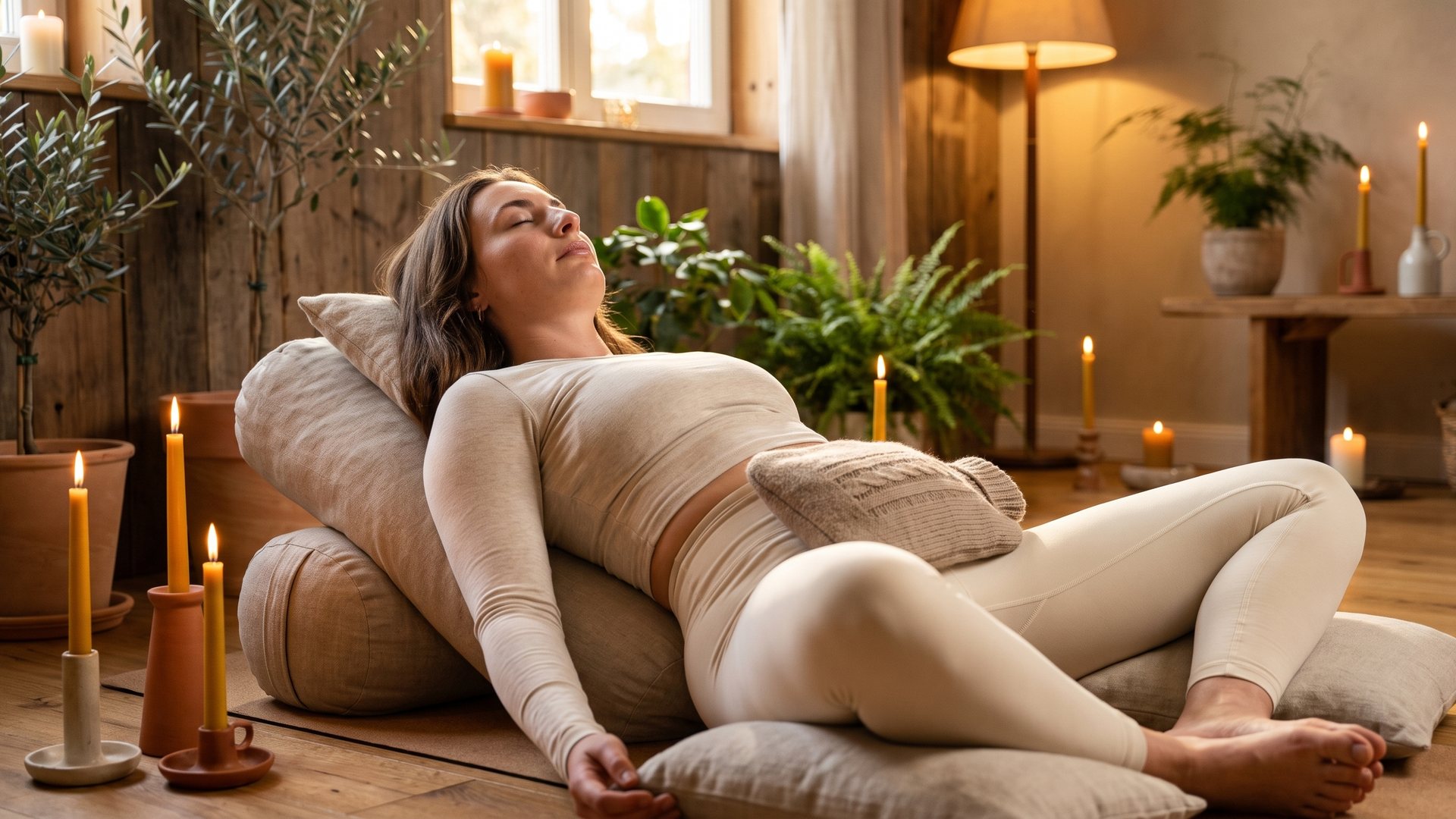
Reclining Bound Angle (Supta Baddha Konasana). Lie on your back. Bring the soles of the feet together, knees falling wide. Place one hand on the belly and one on the heart. If the inner thighs are straining, support the knees with folded blankets or bolsters. This pose releases the inner groin and lower belly without requiring any muscular effort. Breathe slowly and let the weight of the body drop. Stay for three to five minutes.
Supported Child’s Pose. Kneel with the toes together, knees wide. If you have a bolster, place it lengthways between the knees and fold forward over it. If not, a pillow or folded blankets under the torso work well. The forehead rests on the support. This position gently compresses the lower abdomen — some people find this relieves cramping in the same way a heat pad does. Stay for three to five minutes, allowing the breath to deepen naturally.
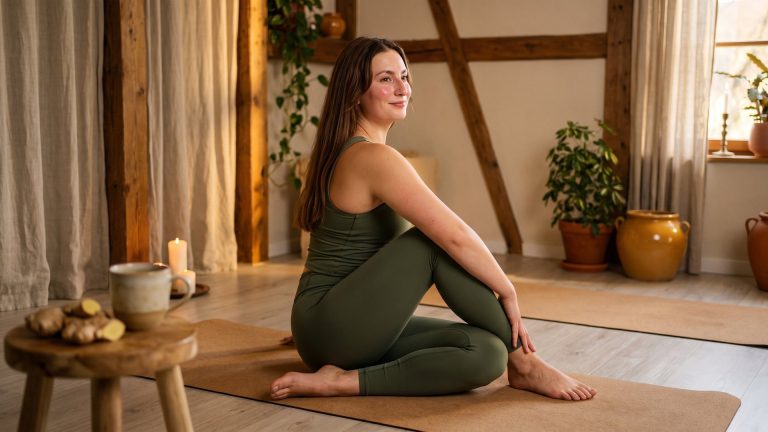
Gentle seated twist. Sit cross-legged. Inhale to lengthen the spine, exhale and rotate slowly to the right, placing one hand behind you and one on the opposite knee. This is not a deep twist — simply a slow rotation. Deep twists are best avoided during menstruation (more on this below). Stay for five to eight breaths, then repeat to the left.
The lower back often holds significant tension during menstruation. Cat-cow movements — slow, breath-led spinal flexion and extension on all fours — can help move the lower back gently and may ease the heavy, achey quality that often accompanies cramping.
Poses for Emotional Waves and Low Energy
The early days of menstruation frequently bring not just physical discomfort but emotional shifts: heightened sensitivity, irritability, sadness, the desire to withdraw. These are not character flaws. They are physiological.
Restorative yoga — poses held passively with full support — tends to be the most appropriate practice during this phase. The goal is not to push through but to receive.
Legs Up the Wall (Viparita Karani). Sit sideways against a wall, then swing the legs up so they rest against the wall while you lie on your back. This mild inversion is generally considered safe during menstruation (unlike headstands or full inversions) and can ease heaviness in the legs. It also supports the parasympathetic nervous system. Stay for five to ten minutes.
Supported Savasana. Place a bolster or folded blankets under the knees. Let the arms fall wide, palms facing up. Cover yourself with a blanket if that feels good. This is not laziness — it is an intentional practice of receiving rest. Stay for ten minutes or more.
Forward folds — seated or standing — tend to feel calming and introverted during this phase. They encourage the gaze and energy to turn inward, which matches the natural tendency during menstruation.
What to Avoid During Your Period
Why Inversions During Menstruation Are Debated
The question of whether to practise inversions — poses where the hips are above the heart, such as shoulderstand, headstand, or legs-up-the-wall — during menstruation has been debated in yoga communities for decades.
Traditional yoga philosophy (particularly in the Iyengar tradition) advises against full inversions during menstruation, on the basis that the downward flow of apana (a concept from Ayurvedic theory relating to downward energy) should not be interrupted. This is not a physiological claim supported by modern evidence, and the research specifically on this question is limited.
From a practical standpoint: a gentle pose like legs up the wall during menstruation is unlikely to cause harm for most people. Full, active inversions like headstands and shoulderstands may not be comfortable when the body is already depleted, and many practitioners choose to omit them during the first two days simply because they do not feel good. This is a reasonable basis for a decision.
If you are uncertain, err on the side of less during the heaviest days. Your body’s signals are reliable guides.
Deep abdominal twists — poses that compress the abdomen significantly, like Marichyasana C or Revolved Triangle — are best set aside during menstruation. The compression and counter-rotation may increase discomfort.
High-intensity, heating practices — vigorous sun salutations, power sequences, hot yoga — often feel at odds with the body’s needs during menstruation. They can increase bleeding and exacerbate fatigue for some people. If energy is genuinely available and this kind of practice feels good, honour that. If it does not, rest.
Cycle-Syncing Your Week
Cycle-syncing means adjusting your yoga practice across the four rough phases of the menstrual cycle rather than treating every week identically. This is an orientation rather than a strict protocol.
Menstrual phase (days 1–5): Rest, restore. Yin yoga, supported restorative poses, gentle Hatha if energy is available. Prioritise sleep and stillness. The Yin class is a natural fit here.
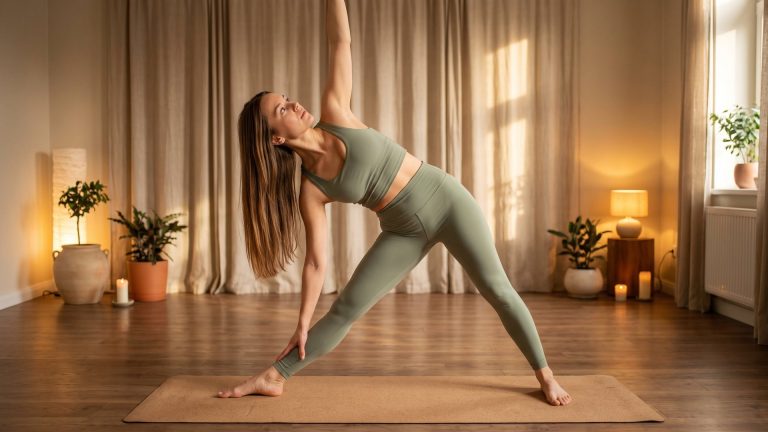
Follicular phase (days 6–13): Energy returning. This is when oestrogen begins to rise and energy returns. A good time to re-engage with more active Hatha, try something new, or return to poses that felt difficult in the previous week. Hatha yoga suits this phase well.
Ovulatory phase (around days 14–16): Peak energy. Many people feel strongest and most socially engaged during this phase. Active, dynamic practice suits it. If you are going to attend a more challenging class, this is often when it will feel most accessible.
Luteal phase (days 17–28): Slowing down. As progesterone rises and then falls, energy often gradually decreases. This phase benefits from a transition back towards Yin, longer holds, and poses that support the nervous system. The second half of the luteal phase — the week before menstruation — is often when PMS symptoms appear, and restorative yoga can offer meaningful support for both the physical and emotional dimensions of this.
This is not prescriptive. Bodies vary significantly. The framework is a starting point for noticing whether your energy and the practice you are attempting are in conversation with each other.
Frequently Asked Questions
Is yoga safe during my period?
For most people, gentle yoga during menstruation is safe and can offer real relief from cramps and emotional discomfort. Avoid very intense practices and full inversions on heavy days if they do not feel good. Always trust your own body’s signals.
Can yoga help reduce period pain over time?
Regular yoga practice may help regulate the stress response and reduce inflammation over time, which could benefit menstrual pain for some people. It is not a medical treatment, but many practitioners find that consistent practice — across the month, not only during menstruation — has a positive effect on the overall experience of their cycle.
What if I am in too much pain to do any yoga at all?
Then rest. There is no obligation to practise through significant pain. If pain is severe enough to prevent normal daily activity, a GP visit is the appropriate first step, not a yoga class.
Should I tell my yoga teacher I am on my period?
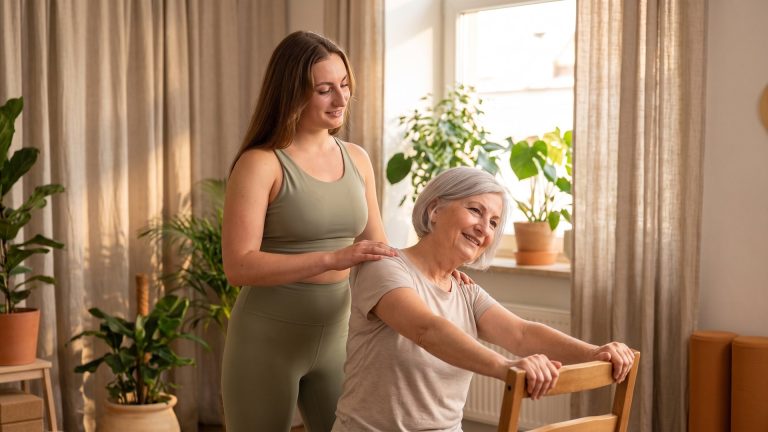
You are never obliged to share this. However, in a small, trusting studio environment, letting your teacher know allows them to offer appropriate modifications without you needing to explain. A good teacher receives this information without commentary.
Can I still come to a Yin class during my period?
Yes. Yin yoga — with its emphasis on passive holds, deep release, and nervous-system regulation — is one of the most supportive practices for the menstrual phase. Many students find the Yin class particularly valuable during this time.
If low-energy days call for a quieter practice, a Yin class in Golders Green offers exactly that — long holds, a warm space, the gentle hum of singing bowls, and a cup of herbal tea afterward. Book your place.
About the author
Tanya is a Yoga Alliance RYS 200 certified yoga teacher (ID 252157), trained at Devvrat Yoga School in Varkala, India (December 2025). She teaches Hatha and Yin yoga at Your Ritual Yoga in Golders Green, NW11 — a small, intentional studio where every class includes sound healing with Himalayan singing bowls and a post-class herbal tea ritual. www.ritual-yoga.co.uk