Written by Tanya — Yoga Alliance RYS 200 (ID 252157), trained at Devvrat Yoga School, Varkala, India (December 2025). Tanya teaches Hatha and Yin yoga at Your Ritual Yoga in Golders Green, NW11.
Bhramari pranayama — bee breath — is perhaps the simplest breathing technique in yoga’s entire toolkit. It requires no props, no specific posture, and no prior experience of breathwork. You can practise it on the Tube, at your desk, or sitting on the edge of your bed at two in the morning when sleep refuses to come.
The name comes from the Sanskrit word for the Indian black bee. When you practise it, you will understand why: the exhale is made with a soft humming sound, a vibration that moves through the skull, the face, the chest, and — if you stay with it long enough — the whole of the nervous system.
It is ancient in origin and increasingly interesting to researchers studying vagal stimulation and nervous-system regulation. The two perspectives — traditional and modern — arrive at the same conclusion through different routes.
What Bhramari Is Doing
To understand why bhramari works, it helps to understand the vagus nerve.
The vagus nerve is the longest nerve in the autonomic nervous system. It runs from the brainstem through the neck and into the chest and abdomen, carrying signals in both directions between the brain and the body’s organs. It is the primary nerve of the parasympathetic nervous system — the one responsible for rest, recovery, digestion, and calm.
The vagus nerve passes through the larynx. When you hum, the vibration of the larynx directly stimulates the vagus nerve. This stimulation triggers a parasympathetic response: heart rate begins to slow, cortisol decreases, the exhale naturally lengthens, and the nervous system begins to move away from its activated, alert state.
Vagal Stimulation via Vibration
The resonance of bhramari is not incidental. It is the mechanism. The specific frequency of the hum — determined by the pitch you naturally produce — creates vibration that travels through the bones of the skull and into the sinus cavities. Research in the area of sound and physiology has found that this kind of endogenous vibration (produced from within rather than heard from outside) has a measurable calming effect on the nervous system.
The exhale in bhramari is also significantly longer than in normal breathing. An extended exhale is itself a parasympathetic signal — the body associates a long exhale with safety. The combination of extended exhale and vagal vibration makes bhramari one of the more potent calming techniques in yoga’s breathing repertoire.
Quiet Hum vs Loud Hum
The pitch and volume you use in bhramari will affect the quality of the experience. A quieter, lower-pitched hum tends to feel more internalised and calming — the resonance settles deep in the chest. A slightly louder hum feels more like clearing or releasing.
Neither is wrong. In a class setting, the volume is naturally kept modest out of consideration for others. In private practice, you can experiment. Many people find that a slightly louder hum on the first round or two — almost a groan — releases held tension before settling into the quieter version.
The Technique, Step by Step
Sit comfortably. This can be cross-legged, in a chair with feet flat on the floor, or in any position where the spine can remain upright without strain.
Close the eyes. Take one or two ordinary breaths to settle.
On the next inhale: breathe in slowly through the nose to about three-quarters of your lung capacity. Do not over-fill.
On the exhale: close the lips gently and hum. The hum is produced from within the throat — not projected outward but allowed to resonate inside the skull. Feel the vibration in the face, behind the nose, in the forehead.
The exhale with the hum continues until it is natural to inhale again. Do not force the exhale to be longer than comfortable. Over rounds, it will naturally extend.
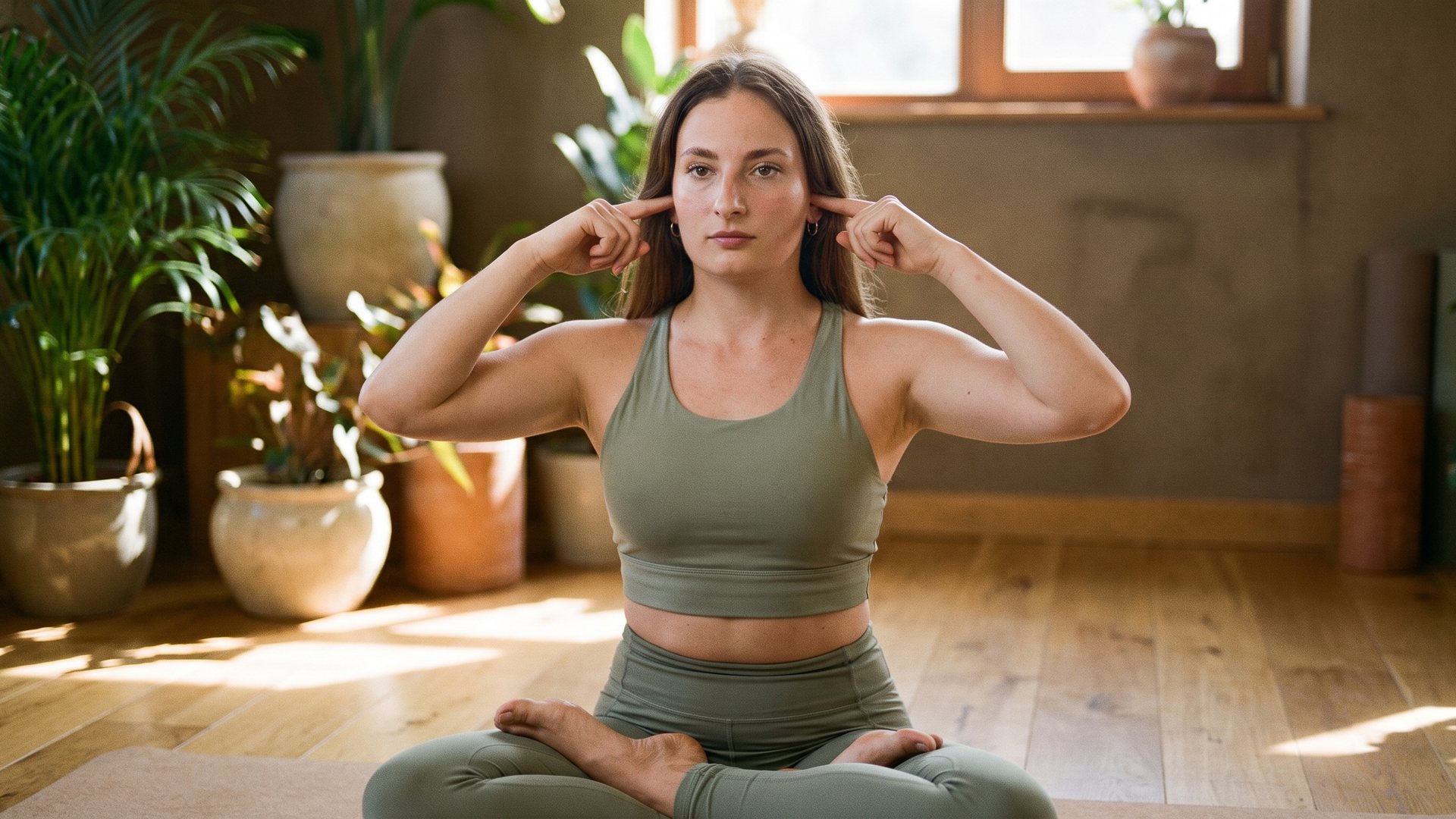
Optional: the shanmukhi mudra position. Many practitioners place their index fingers gently over their ears, or use a classical mudra position — thumbs on the ears, index fingers over the closed eyes, middle fingers at the sides of the nose, ring and little fingers framing the mouth. This seals off external sensation and deepens the internalised quality of the practice. It is not required and can feel unusual for beginners.
Repeat for six to eight rounds to begin. This typically takes two to three minutes.
What 90 Seconds Actually Changes
Ninety seconds is approximately three to five rounds of bhramari at a relaxed pace. Within that time, for most people, something perceptible shifts.
The breath slows. The jaw, which tends to hold tension invisibly throughout the day, softens. The quality of thought often changes — not stopped, but quieted, as if the volume has been turned down.
From a physiological standpoint, heart rate variability — a measure of nervous-system flexibility and resilience — begins to increase even within a few rounds of slow, extended breathing. This is not exclusive to bhramari, but bhramari’s combination of vagal stimulation and extended exhale makes it particularly effective at producing this shift quickly.
For anxiety specifically, the humming acts as a gentle and effective interrupt. When the nervous system is in an anxious loop — thoughts cycling, muscles tight, breath shallow — bhramari introduces a competing signal. The vibration occupies both the physical body and, to some degree, the attention, which breaks the feedback loop that sustains anxious activation.
It does not resolve the source of anxiety. But it can create enough space to respond rather than react.
A 5-Minute Daily Practice
This sequence is suitable for daily use — morning, evening, or both.
Arrive (1 minute). Sit quietly with eyes closed. Do nothing. Simply notice the natural breath — its pace, its depth, whether it is held anywhere. This brief observation sets a baseline and begins the inward turn.
Three preparatory breaths (30 seconds). Three slow nasal breaths, exhale longer than inhale. No humming yet.
Six rounds of bhramari (2–3 minutes). Follow the technique above. Allow the exhale to find its own length. Between rounds, if you notice a brief pause before the next inhale arises naturally, let it rest there — this pause is part of the practice.
Rest in silence (1 minute). After the final round, simply sit. Do not immediately open your eyes or reach for your phone. Allow the resonance to settle. Notice what has changed in the quality of the body and mind.
When to Use It
Before a difficult meeting or conversation. Three rounds of bhramari in a quiet corner before you walk in will lower heart rate and reduce the reactive quality that stress tends to produce.
At the beginning of a yoga class or meditation sit. Bhramari quickly establishes an inward orientation, making it a useful transition between the busy outside world and the quieter space of practice.
During the night if sleep will not come. Lying on your back, practise six to eight rounds. The parasympathetic effect and the internal focus tend to interrupt the circling thoughts that keep people awake.
As a daily nervous-system practice. Five minutes of bhramari each morning or evening, practised consistently, may support a baseline reduction in anxiety over weeks and months.
There are a few situations in which bhramari is better avoided or practised gently: severe ear infections, active tinnitus (where the internal vibration can be uncomfortable), and during pregnancy (where breath retention, if you have been practising any, should be discussed with your midwife first). The basic humming version without any breath retention is generally considered safe.
Frequently Asked Questions
Do I need to know yoga to practise bhramari?
No. It requires only breath and a willingness to sit quietly for a few minutes. No prior yoga experience is needed.
What pitch should my hum be?
Whatever arises naturally. There is no correct pitch, and forcing a particular tone will reduce the ease of the practice. Let the hum find its own level.
Can bhramari help with panic attacks?
It may be useful as part of a broader approach to managing anxiety. During a full panic attack, the breath is often too dysregulated for breathwork to begin immediately. In the build-up to anxiety, or in its aftermath, bhramari can be helpful. Persistent panic attacks should be addressed with appropriate professional support.
How is this different from other breathing exercises?
The distinguishing feature of bhramari is the internal vibration. Techniques like box breathing or 4-7-8 breathing work primarily through breath rhythm and retention. Bhramari adds a layer of vagal stimulation through sound, which tends to produce the calming effect more quickly for some people.
Is bhramari taught in your yoga classes?
Yes. Pranayama — including techniques like bhramari — is integrated into Hatha classes at Your Ritual Yoga. Every class includes breathwork as part of the practice, not as an optional extra. Yin yoga also incorporates breathing guidance, though its emphasis is on passive holding rather than active pranayama.
Bhramari is one of the tools we return to regularly in class. Come and practise it with guidance — in a warm, quiet room, with singing bowls to follow. Join a Hatha class at Your Ritual Yoga.
About the author
Tanya is a Yoga Alliance RYS 200 certified yoga teacher (ID 252157), trained at Devvrat Yoga School in Varkala, India (December 2025). She teaches Hatha and Yin yoga at Your Ritual Yoga in Golders Green, NW11 — a small, intentional studio where every class includes sound healing with Himalayan singing bowls and a post-class herbal tea ritual. www.ritual-yoga.co.uk