Written by Tanya — Yoga Alliance RYS 200 (ID 252157), trained at Devvrat Yoga School, Varkala, India (December 2025). Tanya teaches Hatha and Yin yoga at Your Ritual Yoga in Golders Green, NW11.
Box breathing is one of those techniques that sits at an interesting crossroads. It appears in ancient yogic breathing texts — variations of it are recognisable in the pranayama tradition as a precursor to sama vritti, equal-ratio breath. And it appears in contemporary elite military training, used by US Navy SEALs to reduce physiological stress responses before and during high-pressure situations.
That two such different worlds independently arrived at the same 4-4-4-4 pattern is not coincidence. It reflects something real about how rhythmic, equal-ratio breathing affects the nervous system. This guide explains what that is, how to do it properly, and how to build it into a daily habit.
What Box Breathing Is
Box breathing — also called square breathing or, in yoga, sama vritti pranayama — is a breathing technique in which the inhale, retention, exhale, and post-exhale pause are each held for the same count. The most common version uses a count of four seconds for each phase.
Inhale for four. Hold for four. Exhale for four. Hold empty for four. Repeat.
The name comes from the visual metaphor of tracing the four sides of a square — one breath phase per side. It is a useful image for beginners: each side of the box is equal, each transition is deliberate, the shape is complete.
What makes this pattern physiologically meaningful rather than simply distracting is the effect that regulated, rhythmic breathing has on the autonomic nervous system — specifically on the balance between the sympathetic (activating) and parasympathetic (calming) branches.
The 4-4-4-4 Pattern
Here is the complete technique, step by step.
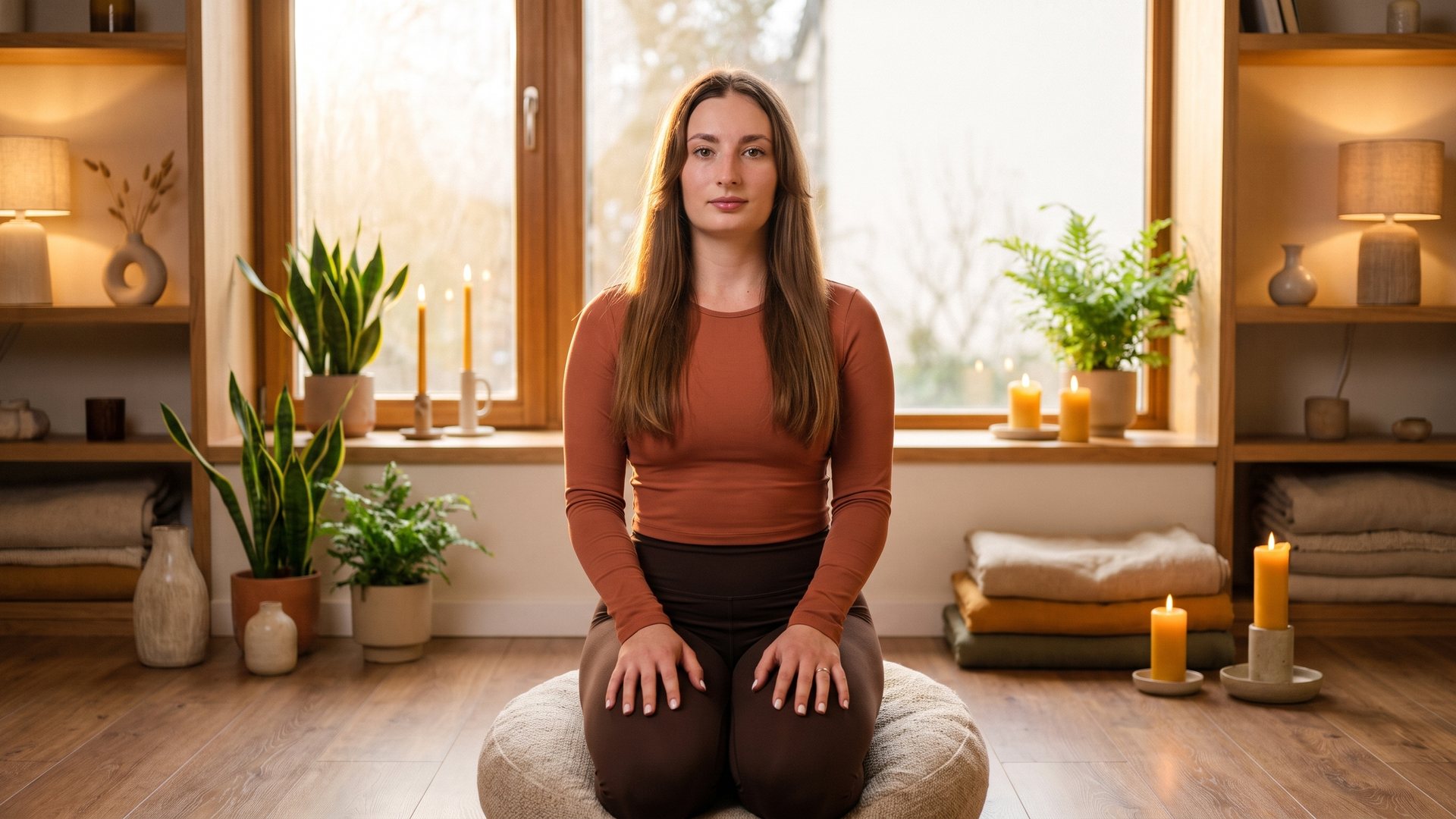
Find a comfortable seated position. The spine is upright — either cross-legged, or in a chair with the feet flat on the floor. Close the eyes if this is safe and comfortable in your current environment.
Take one or two natural breaths to arrive.
Inhale: breathe in slowly through the nose for a count of four. The breath fills the lower lungs first — the belly expands — then the mid-chest, then the upper chest. Do not force a full breath. Simply breathe in to a comfortable three-quarters capacity over the count of four.
Retain: hold the breath at the top for four counts. This is a comfortable hold, not a strained one. The throat is soft, the jaw relaxed. The hold should feel suspended rather than gripped.
Exhale: breathe out slowly through the nose (or gently through the mouth if this feels more natural) for four counts. The breath releases from the upper chest first, then the mid-chest, then the lower belly draws gently in.
Hold empty: pause after the exhale for four counts. This is the phase most people initially find most unusual — sitting with the lungs empty before the next inhale arises. It should feel like a brief suspension, not a suppression.
Return to the inhale. One cycle is complete.
Why Retention Matters
Both holds — at the top and at the bottom — are integral to the technique. They are not simply pauses between the active breath phases.
The retention after the inhale allows the parasympathetic nervous system to begin to register the full breath. It slows the transition between inhale and exhale, which tends to reduce the chest-tightening quality that anxiety produces.
The hold after the exhale is where many experienced practitioners report the deepest calm. In yoga philosophy, this pause — kumbhaka after rechaka — is described as a moment of stillness beyond the breath cycle. In physiological terms, it signals to the body that the exhale is complete, deepening the parasympathetic response before the next breath cycle begins.
If the hold after the exhale feels uncomfortable initially, shorten it — try a count of two until the practice becomes familiar, then gradually extend towards four.
When to Use It (and When Not)
Pre-Meeting, Pre-Bedtime, Mid-Panic
Before a high-stakes situation. The thirty to sixty seconds of box breathing before entering a difficult meeting, giving a presentation, or having a challenging conversation is enough to measurably reduce heart rate and the reactive quality that stress tends to produce. Four to six rounds is sufficient.
At bedtime. Box breathing as part of a pre-sleep ritual — ten minutes before turning out the light, sitting or lying still — can ease the transition into sleep for those whose minds remain active as the day ends. The equal-ratio pattern and the post-exhale hold are particularly conducive to the kind of mental quieting that sleep requires.
During acute stress. When the nervous system is activated — in the middle of a difficult moment, on a crowded Tube, in the aftermath of a difficult interaction — box breathing can interrupt the activation loop. Three to four rounds are often sufficient to shift the physiological state enough to think more clearly.
When not to use it: box breathing with full retention phases is not appropriate during pregnancy without guidance from a midwife or healthcare provider. People with certain respiratory or cardiac conditions should check with their GP before practising breath retention. During an active asthma episode or panic attack, simpler breathing techniques — a long exhale alone — are more accessible.
How Long Before It Works
Most people notice a physiological effect within the first three to six rounds of box breathing — roughly ninety seconds to two minutes of practice. This is not imagination: heart rate variability, a marker of nervous-system regulation, begins to improve rapidly during rhythmic, equal-ratio breathing in study conditions.
The longer-term effect — a reduction in baseline reactivity and a greater capacity to return to calm quickly after stress — emerges over weeks and months of consistent practice. This is the same principle that applies to any form of nervous-system training: the more regularly you create a calm physiological state intentionally, the more readily the nervous system returns to that state under pressure.
A 4-Week Habit-Builder
The goal of this plan is not frequency — it is consistency. Four weeks of daily practice, even briefly, is more valuable than intensive practice for a few days followed by forgetting.
Week 1 — Learning the pattern. Once per day, five rounds of 4-4-4-4. Focus entirely on the count. Choose one fixed moment: morning before rising, lunchtime, or before bed.
Week 2 — Noticing the effect. Continue once daily. After each practice, pause for thirty seconds and notice what has shifted — in the body, in the quality of thought, in tension patterns. This observation phase deepens the practice.
Week 3 — Situational use. Begin using box breathing situationally as well as habitually. Before one specific recurring stressor — the morning commute, a particular meeting, the moment you sit down at your desk — practise three to four rounds.
Week 4 — Review and sustain. Reflect on what you have noticed. Has sleep changed? Has the response to stress shifted? What would the simplest sustainable version of this practice look like for month two?
Most people who reach week four find the technique has become genuinely accessible — something the body knows how to do, rather than something that requires deliberate effort. That is the threshold worth reaching.
Frequently Asked Questions
Is box breathing the same as 4-7-8 breathing?
No. Both are structured pranayama-adjacent techniques, but 4-7-8 uses unequal ratios (four in, seven hold, eight out) with a strong emphasis on the extended exhale. Box breathing uses equal ratios throughout. Both are effective; box breathing is generally considered easier to learn and remember, making it more accessible for situational use.
Can I practise box breathing lying down?
Yes. Lying down is comfortable and effective for pre-sleep practice. The only consideration is that some people find the post-exhale hold slightly more pronounced when lying flat — simply adjust to a count that feels comfortable.
How does box breathing relate to yoga pranayama?
It is directly related. Sama vritti — equal-ratio breathing — is a foundational pranayama technique. Yoga’s breathing tradition has many variants on structured, rhythmic breath, of which box breathing is one of the most accessible. In a Hatha class at Your Ritual Yoga, pranayama is integrated into every session. The Ritual Experience also includes the calming resonance of the singing bowls, which deepens the effect of whatever breathwork precedes them.
Is there a risk of hyperventilating?
If the breath is kept slow and the count is genuinely four seconds per phase, hyperventilation is not a risk. If you feel lightheaded, simply return to your natural breath. Lightheadedness during breathwork usually indicates the breaths are being taken too quickly or too forcefully.
Can children practise box breathing?
Yes, with age-appropriate guidance. It is widely used in school settings as a stress management tool and is safe for most children. A count of three rather than four may be more comfortable for younger children.
Pranayama is at the heart of every class at Your Ritual Yoga. Come and learn it with guidance — in a warm, quiet room, with time to breathe. Join a Hatha class.
About the author
Tanya is a Yoga Alliance RYS 200 certified yoga teacher (ID 252157), trained at Devvrat Yoga School in Varkala, India (December 2025). She teaches Hatha and Yin yoga at Your Ritual Yoga in Golders Green, NW11 — a small, intentional studio where every class includes sound healing with Himalayan singing bowls and a post-class herbal tea ritual. www.ritual-yoga.co.uk