Written by Tanya — Yoga Alliance RYS 200 (ID 252157), trained at Devvrat Yoga School, Varkala, India (December 2025). Tanya teaches Hatha and Yin yoga at Your Ritual Yoga in Golders Green, NW11.
There are days when yoga for fatigue is not a question of motivation — it is a question of understanding what your body actually needs. On those days, the standard advice (“just show up, you’ll feel better once you’re moving”) can feel not only unhelpful but genuinely counterproductive.
Sometimes the kindest, most effective thing you can do is less. Far less. A blanket on the floor. A bolster. Five minutes with your legs up the wall. And the permission — which nobody else can give you, only you — to call that a practice.
This post is for the days you have nothing left.
Energy is a nervous-system state
Most people think of energy as a fuel problem. You are tired because you did not sleep enough, ate the wrong things, or worked too hard. And sometimes that is true. But chronic low energy — the kind that sits in your bones even after a full night’s sleep, the kind that accompanies long periods of stress or emotional labour — is primarily a nervous-system problem.
When the sympathetic nervous system (the fight-or-flight branch) has been running for too long without adequate recovery, the body reaches a state physiologists call allostatic overload. The stress hormones that were meant to be short-term emergency measures — cortisol, adrenaline — become chronic background noise. And one of the most common symptoms is persistent exhaustion.
The paradox is this: vigorous exercise, which many people instinctively reach for when they feel sluggish, adds further demand to an already depleted system. If you are genuinely fatigued — not just a little sleepy — pushing through a strong vinyasa class may leave you feeling worse, not better.
This is not weakness. It is physiology.
Gentle yoga, specifically the kind that activates the parasympathetic nervous system — the rest-and-digest branch — offers a different route. Not through effort, but through surrender. The body can only restore itself when it feels safe enough to stop bracing.
The ‘less is more’ rule for fatigue
In traditional yoga philosophy, prana — life-force energy — is understood not as something manufactured through effort but as something that accumulates when we stop leaking it. Excessive striving, constant stimulation, emotional reactivity: these are all understood as drains on prana. Rest, stillness, and breath are the refill.
Modern nervous-system science arrives at a strikingly similar place.
When you are fatigued, the most therapeutic yoga practice is one that:
- Requires minimal muscular effort
- Keeps the heart rate low and even
- Involves long, passive holds that allow connective tissue to soften without force
- Prioritises the exhale — the breath pattern most strongly linked to parasympathetic activation
- Avoids inversions that raise heart rate or demand balance, which require nervous-system engagement
This is, in essence, a restorative or Yin yoga practice. It may not look like “doing something.” That is precisely the point.
One thing worth naming: resting on purpose is different from collapsing on the sofa. The intention matters. When you come to a bolster or a blanket with the conscious decision to restore, something in the nervous system receives that differently. You are not giving up. You are choosing to receive.
A 20-minute restorative sequence
This sequence asks nothing of you. You need a blanket, a pillow or bolster, and a wall. Move slowly into each shape. Stay for the suggested time. Let the breath soften rather than direct it.
Supported supine poses
Supported Savasana — 5 minutes
Lie on your back with a rolled blanket under your knees and a thin pillow beneath your head. Arms fall slightly away from the body, palms face up. Let the floor hold you completely. Do nothing. If thoughts arrive, let them. You do not need to chase them away — simply do not follow them.
Breathe naturally. Notice, after a minute or two, whether the exhale begins to lengthen on its own.
Reclined Bound Angle / Supta Baddha Konasana — 5 minutes
From Savasana, bring the soles of your feet together and allow the knees to open out to each side. Place a folded blanket under each knee if the inner thighs feel any strain. This opens the hips passively and gently — no muscular engagement required.
This pose is described in the Yin tradition as deeply cooling and calming. Stay with the breath. Notice any holding in the jaw, the throat, the belly, and invite it to soften.
Legs up the wall
Viparita Karani — 8–10 minutes
Sit sideways next to a clear section of wall. Swing your legs up as you lower your back to the floor, bringing your sitting bones as close to the wall as is comfortable. Your legs rest against the wall, ankles uncrossed.
This mild inversion reverses the blood-pooling that comes from sitting or standing all day. It activates the baroreceptors in the neck, signalling to the brain that blood pressure can ease — a direct trigger for parasympathetic activity. Many students find this single pose more genuinely restorative than a full active class.
Remain here for eight to ten minutes. Let your arms rest open. Close your eyes. Allow the exhale to be twice as long as the inhale — in for four counts, out for eight — if that arises naturally.
Transition to your side — 2 minutes
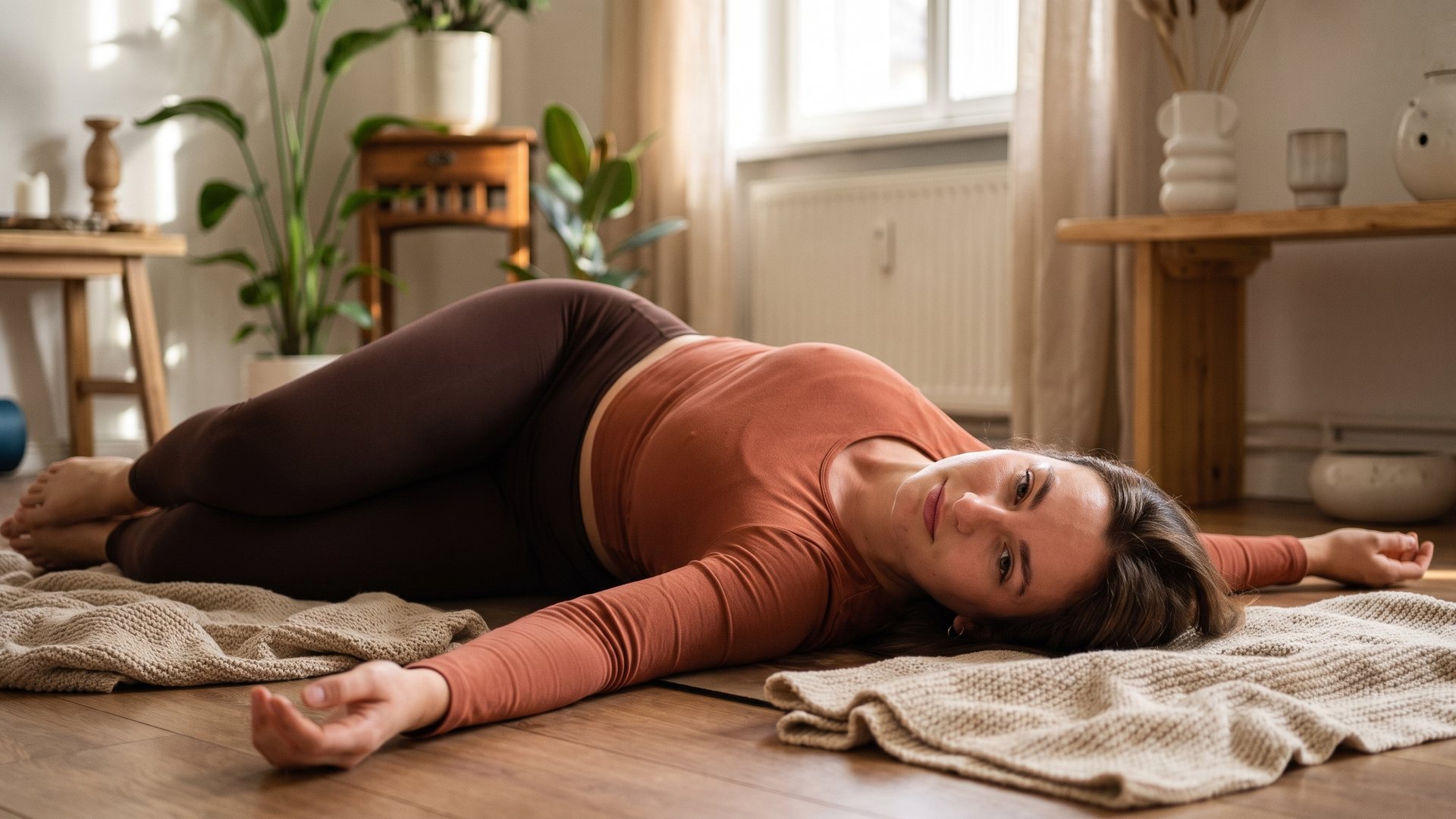
When you are ready, slowly bring your knees to your chest, roll to one side, and pause there. Do not rush to sit up. Rest on your side, drawn into a gentle curl, for two full minutes before slowly pressing yourself to seated.
This transition matters. The nervous-system shifts that happen in restorative yoga can be disrupted by standing up abruptly. Honour the threshold.
When fatigue is medical
Gentle yoga may support energy and wellbeing — but persistent, unexplained fatigue is always worth discussing with your GP.
Chronic fatigue red flags — see a GP
If you notice any of the following, please seek medical advice before or alongside any yoga practice:
- Fatigue that has persisted for more than four weeks without a clear cause
- Post-exertional malaise — exhaustion that worsens significantly after even mild physical effort and takes days to recover from (a hallmark of ME/CFS)
- Fatigue accompanied by weight change, persistent low mood, breathlessness, or heart palpitations
- Fatigue following a viral illness that has not resolved within expected timelines
In conditions such as ME/CFS, fibromyalgia, or post-viral fatigue, the restorative approach described here may still be appropriate — but should be tailored carefully. A one-to-one session with a knowledgeable teacher is often the safest starting point.
There is no one-size-fits-all practice. Your body is the authority.
Frequently Asked Questions
Is it okay to do yoga when I am exhausted?
Gentle, restorative yoga is generally appropriate for tiredness and low energy. What is not recommended for exhausted bodies is vigorous, high-effort practice. If in doubt, prioritise stillness and breath over movement.
How is restorative yoga different from just lying down and resting?
The intention and breath are different. In restorative yoga, you are actively choosing to restore — using specific positions that support circulation and nervous-system regulation — and practising conscious breath. This can produce a measurably deeper recovery than passive rest on the sofa, though both have value.
How often should I practise restorative yoga if I have low energy?
Even two or three times a week at fifteen to twenty minutes can make a noticeable difference over a month. Frequency matters more than duration.
Can Yin yoga help with chronic fatigue?
Yin yoga shares many qualities with restorative yoga and may support nervous-system regulation. It is not a treatment for medical conditions, but for general fatigue driven by stress and depletion, many students find regular Yin practice genuinely helpful.
What should I wear?
Loose, warm layers — your body temperature drops during stillness. Socks. A blanket if you have one. Nothing else is needed.
Ready to rest properly? Our Yin yoga classes are built for exactly this. Come and experience the full ritual — sound healing with Himalayan singing bowls, herbal tea, and a teacher who understands that sometimes the bravest thing is to stop. Book a Yin class →
About the author
Tanya is a Yoga Alliance RYS 200 certified yoga teacher (ID 252157), trained at Devvrat Yoga School in Varkala, India (December 2025). She teaches Hatha and Yin yoga at Your Ritual Yoga in Golders Green, NW11 — a small, intentional studio where every class includes sound healing with Himalayan singing bowls and a post-class herbal tea ritual. www.ritual-yoga.co.uk