Written by Tanya — Yoga Alliance RYS 200 (ID 252157), trained at Devvrat Yoga School, Varkala, India (December 2025). Tanya teaches Hatha and Yin yoga at Your Ritual Yoga in Golders Green, NW11.
Pigeon pose is one of the most requested shapes in any yoga class — and one of the most misunderstood. Students who sit at a desk for most of the day often arrive with hips so compressed that their first encounter with pigeon feels confrontational rather than releasing. Others skip it altogether, convinced their bodies simply “can’t do it.”
Both responses miss the point.
Pigeon pose is not a test of hip flexibility. It is a slow, sustained conversation with the deepest layers of tissue in the hip — and, according to many yoga traditions, with the emotions stored there. Done well, it is among the most effective tools in yoga for addressing the chronic tightness that accumulates from a modern sedentary life.
This guide walks through three difficulty levels, full alignment, and the most common mistakes — so you can meet pigeon pose wherever your hips are today.
Why pigeon works the hips so deeply
The hips are a complex junction of six external rotator muscles (the deep six), the hip flexors, the IT band, the glutes, the adductors, and several layers of connective tissue — including the dense fascia that encases the joint. When we sit for long hours, many of these structures shorten and compress simultaneously. The result is the generalised tightness that makes crossing the legs, walking uphill, or even standing for long periods feel like hard work.
Most stretches target muscles in isolation. Pigeon pose is unusual because it simultaneously addresses:
- The external rotators of the front leg (particularly piriformis, which is implicated in sciatica-like pain)
- The hip flexors and psoas of the back leg, which shorten dramatically with prolonged sitting
- The connective tissue — fascia and joint capsule — that supports and surrounds the hip joint
The connective tissue piece matters especially in a Yin yoga context. Fascia responds not to strong, fast stretching but to sustained, moderate pressure held over time — typically three to five minutes. This is why pigeon held for ninety seconds feels different from pigeon held for four minutes. The first stretches muscle. The second begins to soften the deeper layers.
Three difficulty levels
Not every body is ready for the full expression of pigeon pose, and that is entirely fine. Begin with the level that allows your hips to remain close to level, your breath to stay calm, and your body to feel challenged but not strained.
Supine figure-4
This is sometimes called “dead pigeon” or reclined pigeon, and it offers almost identical hip benefits with none of the weight-bearing demands.
Lie on your back with knees bent and feet flat on the floor. Cross your right ankle over your left thigh, just above the knee. Flex the right foot to protect the knee. If you feel enough sensation here, stay. To deepen, draw both legs towards your chest — left foot lifts off the floor — and you can reach through or around the left leg to draw it closer. Keep the back of the head on the floor. Hold for two to four minutes. Swap sides.
This version is excellent during menstruation, after a long day on your feet, or whenever the hips feel particularly resistant.
Half pigeon
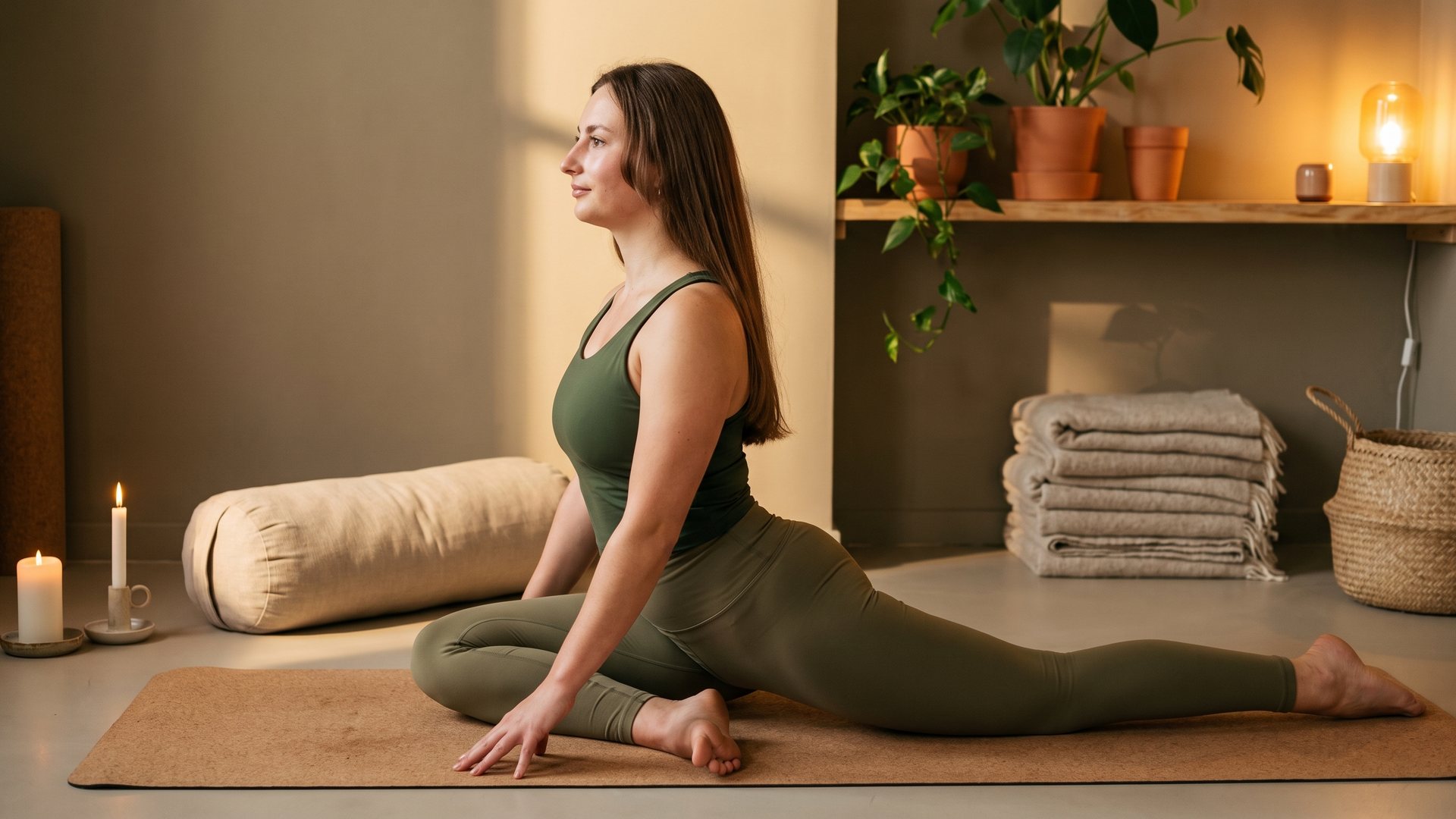
From a hands-and-knees position, slide your right knee forward towards your right wrist, and angle your right shin across the mat so the right foot points towards the left. Extend the left leg straight back. The hips sink towards the mat — if the right hip does not reach the floor, place a folded blanket or block beneath it. The hips should be approximately level: a twisted or collapsed pelvis means the hip is not benefiting from the pose and the sacrum is taking strain instead.
Hands rest on either side of the front shin. You can stay upright, or — once the hips settle — begin to walk the hands forward and lower the torso towards the mat.
Hold for two to four minutes in a Yin practice, or thirty to sixty seconds in Hatha. Breathe steadily. Let the hip soften rather than forcing it down.
Sleeping pigeon
This is the full forward fold of half pigeon. From half pigeon, walk both hands forward until the forearms and eventually the forehead rest on the mat. The chest melts towards the earth. The hips remain heavy.
This is the version most people picture when they imagine pigeon pose. It asks for genuine hip opening and — importantly — the ability to let go. The instinct when sensation intensifies is to grip, clench, and resist. Sleeping pigeon teaches the opposite.
Alignment essentials
Stacked hips and protecting the front knee
The most important alignment point in pigeon is the relationship between the front knee and the front ankle. The knee is a hinge joint — it is designed to flex and extend in one plane. It is not designed to rotate. When the knee is placed awkwardly in pigeon without the ankle being flexed, the rotational force travels directly to the knee joint rather than being absorbed by the hip.
To protect the front knee:
- Flex the front foot. This engages the stabilising muscles around the ankle and reduces rotational torque at the knee.
- Keep the shin at an angle your hip allows. A bigger angle (shin more parallel to the front of the mat) requires greater external rotation at the hip. If your hip is very tight, let the shin angle more acutely — the foot comes closer to the groin.
- Support the front hip if it does not reach the floor. A block or blanket under the right buttock keeps the pelvis level and takes strain off the knee.
If you feel any sharp sensation in the knee — not the hip — come out of the pose. Knee pain in pigeon is nearly always a sign that the rotation is happening at the wrong joint.
Common mistakes
Rushing the depth. Pigeon pose is not a shape to achieve quickly. The hip flexors and external rotators need time to release. Moving into the deepest version immediately — particularly sleeping pigeon — before the outer hip has begun to soften can cause the body to guard rather than open.
Holding the breath. This is the most common response to intensity in any deep hip opener. Watch for the breath becoming shallow or stopping altogether. When you notice it, take a full, deliberate inhale and a long exhale. The nervous system responds to the breath. When the breath lengthens, the tissues often follow.
Collapsing the back hip inward. In half pigeon, the back leg sometimes rotates inward (the foot turns out, the hip drops to one side). This collapses the sacrum and reduces the hip-opening effect on the front leg. Press the top of the back foot firmly into the mat and draw the back inner thigh gently towards the ceiling.
Ignoring discomfort in the lower back. If you feel sensation in the lumbar spine rather than the outer hip, the pelvis is likely tilted too far forward. Tuck the tailbone gently, draw the lower belly in slightly, and reduce the depth of the fold.
How long to hold
Yin holds vs Hatha holds
The answer depends entirely on what you are trying to achieve.
In Hatha yoga, pigeon is typically held for thirty to ninety seconds — enough time for a muscular stretch and a moment of breath. This is warming and effective for maintaining range of motion.
In Yin yoga, the hold extends to three to five minutes — sometimes longer in experienced practitioners. This longer duration allows the fascia and joint capsule to respond. The sensation in the first sixty seconds is muscular and quite intense. By minutes two and three, the muscle tends to soften, and the deeper, quieter sensation of fascial release begins. This is the state many Yin practitioners describe as the sweet spot.
There is no wrong answer between the two. A five-minute Yin hold is not “better” than a one-minute Hatha hold — it is different. Combine both across your weekly practice for the most comprehensive results.
Frequently Asked Questions
Is pigeon pose bad for the knees?
Pigeon pose is generally safe for healthy knees when practised with correct alignment — specifically a flexed front foot, a supported front hip, and careful attention to where sensation is felt. Any sharp pain in the knee (not the hip) is a signal to come out of the pose. If you have a knee injury or recent surgery, consult a physiotherapist before attempting pigeon.
Why do I feel emotional in pigeon pose?
Many practitioners experience unexpected emotional responses — tears, sighing, a sudden sense of release — in deep hip openers. Yoga philosophy holds that the hips store unexpressed emotion; Western somatic therapy offers compatible explanations around the psoas muscle’s connection to the stress response. Whatever the mechanism, the experience is common and nothing to be alarmed by. Let it move through.
Can I do pigeon pose every day?
Yes, in moderate holds. If you practise Yin-length holds (three to five minutes), alternate sides daily rather than doing multiple sessions of the same side in a day. The connective tissue benefits from time to integrate between sessions.
My hips are very tight. Where should I start?
Begin with supine figure-4. This version allows you to find the hip-opening sensation without any bodyweight through the knee or hip joint. Practise it for two to four minutes per side, daily, for two to four weeks — you will likely find half pigeon becomes noticeably more accessible.
Is pigeon the same as Eka Pada Rajakapotasana?
They are related but different. The yoga pigeon described here is a preparatory shape. Eka Pada Rajakapotasana is a much deeper backbend requiring significant spinal and hip extension. Most general yoga classes work with the preparatory version.
Want to hold pigeon properly and feel what a long, guided Yin hold can do for your hips? Our Yin yoga classes include extended hip-opening sequences with full alignment guidance. And if you have a specific injury or area of restriction, our blog post on yoga for tight hips may help you understand what’s going on. Book a class →
About the author
Tanya is a Yoga Alliance RYS 200 certified yoga teacher (ID 252157), trained at Devvrat Yoga School in Varkala, India (December 2025). She teaches Hatha and Yin yoga at Your Ritual Yoga in Golders Green, NW11 — a small, intentional studio where every class includes sound healing with Himalayan singing bowls and a post-class herbal tea ritual. www.ritual-yoga.co.uk