Imagine lying in complete relaxation at the end of your yoga class, your body released, your mind quiet, and suddenly you hear a deep, resonant tone surrounding you. The sound vibrates through your entire being, creating a sensation of peace beyond what you thought possible. Your nervous system drops deeper into relaxation. Your mind becomes completely still. You touch a state of consciousness that feels almost transcendent.
This is the power of sound healing with singing bowls—a practice thousands of years old, now being validated by modern science.
At Your Ritual Yoga, we integrate singing bowl sound healing into every class, creating a unique experience that amplifies yoga’s transformative potential. In this article, I’ll explain what singing bowls are, how they work, the science behind their healing effects, and why this ancient practice is so valuable for modern wellbeing.
What Are Singing Bowls? Ancient Instrument, Modern Healing
Singing bowls are ancient instruments originating in the Himalayan regions of Nepal, Tibet, and India. Made from bronze and other metals, they produce rich, complex tones when struck or played with a special mallet.
For centuries, singing bowls were used in meditation practices, religious ceremonies, and healing rituals throughout Asia. But they’re not merely ceremonial—their unique acoustic properties create genuine physiological effects that modern science is now documenting.
The History & Cultural Significance
Ancient Roots: Singing bowls trace back to pre-Buddhist shamanic practices in the Himalayas. As Buddhism spread, singing bowls became integral to Buddhist meditation practices.
Tibetan Tradition: In Tibet, singing bowls were used in monasteries, temples, and healing practices. Monks would use bowls during meditation to deepen practice and create sacred space.
Modern Rediscovery: In the 1970s-80s, Western practitioners “rediscovered” singing bowls, initially as curiosities. But as people experienced their effects, scientific interest grew.
Contemporary Use: Today, sound healing with singing bowls is used in:
– Yoga classes (like Your Ritual Yoga)
– Meditation centres
– Sound healing therapy
– Hospital and hospice settings
– Stress management programs
– Sleep support
– Trauma recovery programs
How Singing Bowls Work
When you strike or play a singing bowl with a mallet, the bowl vibrates, producing sound. But sound is more than just what you hear—it’s vibration that literally moves through space and through your body.
The Physics:
– Sound travels in waves at specific frequencies (measured in Hertz)
– Singing bowls typically produce frequencies in the 40-600 Hz range
– These frequencies are within the range that significantly affects human nervous system function
– The vibrations physically move through the air and through your body’s tissues
The Biology:
Your entire body is made of cells vibrating at specific frequencies. When external vibrations (like singing bowl sounds) match or complement these frequencies, resonance occurs. This resonance literally changes how your cells vibrate—a process called “entrainment.”
The Science of Healing Sound: Why Singing Bowls Work
Scientific research is increasingly validating what practitioners have known for centuries: singing bowls create measurable physiological changes.
Nervous System Regulation
This is perhaps the most important benefit. Your nervous system exists in two primary states:
Sympathetic (Stress Response): Your body is ready for action. Heart rate increases, breathing quickens, cortisol releases. This is helpful in true emergencies but harmful when chronically activated by modern stress.
Parasympathetic (Relaxation Response): Your body is at rest. Heart rate slows, breathing deepens, digestion and healing activate. This is where genuine healing happens.
How singing bowls help: The specific frequencies and rhythms of singing bowl sounds signal your nervous system that it’s safe to relax. Your parasympathetic nervous system activates, creating a cascade of healing effects:
- Heart rate decreases
- Blood pressure drops
- Cortisol levels decrease
- Breathing deepens naturally
- Digestion improves
- Immune function strengthens
- Sleep becomes deeper
This nervous system shift is profound. For someone chronically stressed, this might be the first time in years their nervous system truly relaxes.
Brainwave Entrainment
Your brain produces electrical waves at different frequencies depending on your state:
Beta waves (12-30 Hz): Awake, active, thinking, processing
Alpha waves (8-12 Hz): Relaxed alertness, meditation, creative flow
Theta waves (4-8 Hz): Deep meditation, sleep, subconscious access
Delta waves (0.5-4 Hz): Deep sleep, healing
When you experience stressful beta wave activity (racing thoughts, anxiety), singing bowl frequencies can entrain your brainwaves towards alpha and theta—states of deep relaxation and healing.
This isn’t magic—it’s a well-documented neurological phenomenon. Your brain naturally synchronises with external rhythms and frequencies.
Vibrational Medicine
Every cell in your body vibrates at specific frequencies. Healthy cells vibrate at optimal frequencies; stressed, tight, or injured tissues vibrate at lower frequencies.
Singing bowl vibrations literally cause tissues to vibrate at healing frequencies. This process:
– Releases tension in tissues
– Improves circulation and lymphatic drainage
– Supports cellular healing
– Reduces inflammation
– Promotes tissue regeneration
Research shows that specific sound frequencies can even support bone healing and reduce pain.
Emotional Release
Emotions are literally stored in your body—particularly in muscles and connective tissue. When you experience stress or trauma, your muscles tense to protect you. Over years, this becomes chronic holding.
Singing bowl vibrations cause tissues to release tension, and as physical tension releases, emotional content often surfaces. Many people cry or feel emotional waves during sound healing—this is healthy release, not distress.
The Experience: What Happens During Sound Healing
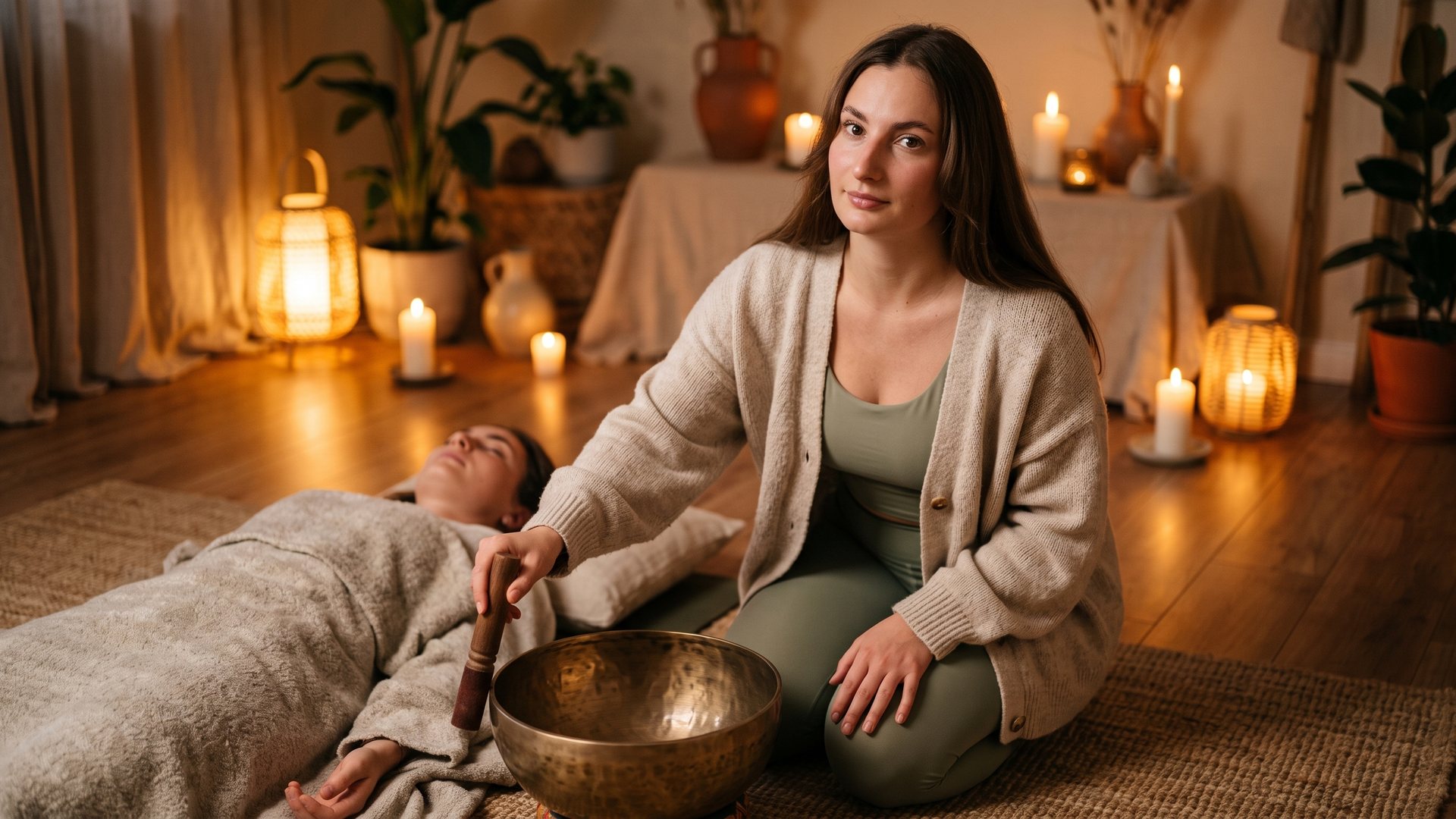
At Your Ritual Yoga, sound healing happens during Shavasana (final relaxation pose) at the end of class. Here’s what typically occurs:
Preparation
You’ve just completed physical yoga practice. Your body is warm, your muscles released, your nervous system beginning to calm. You lie in Shavasana—completely supported, arms at your sides, legs extended, fully receptive.
Your mind, which may have been active during practice, is now settling. You’re in an optimal state to receive sound healing.
The First Tones
Tanya strikes the singing bowl. The first tone emerges—deep, rich, complex. It surrounds you, almost tangible. You might feel it as much as hear it.
Your breath naturally deepens. Your body, which was already relaxed, releases further. There’s nothing to do, nowhere to go. You simply receive.
Deepening Relaxation
As Tanya continues playing, the vibrations move through your body. You might notice:
Physical sensations: Tingling, warmth, vibration, release. Your muscles might twitch as they release tension. Your body literally loosens at the cellular level.
Emotional sensations: Softening, opening, peace. Some people feel their heart open. Others feel deeply cared for. Some people cry.
Mental states: Your mind becomes completely still. Thoughts may continue but feel distant, unimportant. You’re present but not thinking—a state difficult to describe but unmistakable when experienced.
Spiritual experiences: Some people experience visions, colours, or a sense of connection to something greater. Others simply rest in profound peace.
Integration
As the bowl’s tones fade and silence returns, you rest in the peace created. There’s often a quality of timelessness—you’re not sure if minutes or hours have passed.
Gradually, you become aware of your body again, the room around you, sounds of the city outside. But you carry the peace with you, almost tangible.
Awakening
You’re gently invited back to full consciousness. You might slowly move your fingers and toes, take a deeper breath, and when ready, slowly sit up. Often, people move slowly and carefully—they don’t want to leave the peace they’ve accessed.
Many describe the experience as one of the most peaceful moments they’ve had in years.
The Physiological Effects Explained
Why Singing Bowls Affect You So Deeply
Frequency Matching: Singing bowls produce frequencies that naturally support relaxation. These frequencies match or complement your body’s natural healing frequencies.
Resonance: When external vibrations match your body’s natural frequencies, resonance occurs. This is why certain sounds feel good—they’re vibrating in harmony with your being.
Parasympathetic Activation: The sustained, rhythmic nature of singing bowl sounds signals safety to your nervous system. Your parasympathetic response activates—the biological mechanism where healing happens.
Whole-Body Effect: Unlike hearing a sound that only affects your ears, singing bowl vibrations move through your entire body. Tissues that are chronically tense literally vibrate at healing frequencies.
Measurable Changes
Research shows that sound healing produces measurable physiological changes:
Heart Rate Variability: Increases, indicating better nervous system flexibility
Cortisol Levels: Decrease, indicating reduced stress hormone
Blood Pressure: Decreases, indicating relaxation
Brain Activity: Shifts towards alpha and theta waves, indicating relaxation and meditation
Heart Rate: Decreases, indicating activation of parasympathetic response
Breathing: Deepens and slows naturally
These changes persist for hours after sound healing, supporting ongoing relaxation and healing.
Sound Healing Beyond Singing Bowls
While Your Ritual Yoga emphasises singing bowls, sound healing encompasses other practices:
Other Sound Healing Instruments & Methods
Gongs: Large metallic discs producing complex, evolving tones. Gong baths (lying under sustained gong sounds) create profound relaxation.
Tibetan Bowls: Similar to singing bowls but with different acoustic properties.
Crystal Bowls: Made from pure quartz crystal, these bowls produce very high frequencies associated with healing and spiritual opening.
Tuning Forks: Using frequencies linked to specific healing (solfeggio frequencies, for instance).
Voice & Toning: Mantras and vocal toning create healing vibrations.
Binaural Beats: Using two slightly different frequencies to create brainwave entrainment.
Nature Sounds: Flowing water, ocean waves, rainfall create naturally healing frequencies.
The Integration: Sound Healing + Yoga Practice
At Your Ritual Yoga, sound healing is integrated with yoga, not separate from it. Here’s why this integration is so powerful:
Yoga Prepares You for Sound Healing
Physical relaxation: Yoga poses release muscular tension, allowing deeper vibrational effects.
Nervous system priming: Pranayama (breathing) and meditation begin parasympathetic activation, making you receptive to sound healing.
Mental quieting: Yoga naturally quiets the mind, creating the still state where sound healing is most effective.
Emotional openness: Yoga often releases emotions, opening the heart to receive the benefits of sound healing.
Sound Healing Deepens Yoga’s Effects
Amplified relaxation: Sound healing takes you deeper into relaxation than yoga alone might achieve.
Nervous system reset: The specific frequencies further activate parasympathetic response.
Emotional integration: Singing bowl vibrations support emotional release and processing.
Spiritual opening: Many practitioners report that sound healing during Shavasana opens spiritual dimensions of practice.
The Result
The combination creates something greater than either alone. Many students report that the singing bowl experience during Shavasana is their favourite part of class—and often the part that catalyses their most significant healing.
Common Questions About Sound Healing
Q: Is sound healing scientifically proven?
A: Growing body of research supports singing bowl benefits. Studies document nervous system changes, stress reduction, improved sleep, and pain relief. While more research is needed, the evidence is compelling.
Q: Do I need to “believe in” sound healing for it to work?
A: No. The physiological effects occur regardless of belief. Your body responds to vibrations at the cellular level. That said, openness and receptivity tend to enhance effects.
Q: Can sound healing replace other treatments?
A: Sound healing is complementary, not replacement for medical care. If you’re managing serious health conditions, continue working with your healthcare provider while using sound healing as additional support.
Q: What if I don’t feel anything during sound healing?
A: Effects are often subtle. You might not notice immediate sensations but still receive nervous system benefits. Some people feel dramatic shifts; others experience subtle peace that deepens over time.
Q: Is it safe?
A: Yes. Sound healing is safe for most people. Very rarely, intense vibrations might trigger discomfort in people with certain conditions—let your teacher know about any concerns.
Q: Can children benefit from sound healing?
A: Yes. Children often respond beautifully to sound healing. Many schools are incorporating it for stress reduction and focus.
Creating Your Own Sound Healing Experience
While singing bowls are traditionally played by trained practitioners, you can support sound healing in your life:
At Home
Listen to singing bowl recordings: Apps and YouTube offer singing bowl recordings for meditation and sleep.
Create a ritual: Set aside time specifically for listening to sound healing. Light a candle, sit quietly, and fully receive.
Use gentle music: Choose music with slow tempos (below 60 BPM), minimal lyrics, and natural instruments. This supports relaxation.
Deepen Your Practice
Attend sound healing classes: Your Ritual Yoga classes incorporate sound healing. Regular attendance deepens benefits.
Invest in personal sound healing: Some practitioners offer private sound healing sessions focused entirely on vibrational healing.
Learn basic bowl playing: Some teachers offer workshops on learning to play singing bowls, allowing you to create healing vibrations for yourself.
The Deeper Significance
Sound healing isn’t new—it’s ancient wisdom being rediscovered. For thousands of years, cultures recognised that vibration, frequency, and sound are fundamental to existence and healing.
Modern physics confirms what ancient practitioners knew: everything vibrates. Your body is a symphony of vibrations. Sound healing attunes these vibrations towards harmony and healing.
When you experience singing bowl sound healing during yoga, you’re participating in a practice as old as human civilization—a practice that recognises:
- Your body’s natural capacity for healing
- The power of vibration and resonance
- The interconnection between all things
- The significance of sacred space and ritual
Sound Healing at Your Ritual Yoga
Every class at Your Ritual Yoga includes sound healing with singing bowls during Shavasana. This isn’t an extra feature—it’s integral to our approach to yoga and healing.
Why do we emphasise this? Because we’ve seen it transform lives. We’ve watched stressed professionals access deep peace they thought impossible. We’ve seen people with chronic pain experience relief. We’ve witnessed emotional breakthroughs and spiritual openings.
Sound healing amplifies yoga’s already profound potential.
Getting Started with Sound Healing
You don’t need any special preparation or belief system. Simply:
- Come to a class at Your Ritual Yoga
- Complete your yoga practice fully
- Lie in Shavasana with openness and receptivity
- Allow the singing bowl vibrations to move through you
- Notice whatever arises—peace, emotion, sensation, release
That’s it. Your nervous system will respond. Your cells will vibrate at healing frequencies. Your body will relax deeper than before.
The invitation is simple: experience it yourself.
About Tanya
Tanya is a Yoga Alliance RYS 200-certified Hatha and Yin yoga teacher (Reg. ID 252157), trained at Devvrat Yoga School in Varkala, India (200-hour intensive, December 2025) under Rakesh Kumar. She teaches small-class, ritual-led Hatha and Yin yoga in Golders Green, NW11 London — integrating singing-bowl sound healing in Shavasana and a post-class herbal tea ritual.
Read more about Tanya · See the weekly schedule · Enquire about private sessions