Written by Tanya — Yoga Alliance RYS 200 (ID 252157), trained at Devvrat Yoga School, Varkala, India (December 2025). Tanya teaches Hatha and Yin yoga at Your Ritual Yoga in Golders Green, NW11.
Child’s pose is the posture beginners are most likely to overlook and the one experienced practitioners return to most often. It requires no strength, no flexibility, and no particular knowledge of yoga. It asks only one thing: that you stop, fold in, and breathe.
In its apparent simplicity, Balasana (from the Sanskrit bala, meaning child, and asana, meaning posture) does something that many more complex poses cannot: it communicates safety to the nervous system. The body, curled and grounded, the forehead resting on the mat, the breath naturally slowing — this is a posture of genuine rest.
This guide explains what child’s pose actually does, how to practise it well, and how to adapt it for any body.
1. Why Child’s Pose Is Foundational
In a yoga class, child’s pose is offered as a resting place — somewhere to pause between more demanding shapes, somewhere to return when the breath becomes strained, somewhere to simply be when the practice feels like too much.
But calling it a “resting pose” can mislead people into dismissing it. Child’s pose is actively doing something. While you hold it:
- The lumbar spine is gently lengthened, decompressing the facet joints that bear load all day
- The hips and inner groins are passively stretched — the wide-knee variation in particular targets the inner thighs and hip flexors
- The adrenal glands (which sit just above the kidneys, in the region of the lower back) are gently compressed, which is traditionally said in yoga to have a calming, grounding effect
- The forehead pressing against the floor stimulates the vagus nerve pathway, encouraging a shift from sympathetic (alert, activated) to parasympathetic (resting, digesting) nervous-system dominance
The result: heart rate slows, breath deepens, and the mind has permission to quieten.
For busy people — those who spend their days in a state of low-grade activation, moving between tasks and notifications — child’s pose can be genuinely therapeutic even outside a formal yoga class. Two or three minutes on the floor at the end of the working day can meaningfully change the quality of the evening that follows.
2. How to Do It Properly
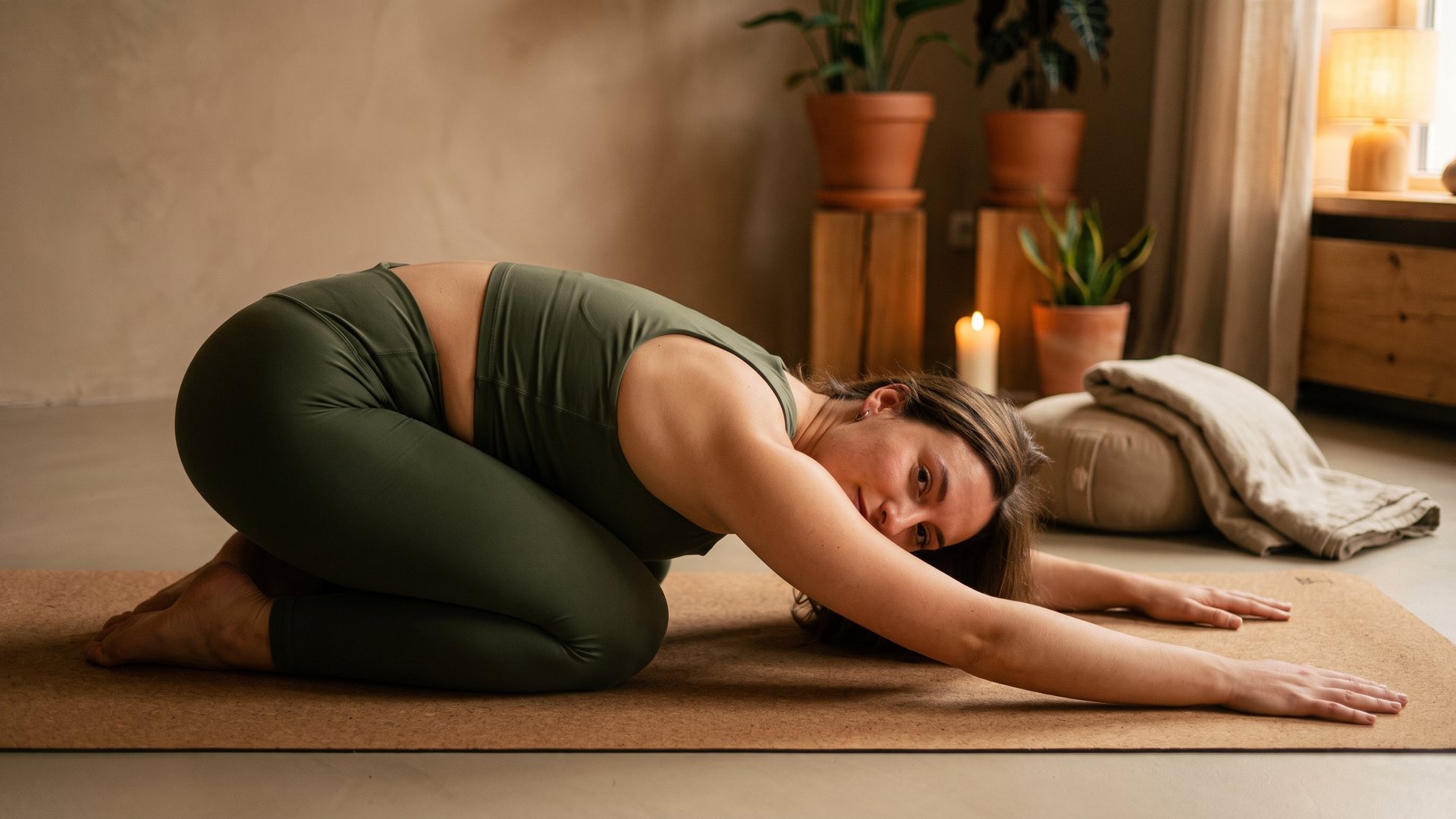
Begin kneeling on the mat with the knees together or apart (more on this below). Bring the big toes to touch. Sit back towards the heels — or as close as you comfortably can. On an exhale, fold the torso forward and rest it between or on top of the thighs.
Extend the arms forward with palms face-down, or release them back alongside the body with palms face-up. The latter creates more release through the shoulders.
Allow the forehead to rest on the mat, a folded blanket, or a block if the floor feels far away.
Close the eyes. Breathe slowly and naturally.
In Hatha classes at Your Ritual Yoga, we typically hold child’s pose for 30–60 seconds as a resting shape between sequences. In Yin classes, where the goal is to reach the deeper connective tissue, we may hold it for 3–5 minutes — long enough for the fascia around the hips and lower back to begin genuinely releasing.
3. Four Modifications for Every Body
Wide-Knee Child’s Pose
Take the knees as wide as the mat allows, while keeping the big toes touching. The torso drops between the thighs rather than resting on top of them. This is often a more accessible version for people with a larger torso, and it creates more space through the inner groin and hips than the narrow-knee variation.
Narrow-Knee Child’s Pose
Knees together, torso folded over the thighs. This version creates more compression through the front of the body — some people find this deeply grounding; others find it claustrophobic. Try both and notice which feels more easeful.
Supported Child’s Pose
Place a bolster or rolled blanket lengthwise on the mat. Straddle it with the knees and fold forward so the entire front of the torso rests on the bolster, the head turned to one side. This is a profoundly restorative version — the support takes away any remaining effort, and many students find themselves genuinely close to sleep within a few minutes.
For anyone with significant hip or lower back tension, the supported version is often the most accessible starting point.
Side Child’s Pose
From a standard wide-knee child’s pose, walk both hands to the right, creating a lateral stretch through the left side of the body. Hold for several breaths, then walk the hands to the left. This variation targets the intercostals, the lateral hip, and the side body more directly than the central version.
Tight Hips? Stiff Knees? Pregnant? Adaptations
Tight hips or stiff knees: Place a rolled blanket between the backs of the thighs and the calves. This reduces the depth of the knee bend and the demand on the hip flexors simultaneously.
Tender knees on a hard floor: Fold an extra blanket under the knees for padding.
Third trimester of pregnancy: A standard child’s pose places pressure on the abdomen and is not appropriate. Use a wide-legged supported version with a bolster, or replace it with a seated forward fold in a chair. Always consult your midwife or obstetrician before beginning a yoga practice during pregnancy.
Difficulty reaching the floor: Use a block or folded blanket under the forehead. The head should feel fully supported — not straining towards the floor.
4. When to Use It in a Sequence
Child’s pose sits well:
- At the opening of practice — before anything demanding, as a moment of arrival and orientation
- Between strong backbends — as a neutralising counter-pose to relieve the lumbar spine
- After arm balances or inversions — as a grounding shape when the nervous system is activated
- At any point when the breath becomes strained — this is the signal the body uses to say it needs a pause
- At the very end, before or as Savasana — particularly in a Yin class, where the transition from long holds to final stillness can be eased by a brief fold
One instruction I give often in class: you are always welcome in child’s pose. It is not a concession or a sign of weakness. It is a choice to listen to your body — which is the entire point of the practice.
5. Common Mistakes
Holding the breath. Child’s pose asks you to breathe into the back of the body — into the lower back and the space between the shoulder blades. If you find yourself holding or shortening the breath, place one hand on the lower back and direct the inhale towards it.
Reaching the arms too far forward and creating shoulder tension. The arms should rest, not reach. If the shoulders are creeping towards the ears, bring the arms alongside the body instead.
Rushing through it. Child’s pose is not a 5-second pause. Give it at least 30 seconds — and if you can, 2–3 minutes. The nervous-system effect accumulates over time.
Assuming it won’t work for your body. Almost every body can access some version of child’s pose. The modifications above are not workarounds — they are the pose, adapted intelligently.
Child’s pose is practised every week in our Hatha classes in Golders Green. If you would like to experience it — and the rest of a full Hatha or Yin sequence — book a class at Your Ritual Yoga.
About the author
Tanya is a Yoga Alliance RYS 200 certified yoga teacher (ID 252157), trained at Devvrat Yoga School in Varkala, India (December 2025). She teaches Hatha and Yin yoga at Your Ritual Yoga in Golders Green, NW11 — a small, intentional studio where every class includes sound healing with Himalayan singing bowls and a post-class herbal tea ritual. www.ritual-yoga.co.uk