Written by Tanya — Yoga Alliance RYS 200 (ID 252157), trained at Devvrat Yoga School, Varkala, India (December 2025). Tanya teaches Hatha and Yin yoga at Your Ritual Yoga in Golders Green, NW11.
Knowing how to choose a yoga mat is one of those decisions that new students often overthink. The market has expanded dramatically in recent years — there are now mats at every price point, in every thickness, from a dozen different materials, with alignment guides, memory foam layers, grip technology, and enough branding to suggest that your mat choice says something significant about you as a person.
It does not. What matters is whether the mat does its job for your body and your practice.
This guide cuts through the noise. There are four things that actually matter, a few things that are largely irrelevant, and three specific recommendations across different budgets that cover most beginners honestly.
1. The Four Things That Matter
Thickness, Grip, Length, Material
Thickness
Yoga mats range from roughly 1.5mm (travel mats, designed to fold small) to 6mm or more (extra-cushioned mats for sensitive joints). For most beginners, 4–5mm is the practical sweet spot.
Thinner mats (2–3mm) offer better ground connection and proprioception — useful for balance poses — but can be hard on knees, wrists, and ankles in longer holds. Thicker mats (6mm+) are cushioned and joint-friendly, but can feel spongy and unstable in standing balances, and are heavier to carry.
For Yin yoga, where you spend extended time in floor poses, a slightly thicker mat or the addition of a folded blanket makes a meaningful difference to comfort. For Hatha, 4–5mm is usually sufficient.
Grip
Grip is the mat’s ability to prevent you from sliding when weight is applied — both your hands and feet on the mat surface, and the mat itself on the floor beneath. Good grip matters in Downward Dog, in Warrior poses, and in any pose where you are bearing weight on your hands.
Most mats have a textured top surface designed to create friction. Natural rubber bases tend to grip hard floors well. The challenge is that grip degrades when the mat is wet from sweat — which is why some students use a thin towel on top during more vigorous practices.
For Hatha and Yin yoga, which are not intense sweating practices, standard grip is usually entirely adequate.
Length
Standard yoga mats are approximately 173cm (68 inches) long. Most adults fit within this length for all lying-down poses. If you are taller than about 185cm, it is worth checking the mat’s length before buying — some brands offer longer versions (183cm or 200cm) that provide the extra few centimetres needed for Savasana without your heels hanging off the end.
Material
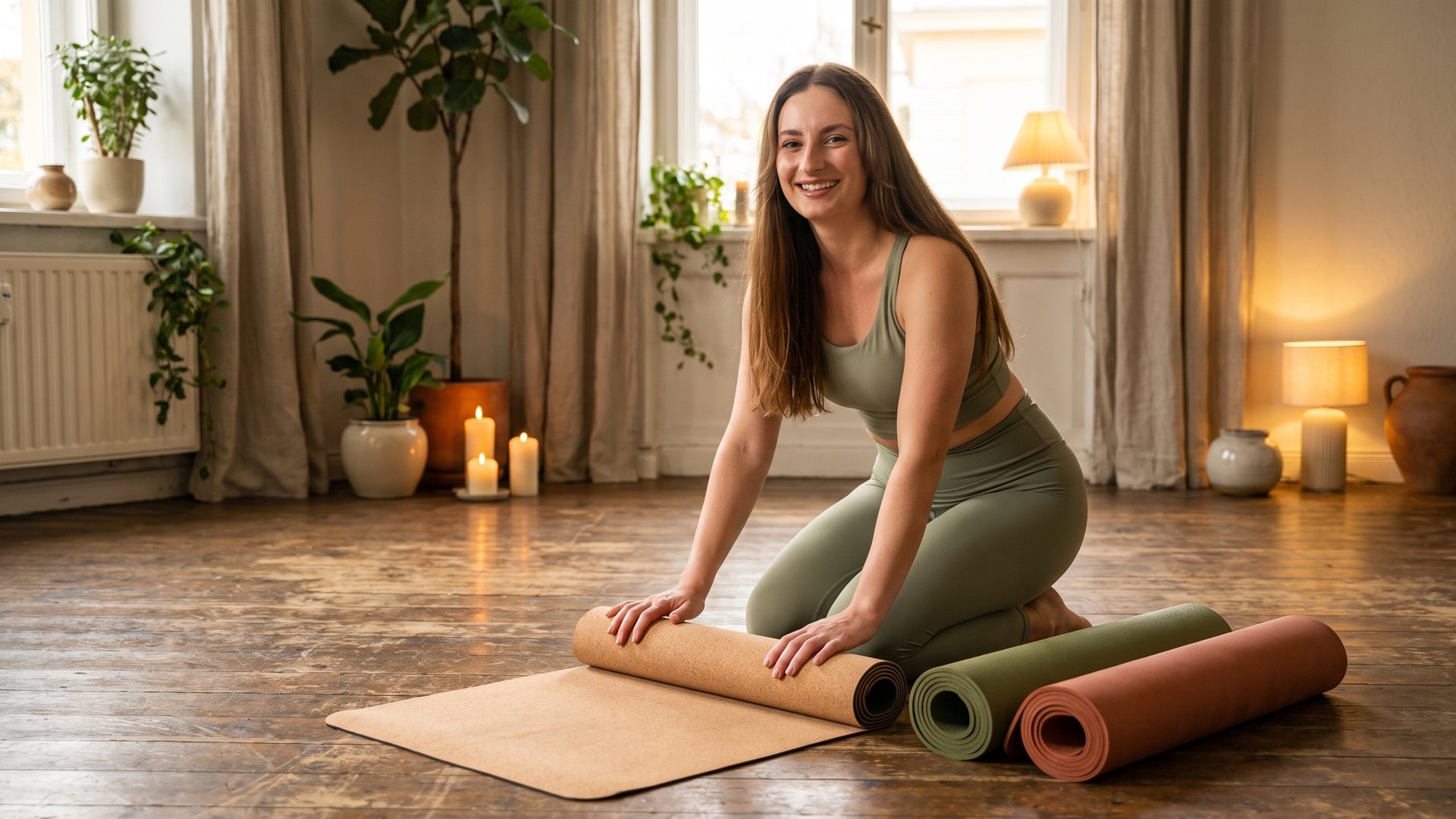
The three most common materials are:
- PVC (polyvinyl chloride) — durable, affordable, good grip, easy to clean. Not biodegradable. Most budget mats are PVC.
- Natural rubber — excellent grip, biodegradable, heavier than PVC. Avoid if you have a latex allergy.
- TPE (thermoplastic elastomer) — a synthetic but more eco-friendly alternative to PVC. Lighter than rubber, increasingly common at mid-range price points.
- Cork — natural surface layer over rubber or TPE. Naturally antimicrobial, good grip when wet. Tends to be higher priced.
2. What to Skip
Alignment lines and printed guides — these visual guides on the mat surface sound useful in principle (parallel lines to check your foot position, central guides for symmetry). In practice, most students stop looking at them after the first two classes. They do not replace a teacher’s eye or your own developing proprioception.
Built-in carrying straps and bags — some mats come with integrated carrying straps or matching bags. These are conveniences, not necessities. A basic strap or a rucksack does the same job for a fraction of the cost.
Antimicrobial coatings — mats marketed with antimicrobial treatments are a reasonable choice if you are sharing mats with multiple people in a rental situation. For a personal mat that you clean regularly, the coating adds cost without meaningful benefit. Simply spray with a mat-cleaning solution (or a diluted tea tree oil mix) after each use and air dry.
Very cheap mats under £10 — these exist, and for occasional occasional use or as a trial, they are not useless. But below a certain price point, the materials become genuinely poor: the surface becomes slippery when weight is applied, the mat degrades quickly, and the smell of cheap PVC can be persistent. A £10 mat is fine for finding out whether you enjoy yoga; it is not adequate as a long-term practice tool.
Why a £20 Mat is Fine for Most People
A decent PVC mat in the £20–£30 range from a reputable brand will serve most beginners well for their first year of yoga. It will grip adequately, cushion reasonably, and survive regular use if cleaned and dried properly. You do not need to spend £100 on a mat before your first class. When (and if) you develop specific preferences — a need for more cushioning, better wet-grip, an eco-material — you will know it from experience, not from a buying guide.
3. Budget Pick
Yoga Design Lab Combo Mat (approx. £30–£40)
At this price point, there are several acceptable PVC or TPE mats from mainstream brands (Liforme Basic, Ativafit, and various Amazon options). The Yoga Design Lab Combo Mat sits at the upper end of the budget range but offers genuinely good grip, pleasant aesthetics, and 3.5mm thickness that works across most styles. It is an honest recommendation rather than a flashy one.
If you are looking for something at the lower end, the Decathlon Domyos Yoga Mat (approximately £15–£25) is a consistently reliable option from a trusted retailer with stores across London.
4. Eco Pick
Liforme Original (approx. £100–£120)
The Liforme is the eco-conscious recommendation that is also, genuinely, one of the best-performing mats available. It is made from natural rubber with an eco-polyurethane top layer, produced in an ethical supply chain, and biodegradable. The grip is excellent — including when damp — and the surface has a pleasant quality that feels considered.
It is significantly more expensive than a budget mat, and the price is only justified if you are committed to regular practice and care about the material provenance of your equipment. For a beginner who is not yet sure whether yoga will stick, it is not the starting point.
For the committed regular practitioner, the Manduka PRO Lite (natural rubber, approximately £60–£90) is a strong alternative at a slightly lower price, with an excellent reputation for longevity.
5. Premium Pick
Jade Harmony Mat (approx. £70–£85)
Jade is a US brand with a strong ethical commitment — they plant a tree for every mat sold, and their mats are made from tapped natural rubber (no synthetic blending). The Harmony is their most popular mat: 4.75mm thickness, outstanding natural rubber grip, and a longevity that many students report lasting five or more years of regular practice.
It is heavier than most mats (approximately 2kg), which matters if you are cycling or walking to a studio regularly. But for quality, ethics, and performance, it is a genuinely excellent premium choice.
6. Caring for Your Mat
A well-cared-for mat lasts years. A neglected one deteriorates quickly.
Clean it regularly — spray with a diluted solution of water and a few drops of tea tree oil (or a commercial mat spray), wipe gently with a cloth, and hang to air dry. Do not leave it wet rolled up in a bag; this creates the conditions for bacteria and deterioration.
Store it rolled, not folded — PVC mats especially can develop permanent creases if stored folded for extended periods. Roll loosely and store in a cool, dry place.
Keep it out of direct sunlight — UV degrades most mat materials over time.
Replace it when it begins to flake or loses grip — a mat that is shedding material or has become slippery is a safety issue. Most mats last one to three years with regular use, longer with gentle care.
Frequently Asked Questions
Q: Do I need to buy a mat before my first class?
A: No. Most studios, including Your Ritual Yoga, have mats available to borrow. Starting with a studio mat for your first few classes lets you develop a sense of what you need before committing to a purchase.
Q: What thickness is best for Yin yoga specifically?
A: A 5–6mm mat or a 4mm mat combined with a folded blanket under the knees provides comfortable support for Yin’s long floor poses. If joint comfort is a concern, erring towards thicker is better.
Q: Should I buy a mat from a yoga-specialist brand or is a sports shop fine?
A: Sports shop mats (Decathlon, John Lewis, Amazon basics) are entirely serviceable for beginners. Specialist yoga brands tend to offer better grip, more considered materials, and longer longevity — worth the premium once you know you are committed to a regular practice.
Q: How do I know when my mat needs replacing?
A: When the surface begins to flake or pill, when it has become noticeably less grippy, or when it has developed permanent indentations from repeated use. Some mats last two years; well-maintained natural rubber mats can last five or more.
Borrowing a mat from the studio is always welcome, especially for your first class. Visit Your Ritual Yoga to find out more, or view the schedule and pricing to book your first session.
About the author
Tanya is a Yoga Alliance RYS 200 certified yoga teacher (ID 252157), trained at Devvrat Yoga School in Varkala, India (December 2025). She teaches Hatha and Yin yoga at Your Ritual Yoga in Golders Green, NW11 — a small, intentional studio where every class includes sound healing with Himalayan singing bowls and a post-class herbal tea ritual. www.ritual-yoga.co.uk