Written by Tanya — Yoga Alliance RYS 200 (ID 252157), trained at Devvrat Yoga School, Varkala, India (December 2025). Tanya teaches Hatha and Yin yoga at Your Ritual Yoga in Golders Green, NW11.
The legs up the wall pose — known in Sanskrit as Viparita Karani, meaning “inverted action” — is one of yoga’s most accessible and underestimated postures. It requires a floor, a wall, and ten minutes. Nothing else.
Yet those ten minutes, done consistently, may offer something that most of the working day does not: a genuine pause. Not a distracted pause with a phone, but a structural one — the body repositioned, gravity reversed through the legs, the nervous system receiving a clear signal that it is safe to rest.
This guide explains what the pose actually does, how to set it up well, and who should approach it with caution.
1. What This Pose Actually Does
Viparita Karani is a mild inversion. The legs are raised above the level of the heart, which changes how the circulatory and lymphatic systems are working.
For the legs and feet: When we stand or sit upright for long periods, fluid pools in the lower extremities. Gravity is not being kind to our ankles or our calves. Raising the legs reverses this, encouraging venous return — the movement of blood back towards the heart — and lymphatic drainage. The physical sensation is almost immediate: a release of pressure through the calves and feet, a lightening.
For the nervous system: Inversions, even gentle ones like this, have a long tradition in yoga as practices for calming the mind. The physiological basis may involve baroreceptors in the neck — sensors that respond to blood pressure changes — signalling the brain to reduce sympathetic tone. The effect is a measurable slowing of the heart rate and a deepening of the breath, typically within 2–3 minutes of holding the pose.
For the lumbar spine: The lower back is freed from its usual gravitational load. Many people with lower back tension find that 5–10 minutes in Viparita Karani eases the compression that accumulates through a working day more effectively than lying flat.
For sleep: Practised in the evening, 10 minutes of legs up the wall — particularly combined with a slow breath practice — may support the transition into sleep by reducing cortisol levels and quietening the arousal systems that keep a busy mind running after dark.
2. Step-by-Step Setup
-
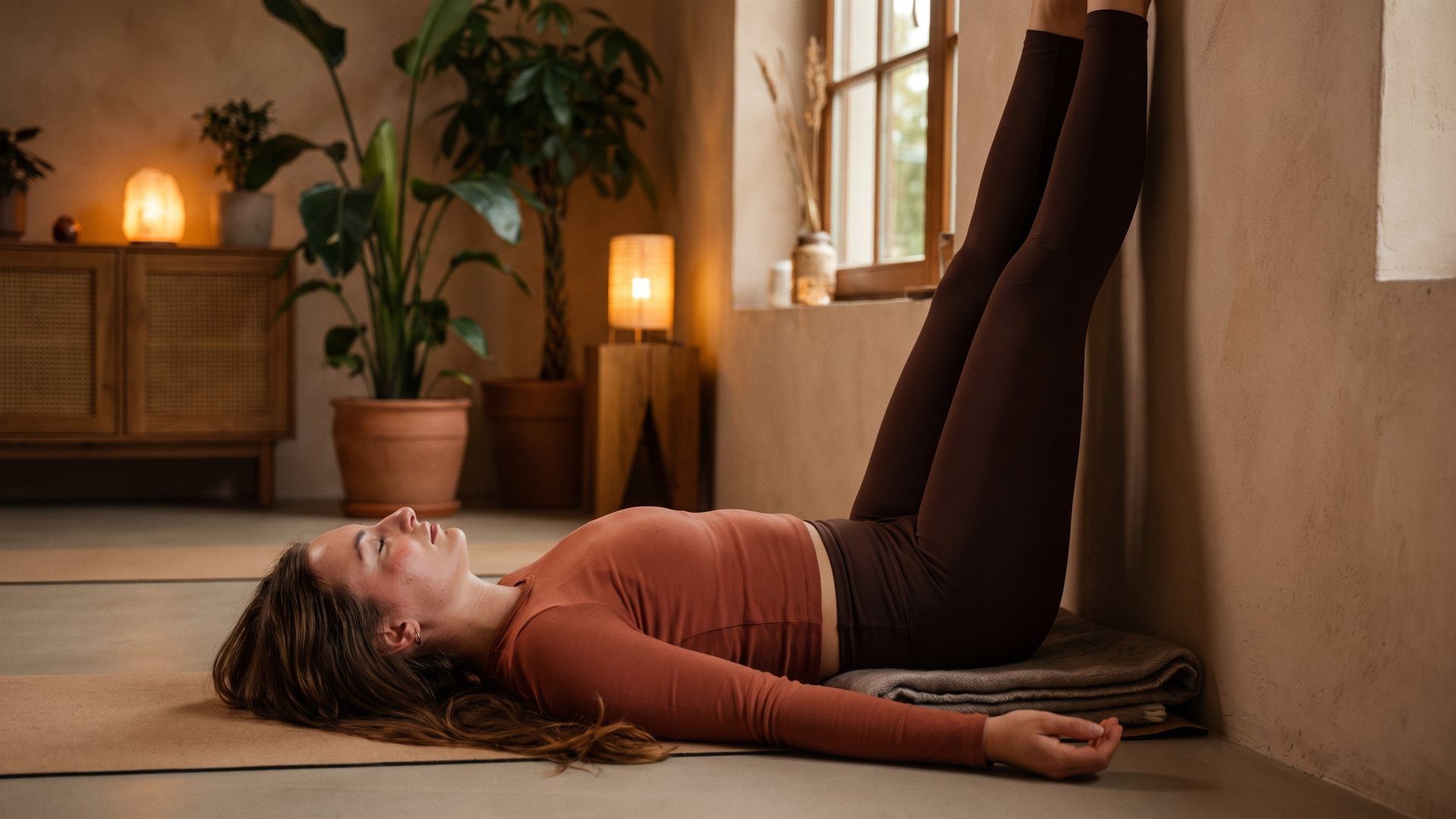
Place your mat perpendicular to a clear section of wall. Bring a folded blanket to the mat if you plan to be there for more than a few minutes.
-
Sit sideways to the wall, with one hip as close to the baseboard as possible.
-
As you lower your back to the floor, swing your legs up so they rest against the wall. Your sitting bones should be close to the wall — some contact is fine; a slight gap of a few centimetres is also fine.
-
Adjust the position of your hips so the lower back feels comfortable. If the legs are straining to stay straight, move slightly further from the wall.
-
Arms rest by the sides with palms face-up, or hands on the belly. Whatever feels easeful.
-
Close the eyes. Let the breath slow.
-
Hold for 5–15 minutes. To come out, bend the knees and roll to one side. Rest there for a breath or two before sitting up.
That is all. There is no advanced version to aspire to.
3. Props That Make It Work
Pillow Under the Hips for Elevation
Placing a folded blanket or thin bolster under the hips — lifting them 5–10 centimetres off the floor — adds a subtle backbend to the posture and changes the angle of inversion slightly. Many people find this version more deeply relaxing than the flat variation. It also opens the chest more, which encourages fuller breathing.
Avoid very thick bolsters under the hips unless you are practising under guidance, as this increases the pressure of the inversion and may not be appropriate for those with eye pressure concerns or late pregnancy.
Eye Pillow + 4-7-8 Breath
Darkness deepens the nervous-system response. An eye pillow — or simply a folded cloth over the eyes — removes visual input and gives the mind less to process. Combined with a slow 4-7-8 breath (inhale 4 counts, hold 7, exhale 8), even 10 minutes can feel like a longer, more complete rest than it is.
This combination — legs up the wall, eye pillow, slow extended exhale — is a reliable end-of-day ritual for many of our students at Your Ritual Yoga. It is as close to a nervous-system off switch as yoga offers.
4. When in the Day to Do It
Morning: Not the most natural time for this pose — the body is rested and movement is usually more appropriate. However, if mornings involve a long commute or early start, a brief 5 minutes can set a useful intention of slowness before the day accelerates.
Midday or afternoon: An excellent antidote to post-lunch energy dip or afternoon screen fatigue. 10 minutes during a lunch break can significantly affect the quality of the second half of the working day.
Evening (recommended): The ideal time for most people. After work, before the evening meal, or after a meal has settled — 10 minutes of Viparita Karani may help the nervous system begin the transition towards sleep earlier in the evening, rather than arriving at 11pm still in a state of low-grade activation.
For those dealing with insomnia or sleep difficulties, practising legs up the wall as part of a consistent bedtime ritual — alongside reduced screen light and a consistent sleep time — may support more reliable sleep onset.
We practise Viparita Karani regularly in our Yin classes, typically towards the end of the session when the body has already moved through several long holds and is ready for complete stillness.
5. Cautions
Late Pregnancy, Eye Pressure — Caution
Late pregnancy (third trimester): Inversions — even mild ones — are generally not recommended in the third trimester without specific guidance from your midwife or obstetrician. The weight of the uterus and changes in circulatory dynamics make this a practice to approach carefully.
Glaucoma or other eye pressure conditions: Any inversion increases intraocular pressure. If you have diagnosed glaucoma or another condition affecting eye pressure, please consult your specialist before practising inversions, including this mild one.
Uncontrolled high blood pressure: While gentle inversions are generally considered safe, if your blood pressure is not well managed, speak with your GP before adding inversions to your practice.
Menstruation: Some yoga traditions suggest avoiding inversions during menstruation. The research basis for this is limited, and many practitioners find no ill effect. Listen to your own body; if inversions feel uncomfortable during your period, rest in a supported child’s pose or savasana instead.
For most people, none of these apply, and legs up the wall is one of the safest and most universally accessible postures in yoga.
We practise Viparita Karani weekly in our Yin classes — followed by Himalayan singing bowl sound healing in Savasana, which deepens the nervous-system rest still further. Join a Yin class at Your Ritual Yoga and experience what complete stillness can feel like.
About the author
Tanya is a Yoga Alliance RYS 200 certified yoga teacher (ID 252157), trained at Devvrat Yoga School in Varkala, India (December 2025). She teaches Hatha and Yin yoga at Your Ritual Yoga in Golders Green, NW11 — a small, intentional studio where every class includes sound healing with Himalayan singing bowls and a post-class herbal tea ritual. www.ritual-yoga.co.uk