Written by Tanya — Yoga Alliance RYS 200 (ID 252157), trained at Devvrat Yoga School, Varkala, India (December 2025). Tanya teaches Hatha and Yin yoga at Your Ritual Yoga in Golders Green, NW11.
A sound bath is one of those experiences that is genuinely difficult to describe in advance. People reach for words like “meditative”, “vibrational”, “deeply relaxing” — and all of these are accurate, but none of them quite prepare you for the quality of attention that the sound produces, or the physical sensation of hearing something that you also feel in your chest, your skull, the soles of your feet.
If you have never experienced one, the best approach is simply to go. But arriving with some understanding of what actually happens, what is expected of you, and why the experience works the way it does, tends to make the first session more open and less self-conscious.
This guide answers the questions most first-time participants have before they walk through the door.
1. What a Sound Bath Actually Is
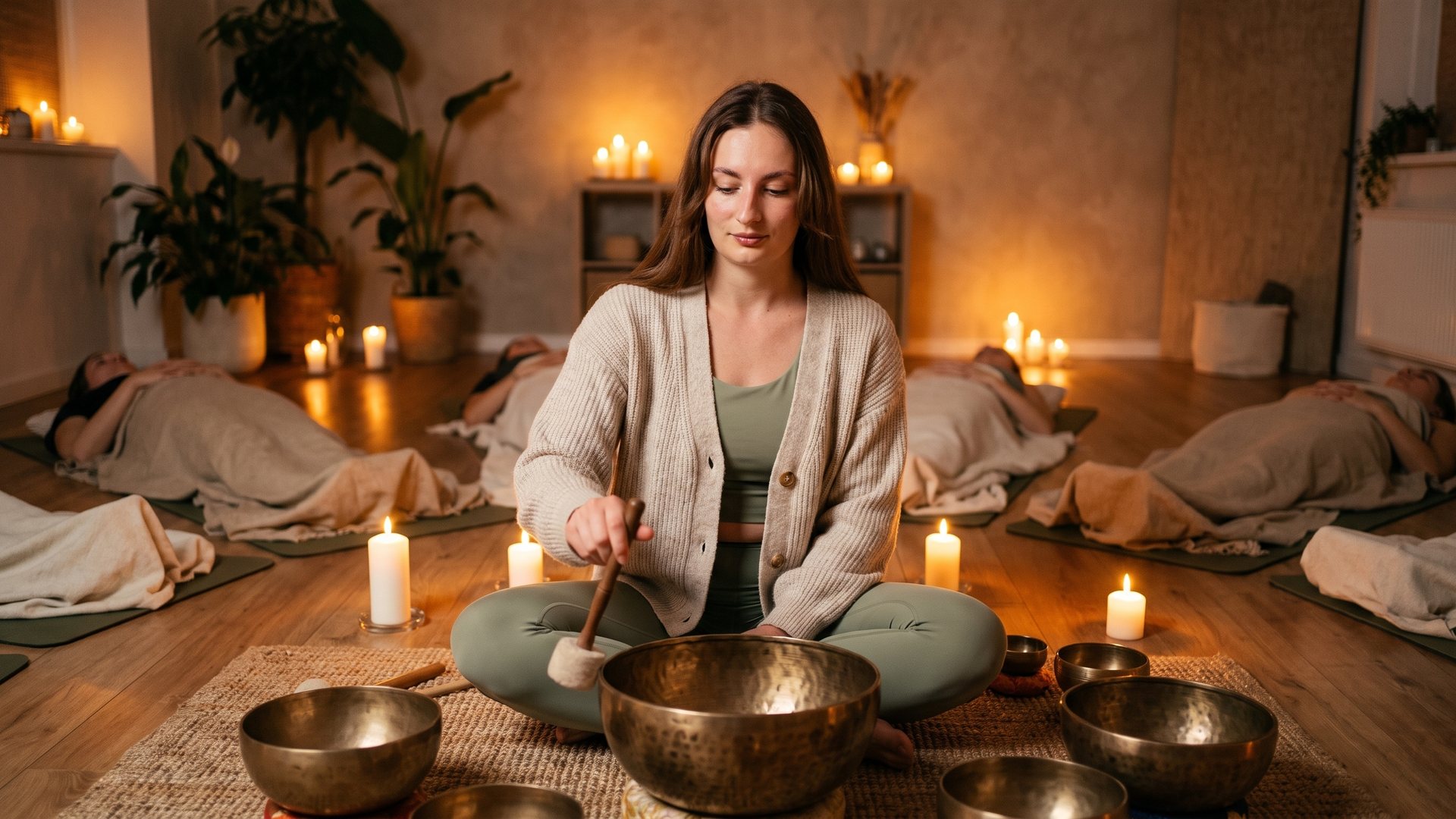
The term “sound bath” refers to the experience of being immersed in sound — not metaphorically, but literally surrounded by it. The sounds produced by instruments like Himalayan (Tibetan) singing bowls, crystal bowls, gongs, and other resonant instruments envelop the body from multiple directions, creating an acoustic environment that is quite different from listening to music.
The distinction is important: you are not listening in the usual sense. You are receiving. The sound is not organised into melody or rhythm in the conventional way; it moves through drones, harmonics, and overtones that sustain and shift gradually. The effect is less like attending a concert and more like resting inside a continuously evolving acoustic texture.
Participants lie on their backs for the duration — usually on yoga mats, often with a blanket and an eye pillow — while the practitioner plays around and sometimes near them. There is no need to do anything. The instruction is simply to receive.
The physiological mechanisms of sound healing are actively studied. Research suggests that the sustained low-frequency vibrations produced by instruments like Himalayan singing bowls may encourage a shift in brainwave activity from the beta state (associated with active thinking and alertness) towards the alpha and theta states (associated with relaxed awareness, creativity, and the edge of sleep). This brainwave entrainment effect may explain why many participants describe feeling deeply rested after a session — even those who are convinced they did not sleep.
2. What You’ll Experience Minute by Minute
Every practitioner and every session differs, but the general arc of a sound bath tends to follow a similar shape.
The settling (0–5 minutes) — you lie down, cover yourself with a blanket, close your eyes. There may be a brief introduction or a few minutes of silent breath to allow the body to arrive. The room is dim and warm. The noise of the world outside begins to recede.
The opening tones (5–10 minutes) — the first sounds begin. Singing bowls are struck or rubbed to sustain their tone. The initial sounds are often simple and spacious — a single bowl, long pauses between each tone. The nervous system begins to orient to the sound rather than the thought stream.
The middle (10–40 minutes) — the sound landscape shifts and deepens. Multiple instruments may be played in combination. The textures become richer. Many participants move into a state of deep relaxation — aware, but not engaged with thought in the usual way. This is the part of the session that most people later find difficult to describe precisely: a kind of suspended wakefulness.
The close (last 5–10 minutes) — the sounds gradually simplify and soften. Longer pauses. Quieter tones. The practitioner gently guides the return to ordinary awareness. Participants are invited to begin to move slowly — fingers, toes, then gradually the whole body — before sitting up.
Silence and transition — most sessions end with a few minutes of silence. Do not rush this. The period of quiet after the sound ends is itself part of the experience.
Lying Down for 45–60 Minutes
For most participants, the physical requirement of lying still is more challenging than the mental one. If you have lower back concerns, hip issues, or discomfort on your back, bring a rolled blanket to place under the knees — this changes the load on the lumbar spine significantly. A folded blanket under the head can also help. Your comfort is necessary; you cannot receive the sound properly if the body is in discomfort.
3. What to Wear and Bring
Wear warm, comfortable clothing. The body temperature drops when lying still, and what feels perfectly warm when you arrive can feel cool within twenty minutes. Thick socks, a long-sleeved top, and comfortable trousers are ideal. Most practitioners provide blankets, but bringing your own adds warmth and familiarity.
Eye pillows (small bags of flaxseed or lavender that rest over the eyes) are often provided and are helpful for closing out light and deepening the sense of inwardness. A yoga mat is usually provided too, though bringing your own is always comfortable.
Leave your phone at the door, or ensure it is on silent and face down. The vibration of a notification — even silent — can interrupt the experience for the whole room. Most sound healing spaces ask participants to avoid mobile phones entirely.
There is nothing else you need to do, prepare, or bring. Arriving open is the only requirement.
4. Yin + Sound Healing vs Standalone Sound Bath
The combination of Yin yoga followed by sound healing during Shavasana — which is what happens in every class at Your Ritual Yoga — tends to produce a different and often deeper experience than a standalone sound bath.
Here is why.
A standalone sound bath asks the nervous system to shift directly from ordinary wakefulness into a state of deep, open receptivity. For many people — particularly those who arrive from a busy workday, a stressful commute, or a mind full of the day’s accumulated concerns — this transition is slow and incomplete. The first twenty minutes of the session are often spent simply arriving, while the mind continues to process and the body holds its tension.
Yin yoga prepares the body and nervous system before the sound healing begins. The long passive holds of a 60–75 minute Yin practice progressively release physical tension, slow the breath, and move the autonomic nervous system towards parasympathetic dominance. By the time Shavasana arrives — and the singing bowls begin — the body is already still and the mind already quieter. The sound healing lands in a body that is prepared to receive it.
This layered approach is why students at Your Ritual Yoga frequently describe the Shavasana sound healing as the deepest part of their practice. It is not an add-on. It is the destination that the Yin practice has been moving towards all along.
5. Frequently Asked Questions
Q: Will I fall asleep?
A: Possibly, and that is completely normal. Many participants enter a state on the boundary between sleep and waking — sometimes called the hypnagogic state — which is itself deeply restorative. Others remain aware throughout. Whether you sleep or not, the body tends to receive the vibrational experience regardless.
Sleeping During a Sound Bath: Normal
Sleep during a sound bath is not a failure. It is often a sign that the body is accessing a level of rest it genuinely needs. The vibrations of the instruments continue to affect the body and nervous system even when the conscious mind is not engaged. Some practitioners consider sleep during a session the most complete possible reception. Do not resist it.
Crying or Emotional Release: Also Normal
Emotion during or after a sound bath is more common than most first-timers expect. The sustained, enveloping nature of the sound can surface grief, relief, joy, or a quality of tenderness that does not usually have space in an ordinary day. This is not a sign that anything has gone wrong. Allow it. It is part of the release the practice offers.
Q: Is sound healing safe for everyone?
A: For most people, yes. Those with epilepsy, certain mental health conditions, or in the first trimester of pregnancy should consult a healthcare professional before attending a sound bath. If you have significant hearing sensitivity (hyperacusis), let the practitioner know in advance. The volumes used in a professional sound healing context are generally gentle; practitioners are mindful of this.
Q: How will I feel afterwards?
A: Most participants describe feeling deeply calm, slightly slow, and genuinely rested. Some feel emotional or tender for a short while after. Drink water, eat something nourishing, and avoid rushing back into intense demands for an hour or two if possible.
Q: Do I need any yoga experience to attend a sound bath?
A: No. A standalone sound bath requires no yoga experience. For a Yin-and-sound-healing class, no prior yoga experience is required either — all levels are welcome.
Every class at Your Ritual Yoga includes sound healing with Himalayan singing bowls during Shavasana. Come and try it alongside Yin yoga — no experience needed.
About the author
Tanya is a Yoga Alliance RYS 200 certified yoga teacher (ID 252157), trained at Devvrat Yoga School in Varkala, India (December 2025). She teaches Hatha and Yin yoga at Your Ritual Yoga in Golders Green, NW11 — a small, intentional studio where every class includes sound healing with Himalayan singing bowls and a post-class herbal tea ritual. www.ritual-yoga.co.uk